Quick answer
Flying termites (alates) that appear around lights after the first rains in Goa are winged reproductives leaving a mature colony to start new ones. An outdoor swarm mainly shows termites are active nearby. A swarm emerging indoors, or discarded wings inside, suggests a colony may be in or under the building. Switch off lights, close windows, sweep them up, note where they came from, and arrange an inspection if they appeared indoors.
Key points
- Flying termites (alates) are winged reproductives released by mature colonies, typically in warm, humid conditions after rain.
- Alates do not bite, sting or eat wood, and most die within hours of swarming.
- Alates emerging indoors suggest a colony may be in or under the building; an outdoor swarm mainly shows termites are active nearby.
- Termites have straight, bead-like antennae, no narrow waist and four wings of similar length; flying ants have elbowed antennae and a pinched waist.
- Note and photograph where alates emerged before cleaning up, as this is the most useful clue for an inspection.
If you live in Goa, you have probably seen it. The first heavy shower of the season arrives, and by evening hundreds of small winged insects are circling the porch light, crawling up the windows and leaving a carpet of papery wings on the floor. These are usually flying termites. This guide explains what a swarm of flying termites after rain in Goa actually means, what it does not mean, and what to do next.
What are flying termites, and why do they appear after the rain?
Flying termites are called alates, or swarmers. They are the winged reproductive members of a termite colony: future kings and queens. Unlike the pale worker termites that feed on wood out of sight, alates have darker bodies, working eyes and two pairs of long wings.
A mature colony releases its alates in a coordinated flight when conditions are right: warm air, high humidity and moist soil. That is why swarms in Goa so often follow pre-monsoon showers and the early days of the south-west monsoon, frequently around dusk. Damp ground makes it easier for a newly paired couple to dig in and start a nest. Goa's humid coastal climate and laterite soils suit termites well, which we explain in why termites thrive in Goa.
Alates are weak fliers and are strongly drawn to light. After a short flight they land, break off their wings, pair up and look for a crevice in soil or damp wood. Most die within hours. Birds, house lizards, frogs and ants eat them, or they simply dry out. Only a very small number manage to found a new colony, which starts tiny and grows slowly.
Are they flying termites or flying ants?
Winged ants also swarm in damp weather, so it is worth checking before you worry. Look closely at one that has landed:
- Waist: termites have a thick, straight body with no narrow waist. Ants have a clearly pinched waist.
- Antennae: termite antennae are straight and bead-like. Ant antennae bend at an elbow.
- Wings: termites have four wings of roughly equal length, longer than the body, that snap off easily. An ant's front wings are noticeably longer than its back pair.
Our quick identification guide to flying ants and flying termites has more detail. If you are unsure, keep a few insects in a sealed jar or zip-lock bag, or take clear close-up photos. Either will help a technician identify them.
Indoors or outdoors: what does the swarm suggest?
Where the alates came from matters far more than how many there were. Many households see insects at a window and assume they emerged inside, when in fact they flew in towards the light. Try to work out whether they were coming in through open doors and windows, or appearing from inside the house: from a crack in the floor, a skirting board, a door frame, a wall joint or a wooden ceiling.
| What you saw | What it suggests | Sensible next step |
|---|---|---|
| Alates circling a street light, garden lamp or outside wall | Termite colonies are active in the surrounding soil, trees or vegetation | Keep lights low, close up at dusk, and watch for other signs over the coming weeks |
| Alates flying in through open windows or doors towards indoor lights | Most likely drawn in from outside. This alone does not prove a colony in the building | Close up, sweep up, and check indoors for other signs |
| Alates emerging from cracks in floors, walls, skirting, frames or furniture | A colony may be inside or beneath the building, or in its timber | Arrange an inspection |
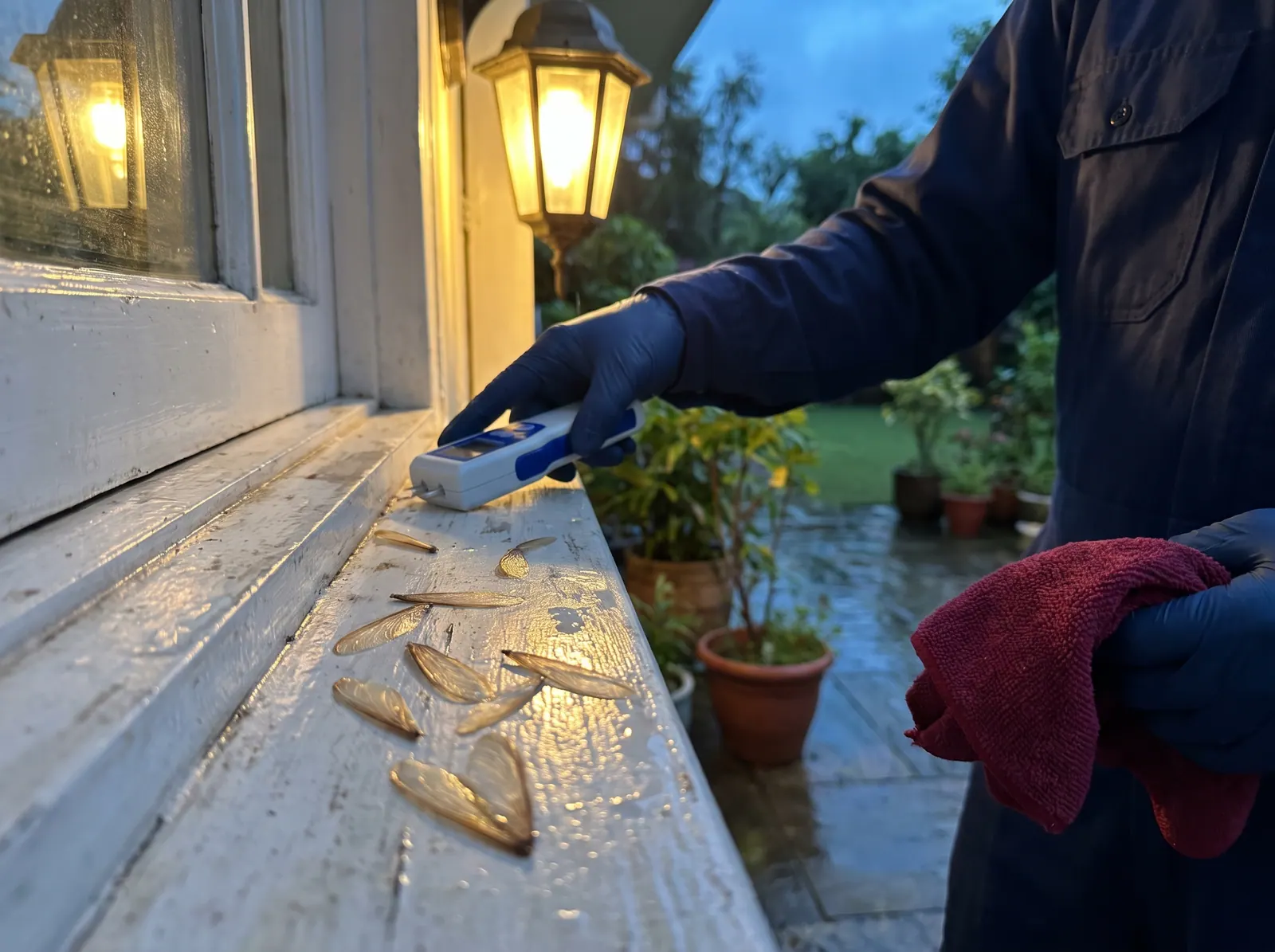
| Shed wings on sills or floors, without having seen a swarm | A swarm happened nearby, possibly indoors while no one was watching | Note the location, and arrange an inspection if it is inside |
| Swarms from the same spot in more than one season | An established colony close to or within the structure | Arrange an inspection |
An outdoor swarm in the compound or from an old tree stump is a reminder that termites are nearby. It is not proof that your house is infested. A swarm that emerges indoors is a much stronger signal and is worth acting on.
What should you do when flying termites swarm?
- Switch off lights you don't need. Turn off porch, balcony and garden lights and draw the curtains so indoor lights are less visible. Alates go where the light is.
- Close doors and windows at dusk on rainy evenings during the swarm season. Use window mesh where you have it.
- Note and photograph where they came from before you clean up. The emergence point is the most useful clue for an inspection.
- Sweep or vacuum them up. Put alates and shed wings in a sealed bag and dispose of it. Empty the vacuum outdoors.
- Keep a sample. A few insects in a sealed container, or a clear photo, helps with identification.
- Seal small gaps temporarily. If alates are coming out of a hairline crack, you can tape over it for the night once you have photographed it. This is a stopgap, not a fix, because the colony itself is elsewhere.
- Check nearby wood. Tap door frames, skirting and wooden furniture near the spot. Note any hollow-sounding or soft wood, and any thin mud lines on walls.
What not to do
- Don't spray household insecticide around the house in a panic. Swarmers die quickly on their own, and spraying them does nothing to the colony. If you do use any product, follow the label directions, ventilate the room, keep children and pets away until it has dried, and wash your hands afterwards.
- Don't pour chemicals into cracks or drill holes yourself. Untargeted DIY treatment rarely reaches the colony, and it can make it harder for a technician to see where the activity really is.
- Don't assume one swarm means serious damage, and don't ignore it either. Treat it as a prompt to check.
Can flying termites harm you or your home?
Alates don't bite or sting, they are not known to spread disease, and they don't chew wood themselves. They are mainly a nuisance: messy, unsettling and short-lived. If anyone in the household has breathing trouble, a skin reaction or other symptoms you think may be linked to insects in the house, please see a doctor.
The real concern is what a swarm points to. Alates only come from a mature colony, and it is that colony's workers that feed on timber, door frames, cupboards, books and stored papers. In older Goan houses with timber rafters, wooden ceilings and staircases, an indoor swarm deserves attention. Our guide to protecting Portuguese-era homes from termites and wood borer covers these houses in particular. For the other signs to watch for through the year, see termite warning signs in Goan homes.
When is a termite inspection worthwhile?
An inspection is worth arranging if any of these apply:
- Alates emerged from inside the house, whether from the floor, walls, frames, built-in cupboards or furniture.
- You find shed wings indoors, especially on sills, under doors or near wooden fittings.
- Swarms appear from the same place in more than one season.
- You also see mud tubes on walls, plinths or foundations, hollow-sounding or blistered wood, or damaged papers and stored items.
- The building has a lot of structural or decorative timber, or woodwork touching soil or damp walls.
- The property stays closed for long stretches of the rains. Our guide to looking after an empty Goa villa during the monsoon has more on this.
- You are planning to buy, rent or renovate a property.
If the only swarm you saw was around a street light or garden lamp, and there are no other signs, it is reasonable to watch and wait. Keep an eye on the house over the following weeks, and arrange an inspection if anything on the list above turns up.
If you do have concerns, there is no need to wait for the monsoon to end. An inspection can take place at any time, and fresh emergence points and wings are useful clues while they are still visible.
What happens when our Goa branch inspects?
Our Goa team follows an Integrated Pest Management approach. That means inspecting first, giving sanitation and proofing advice, and recommending targeted treatment rather than blanket spraying. During an inspection, a technician will typically:
- look at the emergence points, wings and any samples or photos you have kept;
- check floors, wall joints, skirting, frames, wooden fittings, the plinth and the compound for mud tubes and damage;
- look for moisture sources that encourage termites, such as leaking pipes, damp walls and wood touching soil;
- explain what was found and what treatment, if any, is appropriate.
For an occupied building, the usual approach is a post-construction treatment. Holes are drilled at set points, treatment is applied into the soil beneath and around the building, and the holes are then sealed. This is explained on our post-construction termite treatment page. Infested woodwork may also need wood treatment.
Our Goa branch is a licensed pest control operator under the Directorate of Agriculture, Goa, and uses CIB&RC-registered products. Material Safety Data Sheets are kept for the products we use, and a service report is shared after each visit.
Seen flying termites at home? Talk to our Goa branch
If flying termites appeared inside your home, flat or business premises after the rains, get in touch with our Goa branch in Chimbel. Tell us your locality, where the alates came from and anything else you have noticed, and send a photo if you have one. We'll explain what it is likely to mean and whether an inspection makes sense for your property.
Frequently asked questions
QDoes a swarm of flying termites mean my house has termites?
Not necessarily. Alates are drawn to light, so many of the ones you see at windows or around a porch lamp have flown in from colonies in the surrounding soil or trees. The stronger warning sign is alates emerging from inside the building, such as from a floor crack, skirting, door frame or furniture, or shed wings found indoors. If that is what you saw, an inspection is worthwhile.
QWhy do flying termites come out after the first rain?
Mature colonies release their winged reproductives when the air is warm and humid and the soil is moist. Those conditions make it easier for a new pair to dig in and start a nest. In Goa, they often line up with pre-monsoon showers and the early weeks of the south-west monsoon. Swarms are frequently seen around dusk, when the insects head for the nearest lights.
QShould I spray insecticide when flying termites swarm?
It is usually unnecessary. Swarmers lose their wings and die within hours, and spraying them has no effect on the colony that produced them. Switching off lights, closing windows and sweeping them up is enough for the night. If you choose to use a household product, follow the label directions, ventilate the room, keep children and pets away until it dries, and wash your hands.
QAre flying termites dangerous to children or pets?
Flying termites do not bite or sting and are not known to spread disease, so they are mainly a nuisance. Pets sometimes eat them, which is generally not a concern in itself. If anyone in the family develops breathing difficulty, a rash or other symptoms you suspect are linked to insects in the house, please consult a doctor rather than treating it at home.
QI found a pile of wings on my windowsill but never saw a swarm. What does that mean?
Shed wings mean alates landed there, paired up and moved off, often at night when no one noticed. Wings on an outside ledge usually point to colonies nearby. Wings on an indoor sill, under a door or beside wooden fittings are more significant, because the insects may have emerged inside. Photograph the wings and the spot before cleaning, and consider arranging an inspection.
QI live in an upper-floor flat. Can termites still be in the building?
Yes, it is possible. Subterranean termites nest in the soil but can travel upwards through cracks, wall cavities, service ducts and along wooden fittings, often sheltered inside mud tubes. Alates flying in from outside are also common on higher floors because of lit windows. If you see them emerging from inside the flat, mention it to your society as well, since any treatment usually needs to cover the building, not one flat.
QCan a termite inspection be done during the monsoon?
Yes. There is no need to wait until the rains are over, and fresh emergence points and wings are useful clues while they are still visible. After inspecting, the technician will explain what was found, what treatment, if any, suits your building, and how weather or site conditions may affect the timing of that work.
Last updated 13 October 2026. Information on this page is general guidance; your technician will advise on your specific property after inspection.