


Quick answer
Flying termites have a thick, straight waist, straight bead-like antennae and two pairs of equal-length wings that extend well past the body and break off easily. Flying ants have a pinched waist, elbowed antennae and front wings larger than the hind wings. Termite swarmers or shed wings indoors suggest a colony may be in or near the building, so arrange a professional inspection.
Key points
- Flying termites have a broad waist, straight bead-like antennae and equal-length wings much longer than the body.
- Flying ants have a pinched waist, elbowed antennae and front wings larger than the hind wings.
- Termite swarmers do not bite or eat wood; the damage is done by hidden worker termites.
- Swarmers or shed wings found indoors are a reason to arrange a termite inspection.
- Spraying a swarm does not reach the colony; collect samples and note where the insects emerged.
You find winged insects crawling around a window, a tube light or a door frame, often after an evening of rain. The first question is usually whether they are flying ants or flying termites. They look alike at a glance, and both swarm in large numbers. The difference matters, though. A few flying ants are mostly a nuisance, while termite swarmers indoors can be an early sign of a colony feeding on timber in or around your home.
This guide explains how to tell flying ants and termites apart using three simple features: the waist, the antennae and the wings. It also covers what a swarm means, what to do straight away, and when an inspection is worth arranging.
How can you tell a flying ant from a flying termite?
Catch one or two insects, or take a sharp close-up photo, and look at them in good light. A phone camera's zoom or a magnifying glass helps. Check the three features below first. Colour and size vary between species, so they are not reliable on their own.
1. The waist
Ants have a narrow, pinched waist between the chest and the abdomen. The body looks clearly divided into sections, a little like an hourglass. Termites have a broad waist with no pinch, so the body looks thick and straight-sided from front to back.
2. The antennae
Ant antennae are elbowed. They bend sharply partway along, like a bent arm. Termite antennae are straight or gently curved and look like a string of tiny beads.
3. The wings
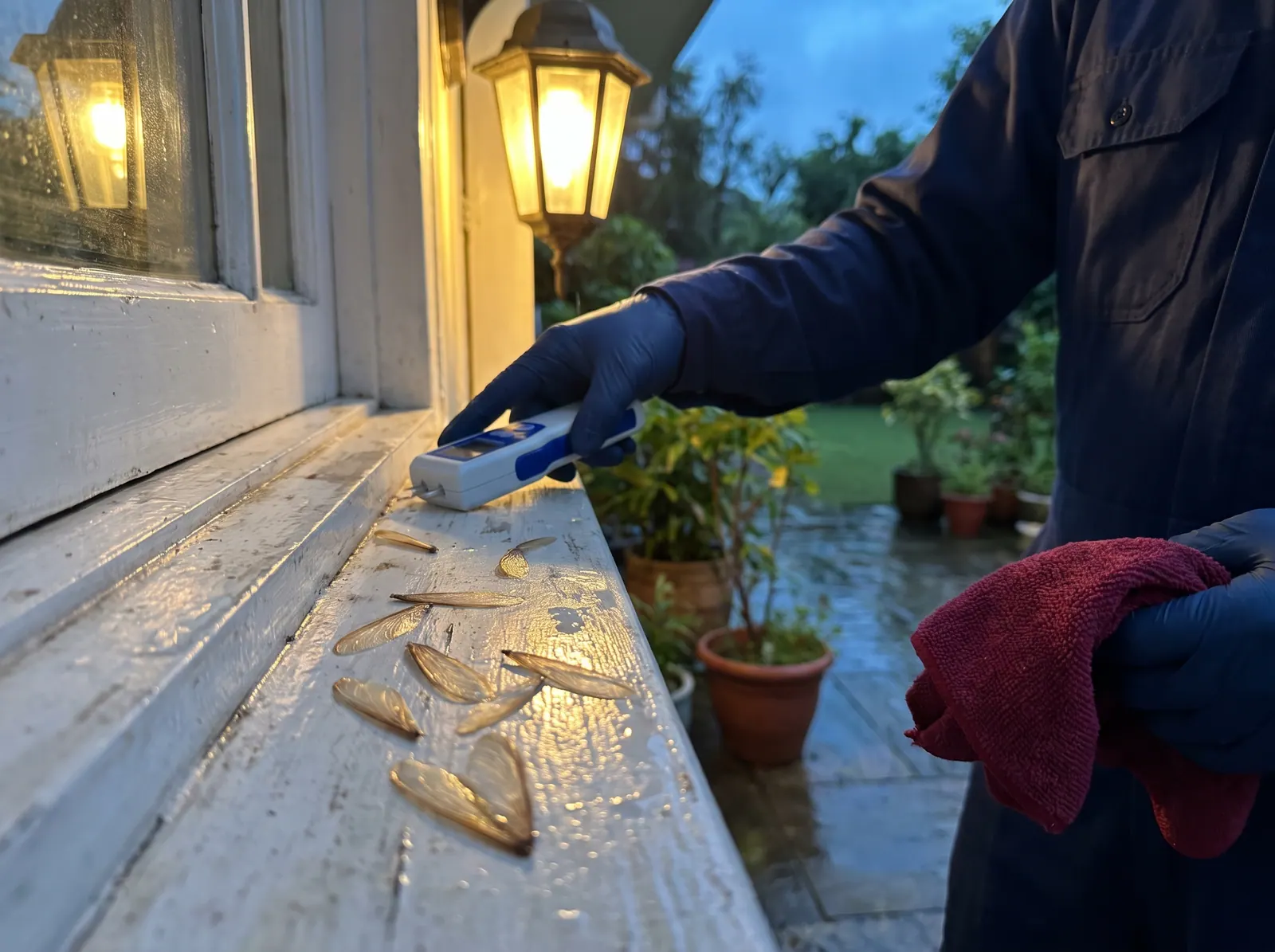
Termite swarmers have two pairs of wings that are equal in size and shape. The wings are much longer than the body, often around twice its length. They are usually pale or translucent and snap off very easily, which is why you often find loose wings lying around.
Flying ants also have two pairs of wings, but the front pair is noticeably larger than the back pair. Their wings are closer to the length of the body and are less often found shed in heaps.
Identification table: flying ant vs flying termite
| Feature | Flying termite (swarmer) | Flying ant |
|---|---|---|
| Waist | Broad, no pinch; body looks straight-sided | Narrow, pinched; body clearly divided into sections |
| Antennae | Straight or slightly curved, bead-like | Elbowed, with a sharp bend |
| Wing pairs | Front and back wings equal in size | Front wings larger than back wings |
| Wing length | Much longer than the body | Roughly as long as the body |
| Shed wings | Break off easily; piles of wings are common | Shed less readily; piles are less common |
| When often seen | Around the onset of the monsoon and after rain, often in the evening near lights | Also after rain, during mating flights |
| What it may mean indoors | A termite colony may be in or near the building; worth an inspection | There may be an ant nest inside; usually a nuisance rather than structural risk |
If you are still unsure, keep a few samples. A trained technician can usually confirm the identification quickly from the insects or a clear photo.
What does a swarm mean for your home?
Swarming is how both insects start new colonies. A mature colony releases winged males and females, called alates or swarmers. They fly out, pair up, drop their wings and try to start a new nest.
In India, swarms are often seen around the start of the monsoon and after rain, frequently in the evening when the insects are drawn to lights. That pattern applies both in Goa's humid coastal climate with its very heavy south-west monsoon, and on the Deccan plateau around Hyderabad, where the rains follow a hot, dry summer. Our guide to seasonal pests and how to prepare for them covers other insects that turn up at this time of year.
If they are termites
- Swarming inside the house: This is the more serious signal. It suggests a colony may be nearby and possibly connected to the building through the foundation, walls, door frames or wooden fittings. Treat it as a reason to inspect, not a reason to panic.
- Swarming outside, drawn to your lights: This shows there are colonies in the area, which is common near gardens and open land. It does not by itself mean your home is infested, but it is a good prompt to check for other signs.
- Piles of wings on sills or floors: Shed wings indoors, especially in the same spot more than once, are worth reporting during an inspection.
The swarmers themselves do not chew wood, bite or sting, and most die within a short time. The damage is done by the colony's worker termites, usually out of sight inside walls, floors and timber.
If they are ants
Flying ants outdoors after rain are part of a normal mating flight and usually need no action. If they keep emerging from inside, for example from a wall crack, skirting or tile joint, there may be a nest within the building.
Some ant species nest in damp or decaying wood. Recurring flying ants near a leaking window frame or a bathroom door are therefore worth a closer look. For persistent indoor trails or nests, see our ant control page.
What should you do immediately after finding a swarm?
- Switch off lights near the swarm and close windows and doors so more do not come in. Drawing curtains also helps.
- Collect a few samples. Put some insects and loose wings in a sealed bag or small jar, or take clear close-up photos. This makes identification much easier later.
- Note where they came from. Look for the spot they are emerging from, such as a floor crack, skirting, window or door frame, electrical box or wooden cupboard. Photograph it.
- Clean up the rest with a vacuum cleaner or broom. Swarmers are harmless to people, so there is no need for chemicals.
- Avoid spraying household insecticide into walls or frames. Spraying kills the swarmers you can see but does not reach the colony, and it can disturb the evidence an inspector needs. If you do use any product, follow the label, ventilate the room, keep children and pets away until it is dry, and wash your hands afterwards.
- Leave mud tubes and damaged wood as they are. Intact tubes show the active route termites are using, which helps target treatment.
For more general advice on what helps and what can backfire, read our dos and don'ts of pest control.
What other signs point to termites?
A swarm is only one clue. Walk around the property and look for these signs, paying attention to damp areas, wooden fittings and the junctions between walls and floors.
- Thin mud tubes, roughly the width of a pencil, running up walls, foundations, pillars or the back of cupboards
- Door frames, skirting or furniture that sound hollow when tapped, or wood that feels soft or crumbles
- Bubbling or uneven paint, especially near woodwork or damp walls
- Soil or mud packed into cracks, joints or the inside corners of wooden units
- Shed wings collecting on window sills, near lights or in spider webs
Fine powder and small round holes in wood usually point to wood-boring beetles rather than termites, which tend to leave mud instead. If that sounds more like your problem, see our page on wood borer treatment.
When should you arrange a termite inspection?
An inspection is sensible in any of these situations:
- Swarmers or shed wings are found indoors, especially more than once
- You notice mud tubes, hollow-sounding timber or other signs listed above
- The property has had termites before, or has a lot of woodwork, and the monsoon is approaching
- You are buying, renting or renovating an older property
- You are planning new construction, where pre-construction soil treatment is far simpler than treating an occupied building later
- You live in a housing society or shared building, where activity in one flat can involve neighbouring units and common areas
How does a professional termite inspection and treatment work?
We follow an Integrated Pest Management (IPM) approach. That means inspection first, then advice on moisture, sanitation and proofing, and targeted treatment only where it is needed. A termite inspection looks at where activity is, how termites are getting in, and what conditions are supporting them, such as leaks, damp walls or wood in contact with soil.
The treatment depends on the building. New construction can receive pre-construction soil treatment, in line with the approach set out in IS 6313 Part 2. Occupied buildings are treated after construction, following IS 6313 Part 3, typically with a drill-fill-seal method: small holes are drilled along wall and floor junctions, filled with termiticide and then sealed. Affected woodwork may also be treated. You can read more on our termite control page.
Our Goa branch is a licensed pest control operator (Directorate of Agriculture, Goa) using CIB&RC-registered products, and we maintain Material Safety Data Sheets for the products we use.
Not sure what you have found?
In Goa: contact our Goa branch in Chimbel. Share your photos and where you found the insects, and we can help you identify them and discuss whether an inspection is needed.
In the Hyderabad region: our Shamshabad branch has recently opened. Tell us your location and the problem, and we'll confirm whether we can help.
Frequently asked questions
QDo flying termites bite or eat wood themselves?
No. Winged termites do not bite or sting, and they are not the ones causing damage. Their job is to leave the colony, pair up and try to start a new nest. The wood is eaten by worker termites that stay hidden inside soil, walls and timber. That is why a swarm matters: it tells you a colony exists somewhere nearby, even if you cannot see it.
QDoes finding flying termites mean my house is infested?
Not necessarily. Termites swarming outdoors and gathering at your lights show there are colonies in the surrounding area, which is common. Swarmers emerging from inside the house, or shed wings repeatedly found in one room, are a stronger sign that a colony may be connected to the building. In that case, an inspection is the sensible next step to find out for certain.
QWhy do flying termites and flying ants appear after rain?
Both insects time their mating flights to suit conditions. Moist soil after rain makes it easier for new pairs to dig in and start a nest, and humid air helps them survive the flight. This is why swarms are so often seen around the start of the monsoon, usually in the evening when the insects are attracted to lights.
QCan I just spray the swarm with insecticide?
Spraying will kill the swarmers you can see, but it does not reach the colony, which is the real source of any damage. It can also disturb the evidence an inspector would use to trace the problem. Vacuuming or sweeping is usually enough for the swarm. If you use any product, follow the label, ventilate and keep children and pets away until it dries.
QHow is termite damage different from wood borer damage?
Termites usually bring mud with them. You may see mud tubes on walls, soil packed into joints, or wood that is hollowed out along the grain. Wood borers, by contrast, leave small round exit holes on the surface and fine, powdery dust below the affected wood. The treatments differ, so identifying the cause correctly matters before anything is done.
QAre flying ants ever a sign of a bigger problem?
Usually not. Most flying ants are simply on a mating flight. If they keep emerging from the same spot indoors, there may be a nest inside a wall, floor or fitting. Some ants prefer damp or decaying wood, so repeated sightings near a leaking frame can also point to a moisture problem that is worth fixing in its own right.
QShould a new building be treated for termites before construction?
Pre-construction soil treatment is generally much simpler than treating a finished, occupied building, because the soil beneath and around the foundation can be treated before floors and walls are laid. The Indian Standard IS 6313 Part 2 covers this stage. It is worth discussing with your builder early, since the treatment has to be timed with construction work.
Last updated 13 October 2026. Information on this page is general guidance; your technician will advise on your specific property after inspection.


