Key points
- House lizards come indoors mainly for insects, warmth and shelter.
- Reducing cockroaches, ants, flies and other insects is central to lizard control.
- Sealing gaps, screening windows and decluttering remove entry points and hiding places.
- Results are a gradual reduction in sightings, not a permanently lizard-free building.
- Keep children and pets away from treated areas until dry or as advised, and ventilate.
House lizards, mostly small house geckos, are a familiar sight on walls and ceilings in Indian homes and businesses. They are not venomous and they eat insects, but few people want them in a kitchen, bedroom, hotel room or food store. Good lizard control starts with one question: why are they here in the first place?
This page explains why lizards come indoors, the methods our technicians use, how to prepare, and what results you can realistically expect.
Why do lizards come into homes and buildings?
Lizards come indoors for three things: food, warmth and shelter. Remove those and a building becomes far less attractive to them.
- Insects around lights. Tube lights, bulbs near doors and lit windows draw moths, flies and other flying insects after dark. Lizards gather where the hunting is easy.
- Gaps and openings. Spaces under doors, unscreened windows, holes around AC pipes, exhaust fans, cable entries and drain outlets all let lizards in.
- Hiding places. Picture frames, wall-mounted cabinets, curtain pelmets, false ceilings, stacked cartons and cluttered storerooms give them shelter during the day and places to lay eggs.
- Moisture and food waste. Kitchens, bathrooms and wash areas attract cockroaches, ants and flies, which in turn attract lizards.
Climate plays a part too. Goa's humid coastal climate and heavy south-west monsoon bring surges of insect activity, while the hot summers and monsoon of the Deccan plateau around Hyderabad do the same. Our guide to seasonal pests and how to prepare explains how pest pressure shifts through the year.
Are house lizards harmful?
House lizards are not venomous and rarely bite. The real concern is hygiene. Their droppings mark walls, curtains and shelves, and like other reptiles they can carry bacteria such as Salmonella. A lizard falling into food, water or utensils is understandably upsetting.
If anyone feels unwell after eating food that may have been contaminated, please see a doctor. For food businesses, keeping food areas free of pests is part of the hygiene requirements under FSSAI Schedule 4, so lizards in a kitchen or store are an audit issue as well as an unpleasant sight.
How does our lizard control work?
We follow an Integrated Pest Management (IPM) approach: inspection first, then sanitation and proofing advice, then targeted treatment where it is needed. You can read more about this on our how we work page.
1. Inspection
The technician looks at where lizards are being seen, checks for droppings and eggs, and notes light sources, entry points and insect activity. This tells us whether the problem is mainly about food supply, easy access, shelter, or all three.
2. Reducing the insects lizards feed on
This is often the most important step. If a home or kitchen has cockroaches, ants, spiders or flies, lizards will keep coming. We treat these underlying pests through services such as cockroach control and general pest control for crawling insects.
3. Entry points and hiding places
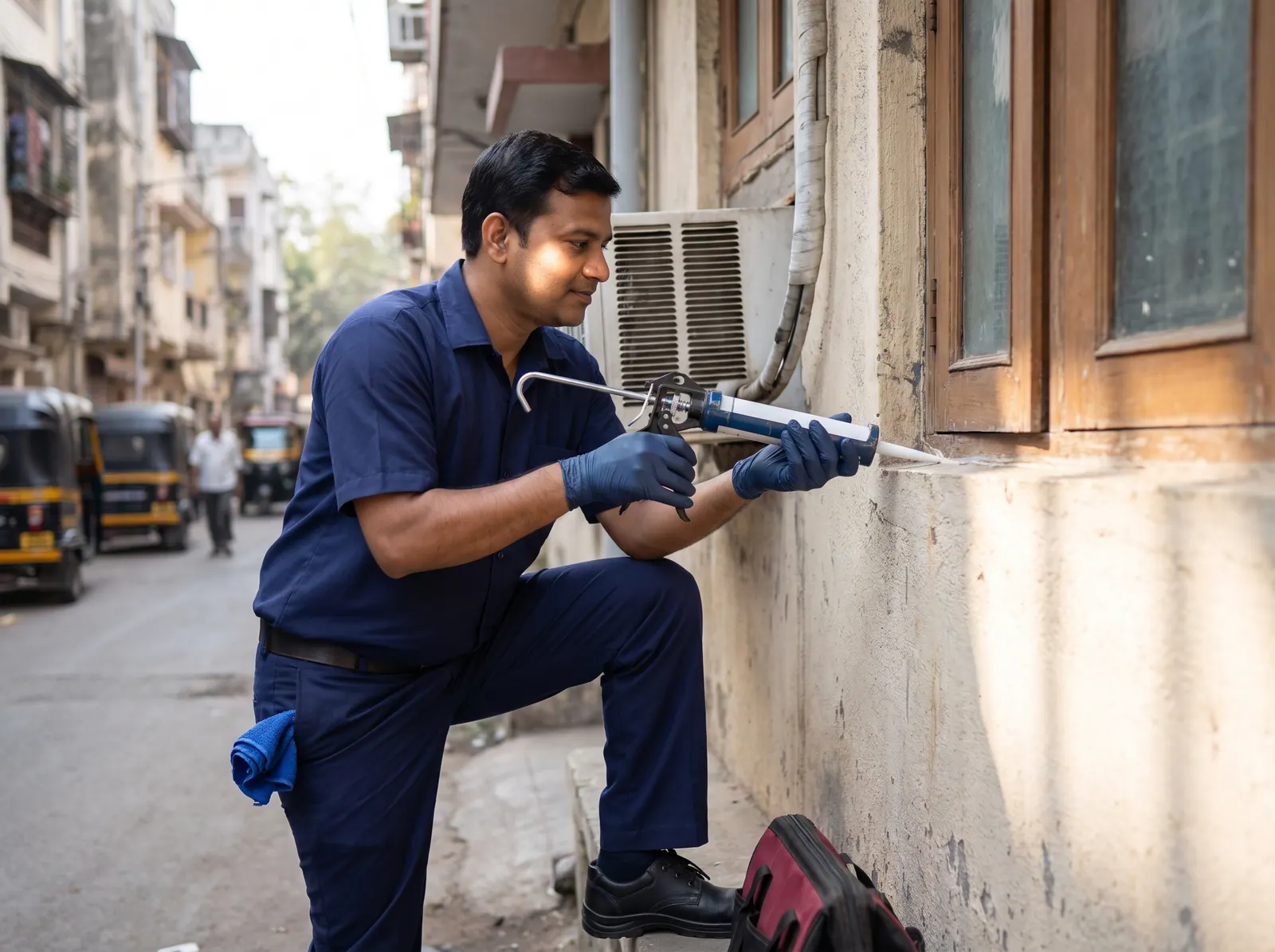
We point out the gaps lizards are using and advise on practical fixes: door sweeps, window and ventilator mesh, and sealing around pipes and cable entries. Eggs found during the inspection can be removed, and we suggest where decluttering or rearranging storage will remove shelter.
4. Targeted treatment of resting areas
Where appropriate, the technician applies a targeted treatment to crevices, the backs of frames and fixtures, and other resting spots. Products are chosen for the site and applied according to label directions, and Material Safety Data Sheets are maintained for the products we use.
5. Lighting and housekeeping advice
Small changes to lighting and daily routines make a lasting difference. The table below summarises what draws lizards in and what helps.
| What attracts lizards | Why it matters | What helps |
|---|---|---|
| Bright lights near doors and open windows | Draws flying insects that lizards hunt | Move outdoor lights away from doorways, use lights that attract fewer insects, close windows at dusk |
| Gaps around doors, windows and pipes | Gives easy entry from outside walls and gardens | Door sweeps, mesh on windows and ventilators, sealing around pipes and cables |
| Frames, cabinets and stacked cartons | Daytime shelter and egg-laying sites | Declutter, check behind frames periodically, store cartons off the floor and away from walls |
| Crumbs, open food, leaks and standing water | Feeds the insects lizards eat | Clean surfaces daily, cover food, fix leaking taps and pipes |
| Existing cockroach, ant or fly problems | A steady food supply keeps lizards coming back | Treat the underlying insect problem |
How should I prepare for a lizard control visit?
A little preparation helps the technician reach the right areas and keeps your household safe.
- Clear access to walls behind large furniture and frames where you can.
- Put away or cover food, utensils and anything on kitchen counters.
- Move pets to another room, and cover or move aquariums and bird cages.
- Tell us in advance about infants, pregnancy, asthma or allergies in the household.
- Arrange for an adult or a representative of the business to be present during the visit.
After the treatment
- Keep children and pets away from treated areas until they are dry, or for as long as the technician advises.
- Open windows and ventilate the rooms.
- Wash hands after touching surfaces in treated areas.
- Avoid wiping or washing treated cracks and corners until the technician says it is fine.
What results should I expect?
Lizard control reduces numbers; it does not make a building permanently lizard-free. Lizards live on outside walls, in gardens and on neighbouring buildings, so an occasional one will still wander in, especially in warm and humid months.
What you should notice is a gradual fall in sightings as insect numbers drop, gaps are closed and hiding places are removed. Eggs laid before the visit may still hatch, so a few small lizards soon after treatment is not unusual. The proofing and housekeeping steps above are what keep numbers low over time.
For homes or businesses where lizards, cockroaches and other pests keep returning, scheduled visits through an annual maintenance contract can keep the underlying insect problem under control.
Lizard control for hotels, restaurants and other businesses
In commercial premises, lizards tend to concentrate in kitchens, food stores, guest rooms, staff accommodation and well-lit entrances. Because lizards in food areas are a hygiene and audit concern, the work is best done on a regular schedule and recorded, alongside cockroach, fly and rodent management.
At our Goa branch, service reports are shared after visits, clients receive updates on WhatsApp, and documentation for food businesses is aligned with HACCP and FSSAI audit expectations. Our Goa branch is a licensed pest control operator (Directorate of Agriculture, Goa) using CIB&RC-registered products. See our commercial pest control page for how scheduled, documented programmes work.
Do home remedies keep lizards away?
Eggshells, onion slices, pepper sprays and peacock feathers are popular suggestions, but there is little reliable evidence that they work. They do nothing about the insects, gaps and clutter that bring lizards in.
Please avoid placing mothballs or mixing household chemicals in living areas, kitchens or anywhere children and pets can reach them. If you need to move a lizard, guide it outdoors gently rather than handling it, and wash your hands afterwards.
Check availability for your branch
Lizard control is part of our company-wide service catalogue. Please check availability for your branch on this page. Our Goa branch in Chimbel can advise on your property, and our Shamshabad branch has recently opened — tell us your location and the problem, and we'll confirm whether we can help. You can reach either branch through our contact page.
Frequently asked questions
QWill lizard control get rid of every lizard in my house?
No honest pest manager can promise that. House lizards live on outside walls, gardens and nearby buildings, so one may still come in occasionally. The aim is to make your home unattractive to them by cutting their insect food supply, closing entry points and removing hiding places. When those steps are kept up, sightings usually fall noticeably and stay lower.
QIs lizard treatment safe if I have young children or pets?
Treatments are targeted at crevices and resting areas rather than sprayed across open rooms, and products are applied according to label directions. Keep children and pets away from treated areas until they are dry or for as long as the technician advises, ventilate the rooms, and wash hands after touching treated surfaces. Tell us beforehand about infants, pregnancy, asthma or allergies so the technician can plan accordingly.
QHow soon will I notice fewer lizards?
Improvement is usually gradual rather than immediate. Lizards leave or stop visiting as the insects they feed on decline and as gaps are sealed, which takes some time. Eggs laid before treatment may also hatch, so seeing a few young lizards soon after the visit is normal. Your technician will explain what to expect for your specific property.
QMy home is clean, so why do I still see lizards?
Cleanliness helps, but lizards are drawn mainly by insects, and insects are drawn by lights, moisture and open windows as much as by food scraps. A spotless flat with a bright light near an open balcony door can still attract lizards. Unscreened windows, gaps around AC pipes and clutter behind frames also play a part, which is why the inspection looks beyond housekeeping.
QDo house lizards lay eggs indoors?
Yes. House geckos lay small, hard-shelled eggs in sheltered spots such as behind picture frames and cabinets, inside cracks, in stored cartons and in rarely disturbed corners. Checking and clearing these areas from time to time is a simple way to stop numbers building up. Our technicians look for eggs during the inspection and can point out likely laying sites.
QWhat should a restaurant do if a lizard is seen in the kitchen?
Treat it as a hygiene issue. Discard any food or drink it may have touched, clean and sanitise the affected surfaces and utensils, and record the incident. Then look for the cause: insects near lights, gaps around service openings or clutter in stores. A scheduled, documented pest management programme helps address the problem and supports your FSSAI and HACCP records.