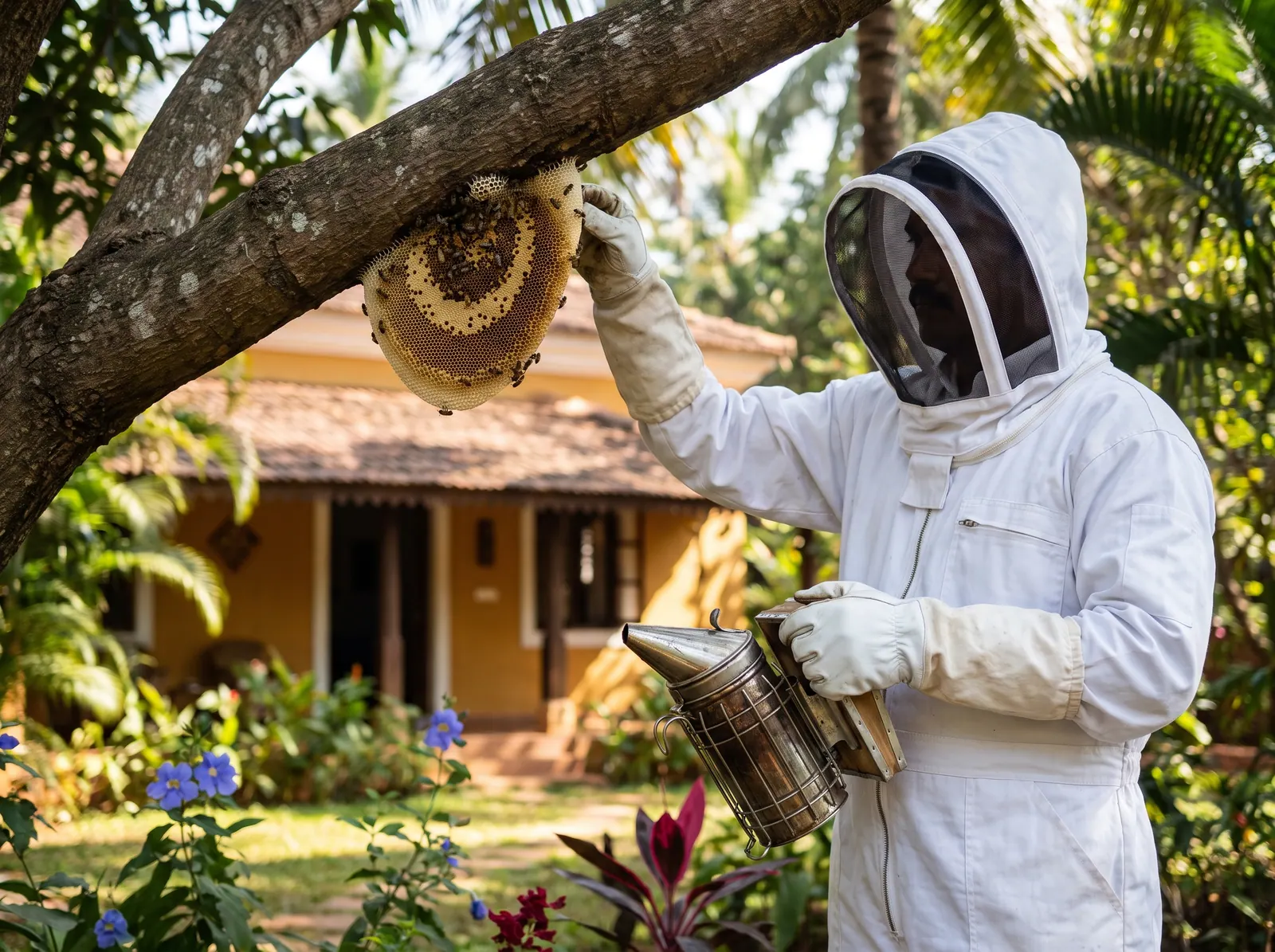
Key points
- Identifying the insect from the nest's shape and position comes before any removal decision.
- Rock bee colonies on high ledges can be large and highly defensive and should never be approached.
- Burning, hosing or spraying a nest yourself tends to agitate the colony and increases the risk of stings.
- Leftover comb can attract other insects and new swarms, so accessible nest material should be cleared.
- Sealing gaps, meshing vents and checking eaves each season reduces the chance of new nests.
What does bee and wasp nest removal involve?
A bee or wasp nest close to a doorway, balcony, window or play area is a genuine safety concern. The risk is greater where children, elderly people, guests or anyone with a known sting allergy are nearby. Professional bee and wasp nest removal means dealing with that nest in a controlled way. That involves working out what the insect is, judging how risky the nest is, and choosing a method that protects the people around it.
Our approach follows the same Integrated Pest Management (IPM) principles we use for every pest. We inspect first, address the conditions that attracted the insects, and treat only where treatment is needed. Not every nest needs to be destroyed, and not every nest can safely be left alone. The assessment decides which applies.
Is it a bee or a wasp? Identifying the nest
Bees and wasps behave differently, nest differently and call for different handling, so identification comes first. You do not need to get close to tell them apart, because the shape and position of the nest usually says a lot. If you can, take a photo from a safe distance using zoom, and share it when you contact us.
| Insect | What the nest looks like | Where it is often found | What to know |
|---|---|---|---|
| Rock bee (giant honey bee) | A single large, exposed wax comb, often covered by a dense layer of bees | High ledges, overhangs and balconies of tall buildings, water tanks, large trees | Colonies can be very large and highly defensive if disturbed. Never approach one. |
| Indian hive bee | Several parallel wax combs hidden inside a cavity | Wall voids, unused AC ducts, meter boxes, hollow trees, old cupboards | Often noticed only as a steady stream of bees entering a gap. |
| Little (dwarf) honey bee | A small, single comb wrapped around a twig or bar | Shrubs, hedges, low branches, grilles | Generally less defensive, but will still sting when disturbed. |
| Paper wasp | An open, umbrella-shaped paper nest with visible six-sided cells, hanging from a short stalk | Eaves, window frames, grilles, balcony ceilings, sheds | Nests start small and grow, and wasps will defend them. |
| Hornet | A larger, enclosed, papery nest, often rounded | Trees, roof spaces, sheltered corners of buildings | Larger insects with painful stings that need extra caution. |
| Potter or mud wasp | Small mud cells or pots stuck to a surface | Walls, door frames, inside unused rooms | Solitary and usually not aggressive. |
| Carpenter bee | No visible nest, just a neat round hole bored into wood, sometimes with sawdust below | Wooden beams, rafters, doors, furniture | Solitary. The concern is damage to timber rather than swarming. |
Why honey bees deserve special consideration
Honey bees are important pollinators for gardens, crops and trees. A colony may sit in a spot that poses little risk, or it may be possible to relocate it safely, for example with the help of a local beekeeper. In those cases, leaving or relocating the colony is usually the better outcome.
Removal or treatment is the right choice when the nest is close to people, stings are likely, and relocation is not practical. We discuss these options with you after the assessment.
A swarm is not the same as a nest
Sometimes you may see a large cluster of bees hanging from a branch or railing. This is often a swarm resting while scout bees look for a permanent home. A swarm may move on by itself within hours or a day or two.
A swarm still should not be disturbed, so watch it from a distance before deciding on removal. If the bees begin building comb, the swarm has become a nest.
What should you do if you find a nest?
Many stings happen when people try to deal with a nest themselves. Until the nest has been assessed:
- Keep children, pets and elderly family members away from the area, and close nearby windows and doors.
- Do not hit, poke, hose down, burn or smoke the nest, and do not throw stones at it.
- Do not spray household insect sprays, kerosene or other liquids at it. Partial attempts tend to agitate the colony rather than remove it.
- Do not block the entry hole of a nest inside a wall or duct. Trapped bees may find their way indoors instead.
- Avoid running grass trimmers, generators, drills or other machinery close to the nest. Vibration and noise can provoke a defensive response.
- In housing societies and workplaces, tell the building management so others can avoid the area too.
If someone is stung: seek medical help immediately in any of these cases:
- There are many stings.
- There is difficulty breathing.
- There is swelling of the face, lips or throat.
- The person feels dizzy.
- The person has a known allergy.
For any other sting reaction that worries you, see a doctor.
How do we remove a bee or wasp nest safely?
Every nest is different, but the work usually follows these steps:
- Information before the visit. We ask what you have seen and where the nest is. We also ask roughly how big and how high it is, and who uses the area. Photos taken from a safe distance help us plan.
- On-site assessment. The technician identifies the species and checks the size and activity of the nest. They also look at access, nearby doors and windows, foot traffic, and any risk to neighbours or passers-by.
- A plan you agree to. We explain the recommended approach. That may be relocation advice, removal, or treatment followed by removal. We also cover timing, the area to be kept clear and any precautions for occupants.
- Securing the area. People and pets are moved away and nearby windows and doors are closed. The technician wears protective clothing suited to the insect.
- Timing. Work is often planned for times when the insects are less active and most of the colony is in the nest, such as early morning or evening. This reduces the number of returning bees or wasps.
- Removal or treatment. The nest is dealt with using the agreed method. Any product used is applied by a trained technician according to its label directions.
- Clearing nest material. Where it can be reached safely, comb, wax and nest material are removed. Old honeycomb left behind can attract ants and other insects, and its scent can draw a new swarm to the same spot.
- Aftercare and prevention advice. We tell you when the area can be used again and what to expect over the next day or two. We also point out which gaps or cavities should be sealed.
It is normal to see a few bees or wasps circling the old site for a short time afterwards. These are usually insects that were away from the nest during the work. Let us know if activity continues.
Nests inside wall cavities or at height can be more complex. Sometimes a wall panel or duct cover has to be opened to reach the comb, or extra access arrangements are needed for high ledges. Any such work is discussed with you, or with the building management, before it begins. You can read more about our general approach on our how we work page.
The safety standards behind the work
We maintain Material Safety Data Sheets for the products we use. In Goa, we operate as a licensed pest control operator under the Directorate of Agriculture, Goa, using CIB&RC-registered products. Our Goa clients receive service reports after visits.
How should you prepare for the visit?
- Leave the nest undisturbed until the technician arrives.
- Plan to keep children, pets and anyone with a sting allergy indoors, in another part of the building or away from the property during the work.
- Close windows, doors and ventilators near the nest. If the technician advises it, switch off exhaust fans or AC units that draw air from that area.
- Move vehicles, laundry, toys and outdoor furniture away from the area, but only if you can do so without going near the nest.
- Arrange access to terraces, ducts, shafts or neighbouring areas in advance, especially in apartment buildings.
- Make sure a responsible adult is available to accompany the technician, as set out in our terms and conditions.
Nests in housing societies, hotels and workplaces
In shared and commercial properties, a nest affects more than one household. Residents, guests, staff and delivery workers can all be at risk from:
- a rock bee colony on a high-rise ledge
- a paper wasp nest above a hotel entrance
- a hive inside a warehouse wall
For these properties, coordination matters as much as the removal itself. That means agreeing a time when the area can be closed off, informing occupants and keeping a record of what was done. Facility managers should report nests early, while they are small, and should not let staff attempt removal. It is also sensible to include eaves, terraces, service shafts and storage areas in routine pest inspections.
How can you stop bees and wasps nesting again?
Bees and wasps look for sheltered, undisturbed spots. Reducing those spots is the most reliable form of prevention:
- Seal gaps, cracks and holes in external walls, especially around pipes, cables and AC lines.
- Fit fine mesh over vents, exhaust openings and unused ducts.
- Cover or close water tanks, unused boxes, meter cabinets and other hollow spaces.
- Remove leftover comb and wax after any removal, and clean the surface.
- Check eaves, balcony ceilings, window frames, grilles and sheds regularly. A paper wasp nest is easiest to deal with when it has only a few cells.
- Paint or seal exposed wooden beams and doors, and fill old bore holes, to discourage carpenter bees.
- Keep outdoor bins closed and clear away spilled sweet drinks and food, which attract foraging wasps.
Bee and wasp activity changes with the seasons. Goa has a humid coastal climate and a heavy monsoon. The Hyderabad region, on the Deccan plateau, moves from a hot, dry summer through the monsoon to a mild winter. Wherever you are, check the sheltered spots on your property as each season changes. Our guide to seasonal pests and how to prepare covers what to watch for through the year.
Pigeons may also be using the same ledges, ducts or balconies. Our bird netting page explains how those areas can be protected from birds. Netting is designed to keep birds out, so do not rely on it to keep out bees or wasps.
Checking availability for your branch
Efficacy Pest Control has two offices: our established Goa branch in Chimbel and a newly opened branch in Shamshabad, in the Hyderabad region. Service availability differs by branch, so please check availability for your branch before booking.
- Goa: visit our Goa branch page to check availability and the areas covered.
- Hyderabad region: our Shamshabad branch has recently opened. Tell us your location and the problem, and we'll confirm whether we can help. See the Hyderabad branch page for details.
You can reach either branch through our contact page. When you get in touch, please tell us:
- what the insect looks like
- where the nest is and how high it is
- whether anyone nearby has a known sting allergy
A photo taken from a safe distance always helps.
Frequently asked questions
QWill the bees be killed, or can they be relocated?
It depends on the species, where the nest is and how close it is to people. Honey bees are valuable pollinators, so if a colony poses little risk or can be safely relocated, perhaps with the help of a local beekeeper, that is usually preferable. When a nest sits beside a doorway, balcony or busy area and relocation is not practical, removal or treatment may be necessary. The technician explains the options after assessing the nest.
QCan I remove a small wasp nest myself?
Even small nests can contain wasps that will defend them. Many stings happen when people knock nests down with sticks, spray them with household aerosols or try to burn them. If you are unsure what the insect is, if the nest is out of easy reach, or if anyone in the home has a sting allergy, leave it alone and have it assessed. Keep children and pets away in the meantime.
QWhy are bees still flying around the spot after the nest was removed?
Foraging bees or wasps that were away during the work often return and circle the old site for a short time before dispersing. Leftover comb or wax can also keep the spot attractive, which is why accessible nest material is cleared and the surface cleaned. If activity continues beyond a day or two, or bees start building again, let us know so the site can be rechecked.
QWhen can my family and pets use the area again?
The technician will tell you when it is safe to return, based on the method used and where the nest was. As a general rule, keep children and pets away from any treated surfaces until they are dry or for as long as advised. Ventilate enclosed spaces, and wash hands after touching anything in the area. Any product is applied according to its label directions.
QCan you deal with a rock bee nest on a high-rise building?
Nests on high ledges or the outer walls of tall buildings need careful planning. Access, the safety of residents below and the size of the colony all matter. Share the height, location and a photo taken from a safe distance, and the team will assess what is involved. Any special access arrangements are discussed with you or the building management before work is agreed.
QIs bee and wasp nest removal covered by a warranty?
For our Goa operation, warranty terms are set out in the service agreement for specific services and vary by pest and treatment. They do not cover structural changes, new construction or cases where post-service instructions are not followed. Because bees and wasps can arrive from outside the property, ask the Goa team what applies before work begins. In the Hyderabad region, our recently opened Shamshabad branch will confirm what it can help with.