


Key points
- Commercial pest control is a scheduled, documented programme rather than a one-off treatment.
- Every programme begins with a site assessment covering pest activity, entry points, food sources, moisture and operating hours.
- Our approach is Integrated Pest Management: inspection, sanitation and proofing advice, and targeted treatment.
- At the Goa branch, service reports are shared after visits, and food businesses receive documentation aligned with HACCP and FSSAI audit expectations.
- Availability differs by branch, so check availability for your branch before booking.
Commercial pest control is different from a one-off spray at home. A workplace has staff, customers, stock, equipment and often an auditor or landlord to answer to. What it needs is a scheduled, documented programme that keeps pests under control week after week and leaves a clear record of what was done.
This page explains how we approach commercial pest control for offices, shops, warehouses and industrial sites. It covers the assessment, how a programme is designed, how visits are scheduled and what records you receive. The programme details describe how our Goa branch works. Availability differs between our two branches, so please check availability for your branch before booking.
What does commercial pest control involve?
We follow an Integrated Pest Management (IPM) approach. In practice, this means we inspect first, find out why pests are present, advise on sanitation and proofing, and then use targeted treatment where it is actually needed. We do not cover the whole building in chemicals by default.
For a business, IPM has practical advantages. Treatment is focused, so there is less disruption to staff and operations. The causes of the problem, such as gaps under doors, waste handling or damp areas, are addressed alongside the pests themselves. The programme also produces a paper trail you can show to management or an auditor.
Which pests matter for different types of premises?
Every site is different, but certain patterns come up repeatedly. The table below is a general guide to what a programme usually focuses on. The real picture for your premises comes from the site assessment.
| Type of premises | Pests to watch for | Where a programme usually focuses |
|---|---|---|
| Offices | Cockroaches, ants, rodents | Pantries, washrooms, false ceilings, cable trays, waste points |
| Shops and showrooms | Cockroaches, rodents, flies, ants | Stockrooms, back-of-house areas, entrances, loading points |
| Warehouses and godowns | Rodents, stored-product insects, birds, termites | Perimeter and dock areas, racking, pallets, roof ledges, stored goods |
| Industrial sites | Rodents, flies, cockroaches, birds | Canteens, waste yards, drains, roof structures, utility rooms |
Rodents are a concern almost everywhere because they gnaw packaging, cables and insulation and contaminate surfaces. Our rodent control work uses inspection, tamper-resistant bait stations, traps and proofing advice. Cockroaches shelter in warm, humid gaps near motors, drains and kitchens. Where they are a problem, targeted cockroach control with gel baiting and crack-and-crevice treatment is usually part of the plan.
How do we assess a commercial site?
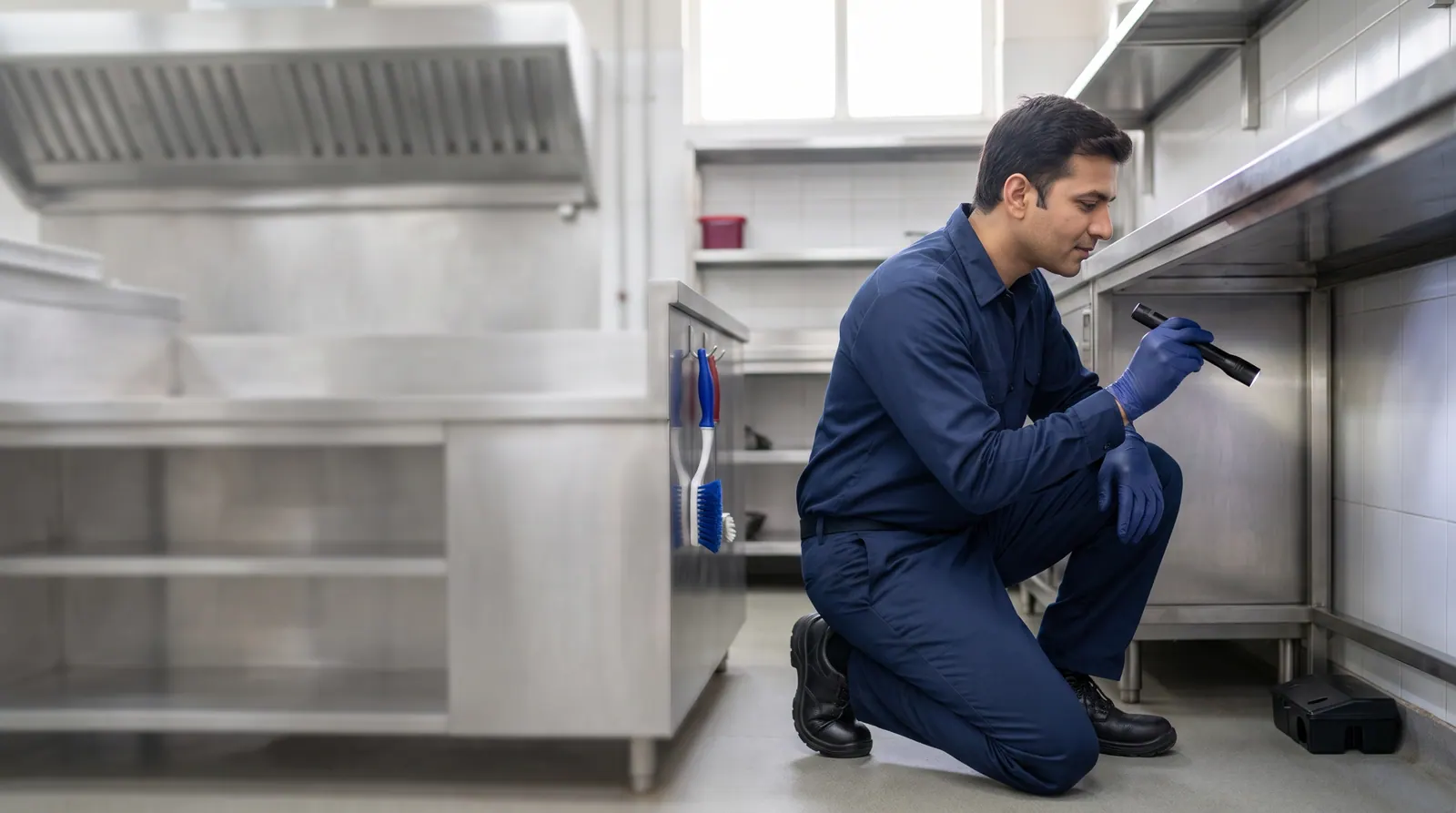
Assessment comes before any treatment or quotation. A technician walks the site with a member of your team, looking at both pest activity and the conditions that encourage it. Typical checks include:
- Signs of activity such as droppings, gnaw marks, live or dead insects, nests and damaged stock
- Entry points, including gaps around doors, shutters, pipes, drains and cable ducts
- Food sources and waste handling, including canteens, pantries, bins and waste yards
- Moisture and harbourage, such as leaking pipes, cluttered storerooms and undisturbed corners
- Building features such as timber frames, false ceilings, ledges and roof spaces
- Any history of past treatment and any audit or compliance requirements you need to meet
We also ask how the site operates: working hours, delivery times, sensitive areas such as server rooms or food zones, and who will be the point of contact. These details shape the programme as much as the pests do.
How is a commercial pest programme designed?
The programme turns the assessment into a written plan. It usually divides the site into zones, for example office floors, canteen, stores, loading bay and external perimeter. For each zone, it sets out which pests are targeted, what monitoring is in place and which treatments may be used.
A programme might combine several services from our catalogue:
- Rodent bait stations and traps around the perimeter and inside stores
- Gel baiting and crack-and-crevice treatment for cockroaches in pantries and washrooms
- Fly source reduction and targeted treatment near waste and food areas
- Ant baiting focused on trails and nests
- Inspection-led anti-termite treatment for the building, plus wood treatment for affected timber and wooden fixtures
- Bird netting for ledges, ducts and loading areas
- Fumigation for stored goods or consignments, where fumigation is the appropriate method
The plan also lists the proofing and housekeeping actions that sit with your team, such as fitting door sweeps, sealing gaps or changing how waste is stored. Treatment alone rarely holds if those causes remain.
How often should commercial pest control visits happen?
Visit frequency depends on the type of business, the pests involved and the level of activity found during assessment. A low-risk office may need less frequent visits than a warehouse holding food stock or a site with a canteen. Frequency can be adjusted as conditions improve or change.
At our Goa branch, visit timing is agreed with you so that work fits around your operations, avoiding busy trading periods or shift changes where possible. Seasonal changes matter too. Goa's humid coastal climate and very heavy monsoon, and the Deccan plateau's hot summer and monsoon around Hyderabad, both bring shifts in pest pressure through the year. Our guide to seasonal pests and how to prepare explains what to expect.
Year-round visits can be set up under an annual maintenance contract, with scheduled visits and service reports. This keeps the programme on track without anyone needing to remember to book.
What reports and audit records do you receive?
For many businesses, documentation matters as much as the treatment itself. A good record shows what was inspected, what was found, what was done and what action is recommended.
- Service reports: At our Goa branch, service reports and proof of service are shared after visits, and clients receive updates on WhatsApp.
- Food business documentation: In Goa, we provide documentation for food businesses that is aligned with HACCP and FSSAI audit expectations. FSSAI Schedule 4 sets out general hygiene requirements for food businesses, and pest control is one part of them, so this is relevant for canteens, food stores and food-handling areas. Kitchens with heavier needs may also find our restaurant pest management service useful.
- Product safety information: We maintain Material Safety Data Sheets for the products we use, which your safety or compliance team may ask to see.
- Licensing: Our Goa operation is a licensed pest control operator (Directorate of Agriculture, Goa) and uses CIB&RC-registered products. For context, pesticide products in India are regulated under the Insecticides Act, 1968.
Keep these records together in a single file or folder. When an auditor, landlord or head office asks for evidence of pest control, you will have a complete history ready. For the Shamshabad branch, please ask about documentation when you contact us.
How should you prepare your premises, and what about safety?
Good preparation makes each visit faster and more effective. Your technician will give site-specific instructions, but these steps apply to most commercial sites:
- Nominate a staff member to accompany the technician and provide access to all areas, including locked stores and roof spaces.
- Inform staff about the visit and the areas involved.
- Cover or remove exposed food, drinks and food-contact items in areas being treated.
- Move stock slightly away from walls where possible, so edges and corners can be inspected.
- Keep a simple log of pest sightings between visits, noting the date, location and what was seen.
- Do not move or open bait stations, and do not clean away gel bait placements unless advised.
After treatment, keep staff and visitors away from treated areas until surfaces are dry or for as long as the technician advises. Ventilate enclosed spaces and make sure anyone who handles treated surfaces washes their hands. If anyone feels unwell or has a bite or sting reaction, they should see a doctor.
In Goa, a warranty applies to the treated area for specific services, as set out in the service agreement. It varies by pest and treatment, and it does not cover structural changes, new construction, or cases where post-service instructions have not been followed.
Is commercial pest control available for my business?
The availability panel on this page shows the current status for each branch. Please check availability for your branch before you make plans.
Goa: Commercial pest control is handled by our Goa branch in Chimbel. Tell us about your premises and the problem, and we will arrange a site assessment.
Hyderabad region: Our Shamshabad branch has recently opened. Tell us your location and the problem, and we'll confirm whether we can help. The programme details on this page describe our Goa practices; the Shamshabad branch will confirm what it can offer for your site.
Commercial Pest Control in Goa towns
Frequently asked questions
QHow is commercial pest control different from residential pest control?
Commercial programmes are built around how a business operates. They are usually zoned by area, scheduled at regular intervals and documented after each visit so managers and auditors can see the history. They also account for staff, customers, stock and working hours. Residential treatment is typically simpler and focused on a single household's living spaces.
QCan visits be arranged so they do not disrupt our working hours?
At our Goa branch, visit timing is agreed with you during programme planning, taking account of your trading hours, delivery times and shift patterns so work can be scheduled for quieter periods. Some treatments need areas to stay clear until surfaces are dry, and your technician will explain any restrictions in advance. In the Hyderabad region, our Shamshabad branch will confirm what it can help with.
QDoes someone from our team need to be present during the visit?
Yes. Our terms ask for a client representative to accompany technicians during service. This person provides access to locked areas, points out where staff have seen pests and receives advice on proofing and housekeeping. It also means someone on your side knows exactly what was treated and where.
QWill the service records satisfy an FSSAI or HACCP audit?
In Goa, we provide documentation for food businesses that is aligned with HACCP and FSSAI audit expectations. Auditors look at your overall hygiene system, not pest control records alone, so the reports work best alongside your own cleaning schedules, sighting logs and corrective actions. Ask what documentation your branch provides when you get in touch.
QDo we need a long-term contract for commercial pest control?
Not necessarily, but regular visits are usually how commercial sites stay under control. An annual maintenance contract is one way to make sure visits and reports happen on a fixed schedule. The right frequency depends on your premises, the pests involved and what the assessment finds, and it can be reviewed as conditions change. Check availability for your branch before planning a contract.
QCan we reschedule or cancel a planned visit?
Yes. Under our terms, cancellations should be made at least 48 hours before the scheduled service, and a late-cancellation fee may apply. For a scheduled commercial programme, it helps to tell us early about events such as stock audits or renovation work so visits can be moved without leaving gaps in coverage.


