Key points
- Restaurant pest management focuses on cockroaches, rodents and flies in kitchens, stores, drains and waste areas.
- The approach follows Integrated Pest Management: inspection, sanitation and proofing advice, then targeted treatment.
- Visit frequency depends on the pest and level of activity, and may be weekly, monthly or quarterly.
- A pest control file for audits typically includes service reports, a bait station plan, a sighting log and corrective action records.
- Service availability differs by branch; the Goa branch in Chimbel is established and the Shamshabad branch has recently opened.
Restaurant pest management is a planned, kitchen-focused programme. It keeps cockroaches, rodents and flies away from food and leaves a clear record of what was done. A commercial kitchen is warm, damp and full of food and hiding places, so occasional spraying rarely holds for long.
What works is regular inspection, targeted treatment, good housekeeping, and records your team can show an auditor or food safety officer. This page explains our approach to restaurant kitchens:
- where we look
- how we treat
- how visits are scheduled
- what records you should keep
- what happens when pests are found
Availability differs by branch, so please check availability for your branch.
What does a restaurant pest management programme include?
We follow an Integrated Pest Management (IPM) approach. That means inspection first, then sanitation and proofing advice, then targeted treatment where it is actually needed. For a restaurant, the programme usually covers:
- Cockroaches: gel baiting and targeted crack-and-crevice treatment in kitchens, wash areas, food areas and drains.
- Rodents: inspection, tamper-resistant bait stations, traps and proofing advice for rats and mice.
- Flies: source reduction, sanitation advice and targeted treatment for house flies, fruit flies and drain flies.
- Records: written proof of what was inspected, found, treated and recommended at each visit.
Because food is prepared on site, treatment choice and placement matter as much as the treatment itself. Products are kept away from food, food-contact surfaces and utensils, and are applied where pests live and travel rather than across open surfaces.
Where do pests hide in a restaurant kitchen?
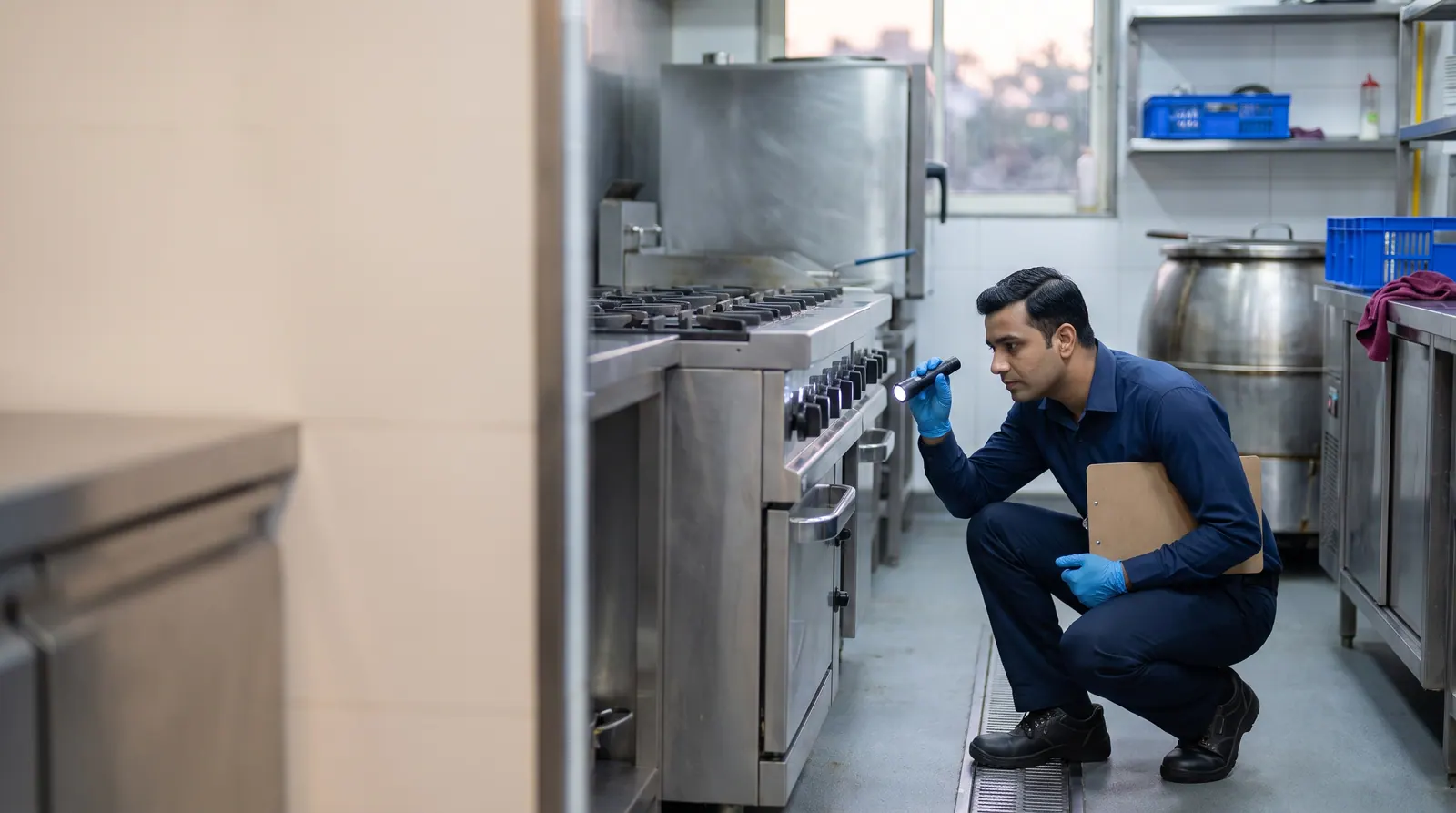
Most kitchen infestations start in a small number of predictable places. These spots are warm and damp, collect food residue, or give pests a gap to get in through. A good inspection checks each one, including areas staff rarely see.
| Hotspot | Pests usually involved | What we check |
|---|---|---|
| Behind and under ranges, fryers, tandoors and hot cabinets | Cockroaches | Grease build-up, cracked tiles, gaps behind equipment and wall joints |
| Dishwash and pot-wash area, sinks | Cockroaches, drain flies | Leaks, standing water, food residue around sink bases and pipework |
| Floor drains, gullies and grease traps | Drain flies, cockroaches, rodents | Organic film inside drains, broken or missing covers, overflow |
| Dry stores and goods receiving | Rodents, cockroaches, stored-product insects | Gnawed packaging, droppings, stock kept on the floor, incoming cartons |
| Refrigerator motors and under-counter chillers | Cockroaches | Warm motor housings and voids where cockroaches cluster |
| Waste bins and garbage holding area | Flies, rodents | Lids, spillage, how often bins are emptied and washed |
| Bar, service counter and dining area | Cockroaches, ants, fruit flies | Bar sinks, beverage dispensers, fruit storage, upholstered seating |
| Pipe, cable and duct entry points | Rodents, cockroaches | Unsealed gaps in walls, ceilings and false ceilings |
Cardboard deserves a special mention. Cartons from suppliers can carry cockroaches and their egg cases into a kitchen, and stored cardboard gives them shelter. Unpacking deliveries at the receiving point and removing cardboard promptly is one of the simplest prevention steps a kitchen can take.
How do we treat cockroaches, rodents and flies in a working kitchen?
Cockroaches
Cockroaches that breed indoors hide in cracks close to food, water and warmth. Gel bait is placed in small spots inside those cracks and voids, where cockroaches feed on it. Targeted crack-and-crevice treatment reaches harborage that bait alone may not cover.
Kitchen staff should not spray household insecticide over gel or wipe it away, as this reduces its effect. Our guide on how to prepare for cockroach gel treatment explains what to do before and after a visit. You can read more about the method on our cockroach control page.
Rats and mice
Rodent control in a food business relies on monitoring and proofing as much as on bait. Tamper-resistant bait stations are secured in suitable positions, generally around the outside and perimeter of the premises.
Traps and monitoring are generally preferred close to food-handling areas, so there is less risk of bait or carcasses ending up near food. Proofing advice covers door gaps, drain openings, and holes around pipes and cables, because a rodent that cannot get in does not need to be controlled. See our rodent control service for more detail.
Flies
Flies follow their breeding sources: waste, dirty drains, spilled food and over-ripe fruit. Treatment without removing the source rarely lasts.
We start by finding where flies are breeding, then give sanitation advice and carry out targeted treatment. Drain flies, for example, usually point to organic film inside drains that needs physical cleaning. Fruit flies often point to fruit, juice or bar waste left out. Our fly control page covers the different fly types.
Pest activity often rises in warm, humid months. Expect more pressure during Goa's heavy south-west monsoon and during the monsoon and hot season on the Deccan plateau around Hyderabad. A programme should allow for this rather than treat every month the same.
How often should a restaurant have pest control visits?
Visit frequency depends on the pest, the level of activity, the size of the kitchen and the building. Depending on the situation, a regular maintenance schedule may be weekly, monthly or quarterly. An active infestation usually needs closer follow-up until it is under control.
Timing matters as much as frequency. Visits work best when the kitchen is closed or quiet, because:
- food and utensils can be put away and covered properly
- technicians can reach behind equipment without disrupting service
- treated areas can be left as advised before food preparation resumes
Discuss a suitable time slot when you plan the programme. For year-round scheduled visits with service reports, many businesses choose an Annual Maintenance Contract, which keeps visits regular and records in one place.
What records should a restaurant keep for food safety audits?
The FSSAI Schedule 4 hygiene requirements expect food businesses to have effective pest control in place. HACCP-based food safety systems also treat pests as a hazard to be controlled and monitored.
In practice, auditors and inspectors usually want evidence, not just a statement that pest control is done. A well-kept pest control file typically contains:
- Service reports for each visit: date, areas inspected, pests found, treatment carried out and recommendations
- A site plan showing where bait stations and traps are located
- A pest sighting log filled in by your own staff between visits
- Corrective action records showing what was done about each finding and when it was closed
- Product information, including safety data sheets for the products used
- A copy of the service agreement and visit schedule
Material Safety Data Sheets are maintained for the products we use. At our Goa branch in Chimbel, we are a licensed pest control operator (Directorate of Agriculture, Goa) using CIB&RC-registered products. For food businesses in Goa, we provide documentation aligned with HACCP and FSSAI audit expectations, and share service reports after visits along with WhatsApp updates.
What happens when pests are found? Corrective actions explained
A sighting is not a failure in itself; ignoring it is. A clear corrective action routine turns each finding into a fix and gives auditors a record of how the problem was handled.
- Record it. Staff note what was seen, where, and when in the sighting log.
- Report it. The kitchen manager informs the pest control provider, especially if activity is repeated or in a food area.
- Protect food. Any food or packaging that may have been contaminated is handled according to your food safety procedures.
- Find the source. An inspection identifies where pests are coming from or breeding, not just where they were seen.
- Treat and fix. Targeted treatment is combined with the real cause: deep cleaning, a repair, a sealed gap, better waste handling or stock rotation.
- Check and close. A follow-up check confirms the action worked, and the entry is closed in the records.
Some corrective actions belong to the pest control team and some to the restaurant, such as fixing a leaking pipe or replacing a broken door seal. Good service reports make it clear who is responsible for each recommendation.
How should your kitchen team prepare, and what about safety?
Before a visit:
- Store or cover all food, and put away utensils and crockery.
- Clear access to areas under and behind equipment where possible.
- Empty and close waste bins.
- Tell the technician about recent sightings and where they occurred.
- Nominate a staff member to accompany the technician during the service.
After a visit:
- Follow the technician's advice on when staff can re-enter treated areas and when food preparation can resume.
- Ventilate the kitchen as advised.
- Clean food-contact surfaces before use, without washing away bait placements.
- Wash hands after handling anything in treated areas.
Products are applied according to their label directions. If any staff member feels unwell after a treatment, or suffers a bite or sting, they should see a doctor.
Check availability for your branch
Our Goa branch in Chimbel is our established operation. Our Shamshabad branch has recently opened. Please check availability for your branch on this page.
Then get in touch with us with three details: your location, the type of food business, and the pest problem you are seeing. We'll confirm whether and how we can help.
Frequently asked questions
QIs it safe to treat a kitchen that prepares food every day?
Yes, when treatment is planned around food safety. Gel baits and targeted crack-and-crevice treatment are placed where pests hide, not on open surfaces. Food and utensils should be stored or covered before the visit. Staff should follow the technician's advice on re-entry and on cleaning food-contact surfaces before use. Products are applied according to label directions, and safety data sheets are maintained for the products used.
QDo we have to close the restaurant for pest control?
Usually not for routine visits, but timing matters. Visits are best planned for when the kitchen is closed or quiet, so food can be put away and technicians can reach behind equipment. A heavier treatment, such as for a serious cockroach infestation, may need a longer gap before food preparation resumes. The technician will explain what is needed for your situation.
QWhy do cockroaches keep coming back even after spraying?
Surface spraying often misses cockroaches hiding deep in cracks, motor housings and equipment voids. It can also disturb them into new hiding spots. Egg cases may also survive and hatch later. Repeated activity is also common when cardboard, grease build-up or leaks give cockroaches shelter and water. Gel baiting, targeted crack-and-crevice work and fixing these conditions together tend to give more lasting control.
QWhat should our own staff record between pest control visits?
Keep a simple pest sighting log. Note the date, time, exact location, the type of pest if known, and who saw it. Record what was done in response and when the issue was closed. Auditors often look at this log alongside the service reports, and it helps the pest control team see patterns and find sources faster.
QDoes the service cover pests that come in from neighbouring shops or drains?
In Goa, a warranty applies to the treated area for specific services, as set out in the service agreement. Warranty terms vary by pest and treatment, and exclude structural changes, new construction, or not following post-service instructions. Pests entering from neighbouring premises or public drains need proofing measures such as sealing gaps and fitting drain covers. Ask the technician for prevention advice specific to your building.
QAre pest control records enough to pass an FSSAI or HACCP audit?
Pest control records are one part of an audit, not the whole of it. Auditors also look at cleaning, storage, waste handling and building condition. Good service reports, a bait station plan, a sighting log and closed corrective actions show that pests are being actively managed. In Goa, we provide documentation aligned with HACCP and FSSAI audit expectations.