Quick answer
Efficacy Pest Control's Goa branch provides termite control in Porvorim, including Alto Porvorim, Socorro, Sangolda and Penha de França. Every job starts with an inspection to find where termites are entering and feeding. Occupied homes and offices usually receive post-construction drill-fill-seal treatment along wall–floor junctions. New buildings receive pre-construction soil treatment, and affected woodwork is treated directly. We use CIB&RC-registered products and share a service report after each visit.
Key points
- Termite control in Porvorim is provided by Efficacy Pest Control's Goa branch in Chimbel, including Alto Porvorim, Socorro, Sangolda and Penha de França.
- Occupied buildings usually receive post-construction drill-fill-seal treatment, while new construction receives pre-construction soil treatment.
- The Goa operation is a licensed pest control operator (Directorate of Agriculture, Goa) using CIB&RC-registered products.
- A service report is shared after each visit, and food businesses receive documentation aligned with HACCP and FSSAI audit expectations.
- A warranty applies to the treated area for specific services, as set out in the service agreement.
Termites rarely announce themselves. In Porvorim, the first sign is often a door frame that sounds hollow, a thin line of mud running up a wall, or a scatter of tiny wings on a windowsill after the first monsoon showers. Our Goa branch provides termite control in Porvorim for flats, independent houses, villas, housing societies and commercial premises. We start with an inspection, then treat the places termites are actually using.
We are a licensed pest control operator with the Directorate of Agriculture, Goa, and we use CIB&RC-registered products. Our work follows Integrated Pest Management (IPM): find the source, correct the conditions that help termites, then treat in a targeted way rather than spraying everywhere.
Why do Porvorim properties get termites?
Most termite damage in Goan buildings is caused by subterranean termites. They live in the soil, need moisture, and reach wood above ground through cracks, joints and the mud tubes they build along walls. Goa's long and very heavy south-west monsoon keeps soil and masonry damp for months, which suits them well.
Porvorim's mix of properties creates some typical risk points:
- Apartment blocks in Alto Porvorim and along the highway: termites can travel through expansion joints, electrical conduits and service shafts, so one flat's problem may begin in a ground-floor store or a neighbouring unit.
- Independent houses and villas with gardens, for example in Sangolda and Socorro: tree stumps, stacked timber, wooden garden fixtures and planters placed against walls give termites an easy route into the house.
- Older homes with wooden rafters, ceilings, staircases and window frames: more timber means more to protect, and damage can stay hidden inside beams for a long time.
- New buildings and extensions: construction is the one stage when the soil beneath the floor can be treated before it is sealed over.
What signs should you look for?
Walk around your home or office, including storerooms, the area under the kitchen sink and the back of wardrobes. Common signs include:
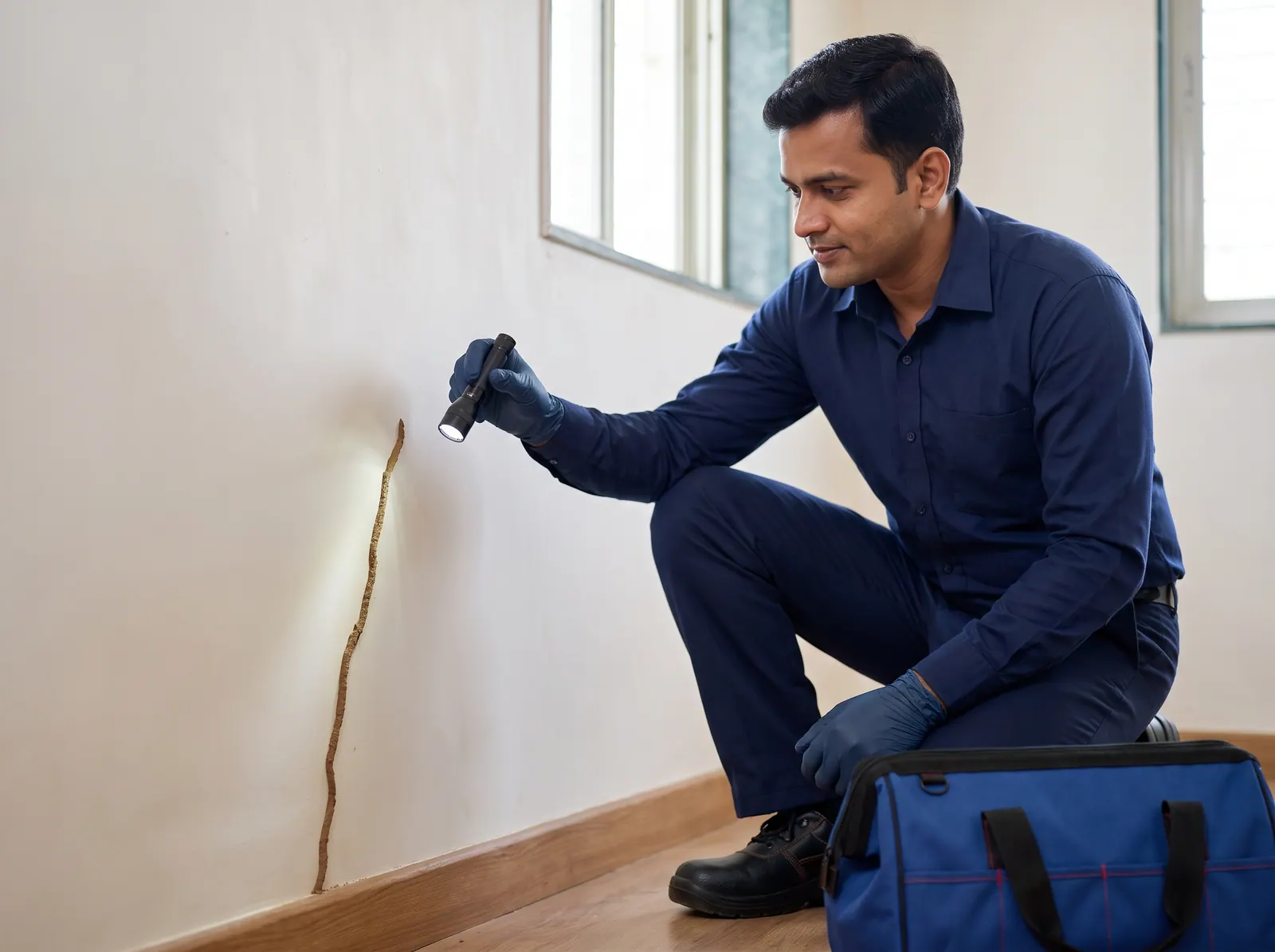
- Mud tubes on walls, foundations, skirting or behind cupboards
- Wood that sounds hollow when tapped, or paint that bubbles on door and window frames
- Discarded wings near windows and lights, often on humid evenings around the start of the monsoon
- Damaged cardboard boxes, books or files in storerooms
- Doors and drawers that suddenly stick or sag
Fine powder falling from small round holes in furniture is more often a sign of wood borers than termites; our page on wood borer treatment in Porvorim explains the difference. For a fuller checklist, see our guide to termite warning signs in Goan homes.
If you find mud tubes, try not to break them or spray store-bought insecticide before the inspection. Leaving them in place makes it easier to trace where the termites are coming from.
Which termite treatment does your property need?
The right method depends on the stage of the building and where the activity is. This table summarises the usual options.
| Your situation | Usual treatment | What it involves |
|---|---|---|
| Building a new home, shop or extension | Pre-construction soil treatment | Treating the soil at foundation and plinth stages before flooring is laid, following the practice described in IS 6313 (Part 2) |
| Active termites in an occupied flat, house or office | Post-construction drill-fill-seal | Drilling small holes along wall–floor junctions and other entry points, filling them with termiticide and sealing them, following IS 6313 (Part 3) practice |
| Damaged doors, frames, cupboards or rafters | Wood treatment | Treating affected timber directly, with advice on replacing pieces that are badly weakened |
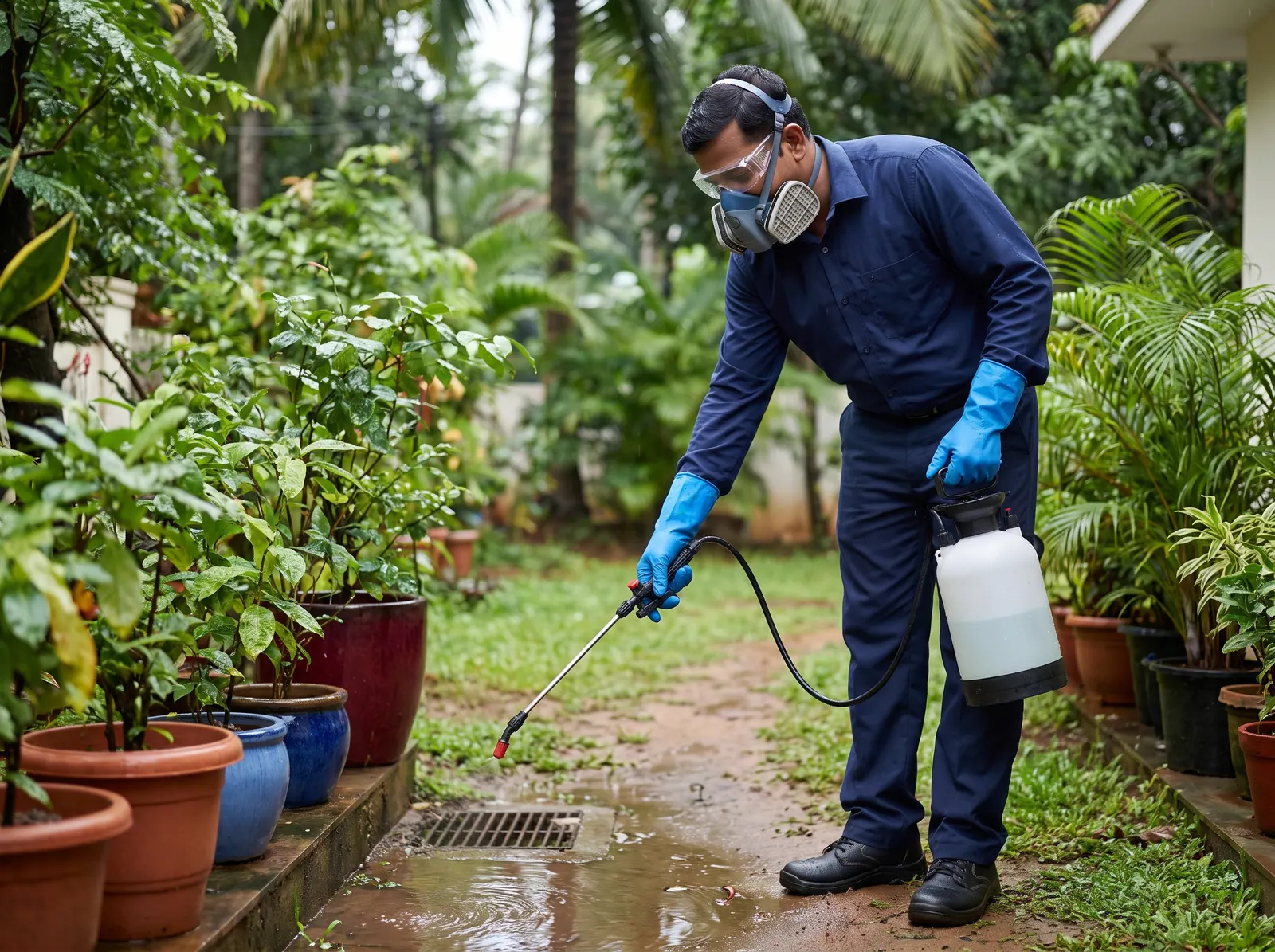
| Termites in garden beds, stumps or boundary walls | Garden and perimeter treatment | Treating outdoor sources so they do not feed activity inside the building |
You can read more about pre-construction anti-termite treatment, post-construction termite treatment and garden and landscape termite treatment on their dedicated pages.
How does a termite job in Porvorim run?
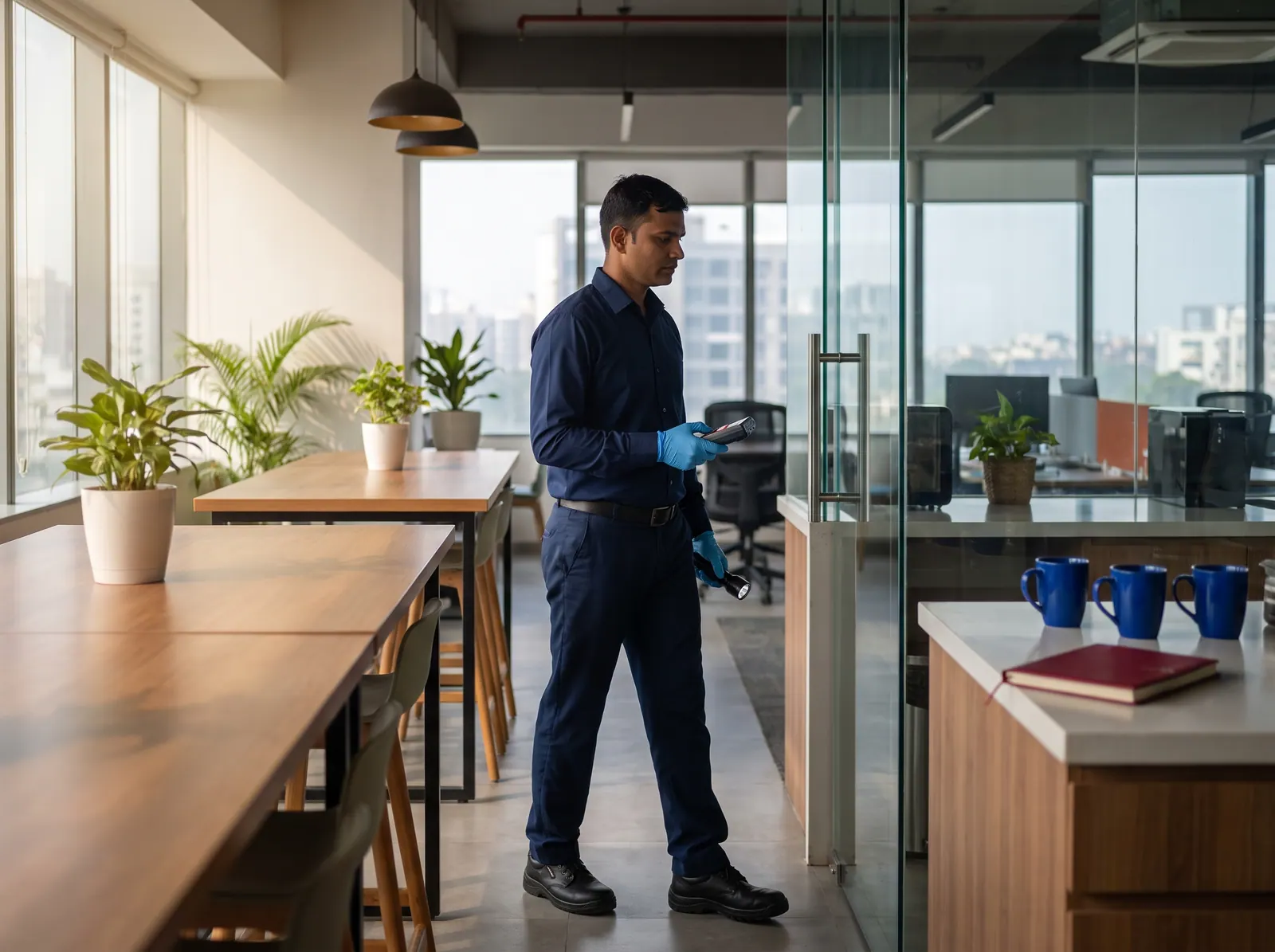
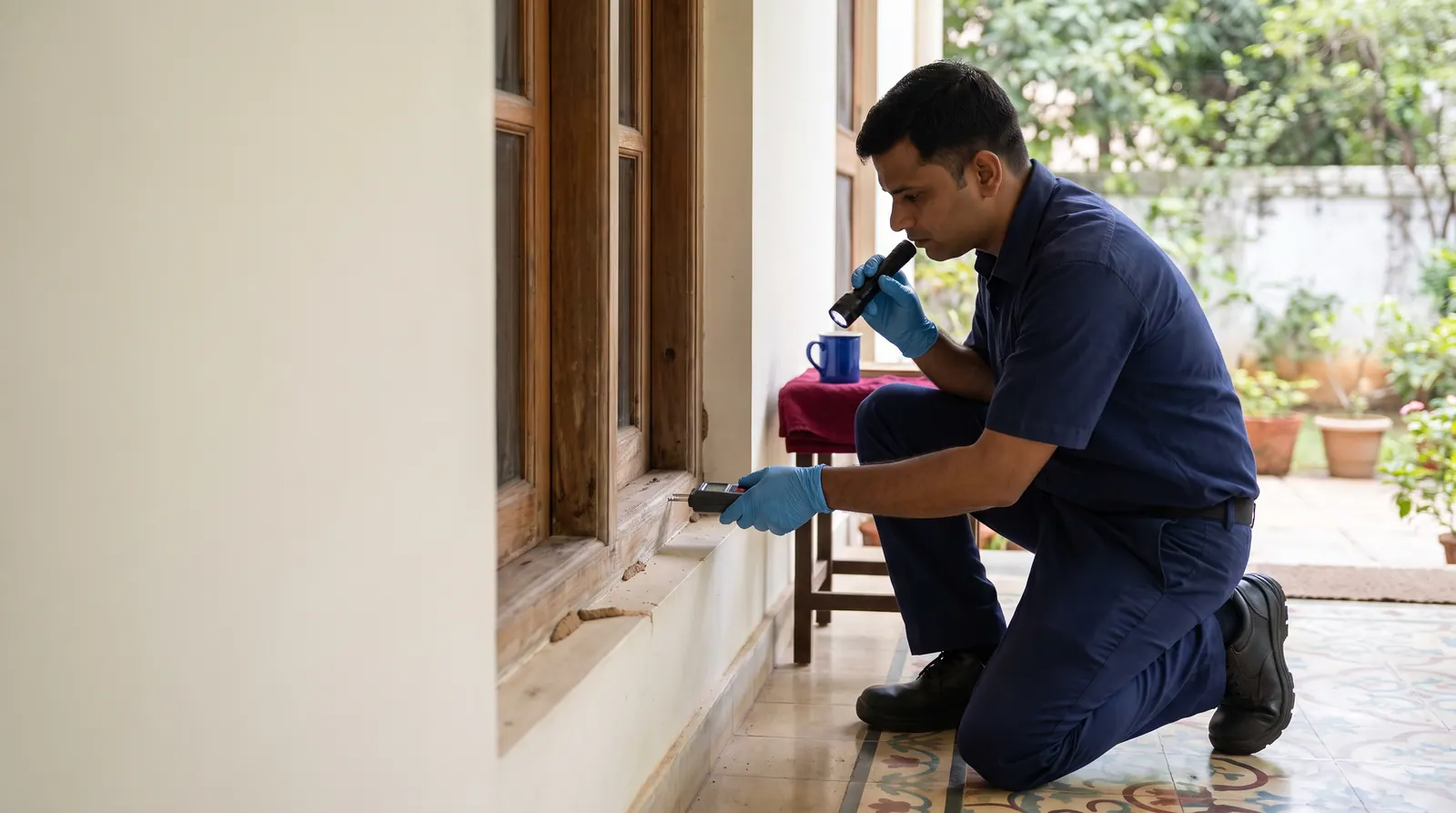
- Inspection. We check walls, floors, woodwork, wet areas and storerooms, plus the outside of the building, including the garden and compound wall. A member of your household or staff accompanies the technician.
- Findings explained. We show you where termites are active, their likely entry route, and any moisture problems, such as leaking pipes or wall seepage, that need fixing.
- Plan and quotation. You receive a clear scope: the areas to be treated, the method, the number of visits, and the warranty that applies.
- Preparation. Clear access along the walls being treated, empty the space under sinks and the base of wardrobes, cover or remove food, and arrange for children and pets to be away from the work area.
- Treatment. We treat only the required spots, drill neatly and seal the holes afterwards.
- Service report. After the visit we share a report as proof of service, along with updates on WhatsApp.
- Aftercare. Keep children and pets away from treated areas until they are dry or for as long as the technician advises, ventilate the rooms, and wash hands after touching treated surfaces.
We maintain Material Safety Data Sheets for the products we use, so handling and safety information is available if you need it.
Flats, villas, societies and businesses
Flats and housing societies
Treating a single flat helps, but if termites are coming from common areas, ground-floor stores or the soil around the building, activity can reappear. Societies benefit from a block-level inspection covering parking areas, meter rooms, service shafts, garden beds and compound walls. Service reports can be kept on file by the committee.
Independent houses and villas
Here the garden often matters as much as the house. Treatment usually combines the building perimeter and internal entry points with outdoor sources. Simple changes, such as moving firewood and timber off the ground and keeping planters away from walls, make a real difference.
Offices, shops and restaurants
Offices with paper records and wooden partitions need storerooms and cabinets checked carefully. For restaurants and other food businesses, we schedule work around service hours and provide documentation aligned with HACCP and FSSAI audit expectations.
What affects the cost, and what does the warranty cover?
The cost depends on the built-up area, the level of termite activity, the treatment method, and how much woodwork is affected. Pre-construction and post-construction treatments are priced differently. We give a quotation after the inspection rather than guessing over the phone. Payment follows the quotation or invoice, and cash, UPI, card, net banking and bank transfer are accepted.
For specific services, a warranty applies to the treated area, as set out in your service agreement. It varies by treatment and does not cover structural changes, new construction, or cases where post-service instructions were not followed. If termites enter from a neighbouring property or an untreated area, we will advise you on preventing this.
Which parts of Porvorim do we cover?
Our Goa branch covers Porvorim, including Alto Porvorim, Socorro, Sangolda and Penha de França. If you are unsure whether your lane or building is included, simply ask. For other pest problems in the area, see our pest control services in Porvorim.
To arrange an inspection, contact our Goa branch in Chimbel. Tell us your location in Porvorim, the type of property and what you have noticed. Photos of mud tubes or damaged wood help us prepare for the visit.
Frequently asked questions
QDo we need to move out of our flat during post-construction termite treatment?
Moving out is not usually necessary, but the technician will advise you based on the rooms being treated. Plan to keep children and pets out of treated areas until they are dry or for as long as advised, and keep windows open for ventilation. If anyone in the household has a health condition or feels unwell afterwards, please consult a doctor.
QIs termite treatment safe for children and pets?
We use CIB&RC-registered products, apply them only where they are needed, and maintain Material Safety Data Sheets for everything we use. Safety also depends on following the aftercare advice: keep children and pets away from treated areas until dry or as advised, ventilate the rooms and wash hands after touching treated surfaces. See a doctor if anyone shows a reaction.
QHow soon will termite activity stop after treatment?
It varies with the level of infestation and the method used. Some activity stops quickly, while other areas may take a few days to show a clear improvement. Old mud tubes and existing damage will remain until they are cleaned or repaired. If you notice fresh activity in a treated area, tell us so we can check it against your service agreement.
QTermites have appeared in several flats in our Porvorim society. Should each flat be treated separately?
Individual treatment can help, but when several flats are affected, the source is often shared: soil around the building, ground-floor stores, shafts or garden beds. A block-level inspection covering common areas usually gives a clearer picture. The society committee can then decide on a coordinated plan and keep the service reports on record.
QI am buying a resale flat or house in Porvorim. Should I get a termite inspection first?
It is a sensible step, especially for older properties or ground-floor units with a lot of woodwork. An inspection can reveal active termites, past damage and moisture problems that may affect repair costs. Ask the seller for access to storerooms, wardrobes and the area under sinks, as these are places where early signs are often hidden.
QWhat should we do before the technician arrives?
Clear furniture and stored items away from the walls being treated, empty the space under sinks and the base of wardrobes, and cover or remove food. Arrange for pets to be kept away. Someone from your household or staff should be present to walk around with the technician. If you need to reschedule, please let us know at least 48 hours in advance.
QCan restaurants and food businesses in Porvorim get documentation for audits?
Yes. For food businesses, we provide service records aligned with HACCP and FSSAI audit expectations, and we share a report after every visit. Treatment is planned around service hours, and food contact areas are protected during the work. Your hygiene or quality team can keep the reports alongside your other audit records.
Last updated 13 October 2026. Information on this page is general guidance; your technician will advise on your specific property after inspection.