Quick answer
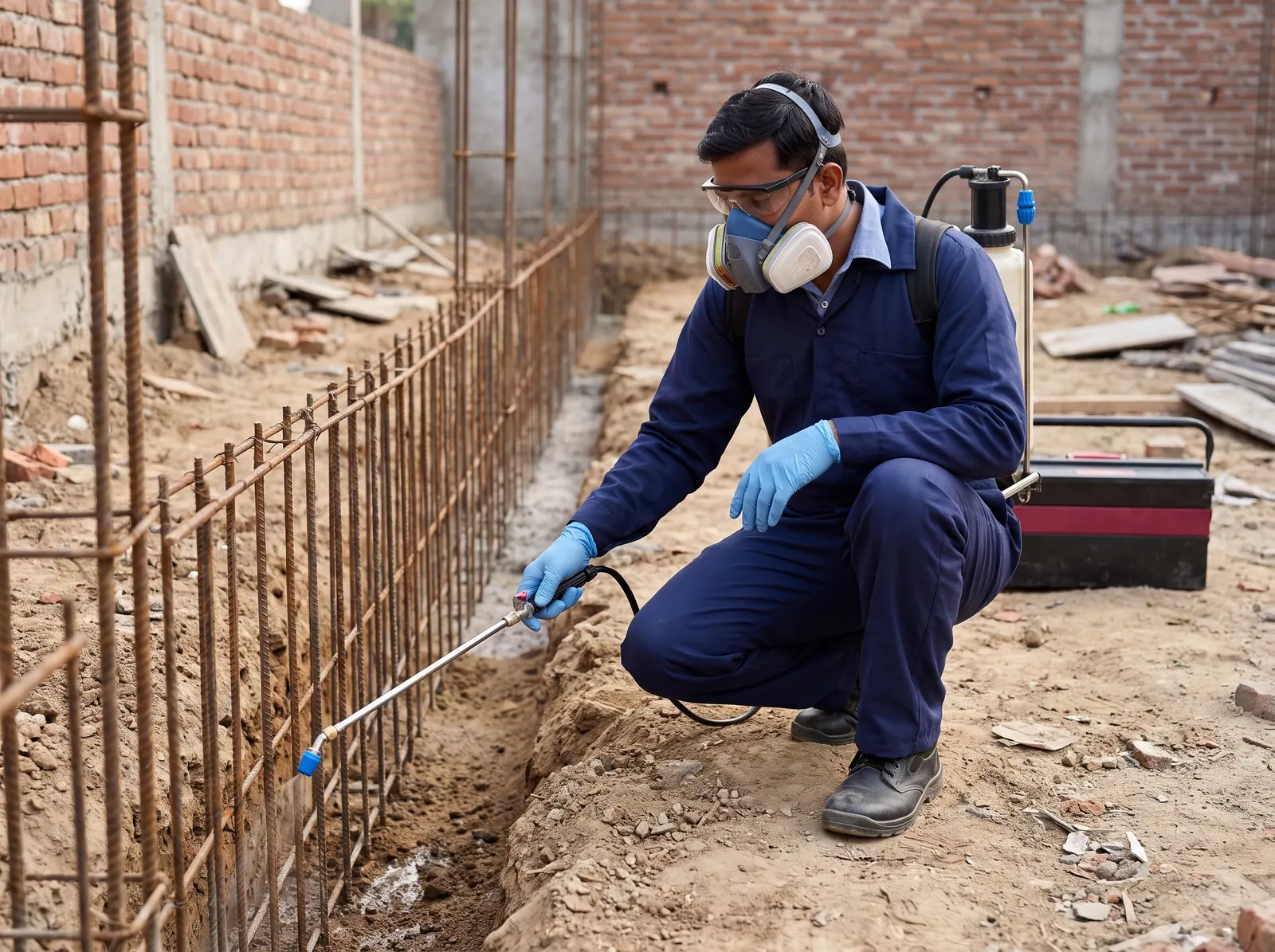
Pre-construction anti-termite treatment in Goa means treating the soil in stages while a building goes up. The stages are foundation trenches and pits, backfill, the compacted plinth fill, and junctions just before flooring, broadly following IS 6313 (Part 2). Our Goa branch plans each visit around your construction schedule and the monsoon, because waterlogged soil and heavy rain reduce effectiveness. We share a service report after every stage for your records.
Key points
- Pre-construction anti-termite treatment is applied to the soil in stages: foundation trenches, backfill, plinth fill, before flooring and along the external perimeter.
- The Indian Standard IS 6313 (Part 2) covers anti-termite measures in buildings during construction.
- Waterlogged soil and heavy rain soon after application reduce how well soil treatment works, so monsoon timing matters in Goa.
- Builders should keep dated stage records, marked drawings, product registration details, photographs and service reports.
- Soil disturbed after treatment, for example by plumbing trenches, should be re-treated before it is covered.
Pre-construction anti-termite treatment in Goa creates a treated soil barrier beneath and around a new building before it goes up. Subterranean termites live in the soil. They travel up through cracks, joints and service openings to reach timber, paper and other cellulose. Treating the soil at the right construction stages is far easier and more thorough than trying to reach the same soil once floors and walls are in place.
This page is for plot owners, builders and site engineers planning a house, villa, housing project or commercial building in Goa. It covers four things:
- the stages at which our Goa branch in Chimbel treats the soil
- how the monsoon and local ground conditions affect timing
- how to keep the site safe during treatment
- which records to keep for the life of the building
What does pre-construction treatment involve?
The work broadly follows the Indian Standard IS 6313 (Part 2), which covers anti-termite measures in buildings during construction. A termiticide solution is applied to the soil in stages as the foundation and plinth are built. The finished structure then sits on, and within, treated ground.
Our Goa operation is a licensed pest control operator under the Directorate of Agriculture, Goa. We use only CIB&RC-registered products, applied according to their label directions.
We work to an Integrated Pest Management approach, so we also look at problems a chemical barrier cannot solve on its own. These include timber offcuts and formwork buried on site, poor drainage near the plinth, and gaps around pipes and conduits. Our termite control service overview describes the full range of termite work we carry out.
Which construction stages need soil treatment?
Each stage treats soil that will soon be covered by concrete or fill and cannot easily be reached again. The table shows the typical sequence. The exact plan depends on your foundation design.
| Stage | When to call us | What is treated |
|---|---|---|
| Foundation trenches and column pits | After excavation is complete, before PCC or footing concrete is laid | Bottom and sides of trenches and pits |
| Backfill | As earth is returned around footings, columns and plinth walls | Backfilled soil, treated as it is placed |
| Plinth filling | After the plinth is filled and compacted, before the floor bed | Top surface of the compacted fill inside the plinth |
| Before flooring | Just before sub-floor concrete is cast | Wall-floor junctions, service pipe and conduit entry points, and any fill disturbed since the plinth visit |
| External perimeter | After the plinth is complete, before final paving or landscaping | Soil along the outside of the plinth walls |
Why the stages depend on each other
A barrier is only as good as its weakest point. Plumbing or electrical trenches are sometimes dug through treated plinth fill after our visit. If that happens, the disturbed soil should be treated again before the floor is cast.
Tell your site team to report these changes, and tell us before the flooring stage. Leftover timber, roots and cardboard should be cleared from trenches before treatment, because buried cellulose can feed a termite colony right beside your foundation.
How do Goa’s monsoon and laterite ground affect planning?
Rain and wet soil
Goa’s south-west monsoon brings very heavy, sustained rain, roughly from June to September. Soil treatment needs ground that can absorb the solution. Waterlogged trenches and saturated fill do not take up treatment evenly. Heavy rain soon after application can also wash the solution away before it settles into the soil.
- Pump out standing water and let trenches drain before a treatment visit.
- Avoid scheduling a visit just before heavy rain is expected. We may advise postponing if conditions are unsuitable.
- Where practical, cover the treated area or move on to the next construction step promptly.
- If a treated trench floods before concrete is placed, tell us so we can reassess.
- If you plan foundations for the dry months, share your timeline early. If work continues into the monsoon, we plan visits around breaks in the rain.
Laterite and mixed ground
Laterite is widespread in Goa, both as the ground many plots sit on and as the local building stone. Site conditions still vary a great deal. Some plots have hard laterite and gravel, others looser or more clayey soil. Imported backfill can be quite different from the original ground.
How soil absorbs a treatment depends on its texture and moisture. For that reason, our technician checks the actual trenches and fill at each visit rather than assuming one approach suits every plot.
How do we coordinate with your construction schedule?
Pre-construction work succeeds when the treatment visits fit the site programme and do not hold it up. A typical project runs like this:
- Share details early. Send the site location, approximate built-up area, foundation drawings and expected excavation date.
- Plan the stages. We review the plans, list the treatment stages for your design and prepare a quotation.
- Give stage notice. Your site engineer tells us as soon as each stage is nearly ready, so the visit can be scheduled without delaying concreting or filling.
- Prepare the site. Trenches should be at final level, free of debris, timber and roots, and drained. Plinth fill should be compacted before its treatment.
- Treat and report. A client representative or site supervisor accompanies our technicians during each visit. Afterwards we share a service report, with updates over WhatsApp.
- Protect the treated soil. Brief workers not to dig into or remove treated soil. If it is disturbed, let us know before it is covered.
For a wider view of where termite work fits into a project, see our builder’s guide to anti-termite treatment for new construction in Goa.
What records should a builder keep?
Good records protect you if questions come up years later. A buyer, a housing society or a pest control technician may want to know what was done, where and when. Keep these together in your project file:
- The date of each treatment stage, matched to your construction log
- The areas treated at each stage, marked on a copy of the foundation or plinth drawing
- The product name and CIB&RC registration details as shown on the label
- Ground and weather conditions at each visit, such as dry, damp or after rain
- Photographs of each treated stage taken before concrete or fill covers it
- The service reports we share after each visit
- The service agreement, including any warranty terms and their exclusions
- Material Safety Data Sheets for the products used, for your site safety file. We maintain these and can share them on request.
If you are building flats or villas for sale, a tidy file like this is easy to hand over to buyers or the society at completion.
How is the site kept safe during treatment?
- Only our technicians handle and apply products, following label directions.
- Workers and visitors stay out of the area being treated until it has dried or for as long as we advise.
- Keep children and pets away from the site during and after treatment.
- Tell us about any open well, water tank, sump or drain on or next to the plot so we can plan around it.
- No eating, drinking or smoking in the treatment area. Wash hands after work.
- If anyone feels unwell after exposure, they should see a doctor promptly.
Will the building still need post-construction treatment later?
Pre-construction treatment is the simplest chance to get soil treatment right, because every surface is still open. It does not protect the building forever on its own. Later extensions, compound walls, new plumbing lines and garden digging can all break through the treated soil.
Our guide on how long anti-termite treatment lasts explains what affects its life. If your project has already reached floor level, or termites appear in a finished building, the route is post-construction termite treatment using drill-fill-seal. For lawns, trees and landscaped areas around a new building, see garden and landscape termite treatment.
Where a warranty applies, it covers the treated area, and its terms are set out in the service agreement. Read the exclusions before work starts, for example structural changes made after treatment or post-service instructions not being followed.
Planning a building project in Goa?
Our Goa branch in Chimbel offers termite control, including pre-construction soil treatment, in the areas listed in our records. These include Panaji, Margao, Vasco da Gama, Mapusa, Porvorim, Ponda, Calangute, Candolim and Baga, and the localities around them. You can check the full list on our areas we serve page. If your plot is elsewhere in Goa, ask us and we will tell you whether we can help.
The best time to get in touch is before excavation starts. Contact our Goa branch with your site location, approximate built-up area, foundation drawings and planned start date, and we will work out a stage-by-stage plan that fits your schedule.
Frequently asked questions
QOur footings are already poured. Is it too late for pre-construction treatment?
Not entirely. If the plinth has not yet been filled, the backfill, plinth fill, pre-flooring and external perimeter stages can still be treated, even though the trench stage has passed. Once floors are cast, soil treatment has to be done by drilling through the floor and along walls instead. That is post-construction treatment. Tell us exactly how far construction has reached and we will advise which stages are still possible.
QCan soil treatment be done during Goa’s monsoon?
It can, but it needs careful timing. Treatment should not be applied to waterlogged trenches or saturated fill, or just before heavy rain, because the solution may not soak in evenly or may wash away. If your work continues through the monsoon, drain trenches before each visit and give us early notice. Where practical, cover treated areas or move on to concreting promptly. We may suggest postponing a visit if conditions are unsuitable.
QWhat do you need from us before the first site visit?
Please share the plot location, approximate built-up area, foundation drawings and your expected excavation date. It also helps to know the name of the site engineer or supervisor who will coordinate with us, and whether there are wells, water tanks or drains on or next to the plot. With this we can list the treatment stages for your design and prepare a quotation.
QIs there a warranty on pre-construction anti-termite treatment?
For specific services, a warranty applies to the treated area, as set out in the service agreement. Terms vary by treatment, and exclusions apply, such as structural changes after treatment or post-service instructions not being followed. Please read the agreement before work starts and keep it in your project file with the service reports, so the terms are clear to you and any future owner.
QIs the treatment safe for construction workers on site?
Our technicians apply CIB&RC-registered products according to their label directions, and we maintain safety data sheets for the products we use. Workers should stay out of the area being treated until it is dry or for as long as we advise. They should avoid eating or drinking there and wash their hands after work. Anyone who feels unwell after exposure should see a doctor.
QWhich parts of Goa do you cover for pre-construction treatment?
Our Goa branch in Chimbel covers the towns and localities in our records. These include Panaji, Margao, Vasco da Gama, Mapusa, Porvorim, Ponda, Calangute, Candolim and Baga, and the localities around them. For sites outside these areas, share the exact location with us and we will confirm whether we can take on the work.
Last updated 13 October 2026. Information on this page is general guidance; your technician will advise on your specific property after inspection.