Quick answer
Efficacy Pest Control's Goa branch provides wood borer treatment in Porvorim, including Alto Porvorim, Socorro, Sangolda and Penha de França. A technician first inspects for fresh powder and exit holes to confirm the borers are active and rule out termites. Affected furniture, doors, frames or timber is then treated where the larvae feed, followed by moisture and storage advice. The price is quoted after inspection.
Key points
- Fresh, pale powder that reappears after cleaning usually means wood borer larvae are still active.
- Wood borer and termites need different treatments; mud tubes point to termites.
- Household surface sprays seldom reach larvae feeding deep inside wood.
- The Goa branch covers Porvorim, Alto Porvorim, Socorro, Sangolda and Penha de França.
- Quotes follow an inspection, and any warranty covers the treated area as set out in the service agreement.
Wood borer treatment in Porvorim: what it covers
Small round holes in a cupboard, a little heap of fine powder under a bed or door frame, or a shelf that has started to sag. These are the usual reasons people in Porvorim ask about wood borer treatment. Our Goa branch in Chimbel treats furniture, doors, window and door frames, and structural timber affected by powder-post and furniture beetles.
Every job starts with an inspection. We confirm whether the borers are still active and check that the damage is not actually termites. Then we treat only the pieces and areas that need it. You receive a service report after the visit, along with practical advice on moisture and storage so the problem is less likely to return.
Is it wood borer, and is it still active?
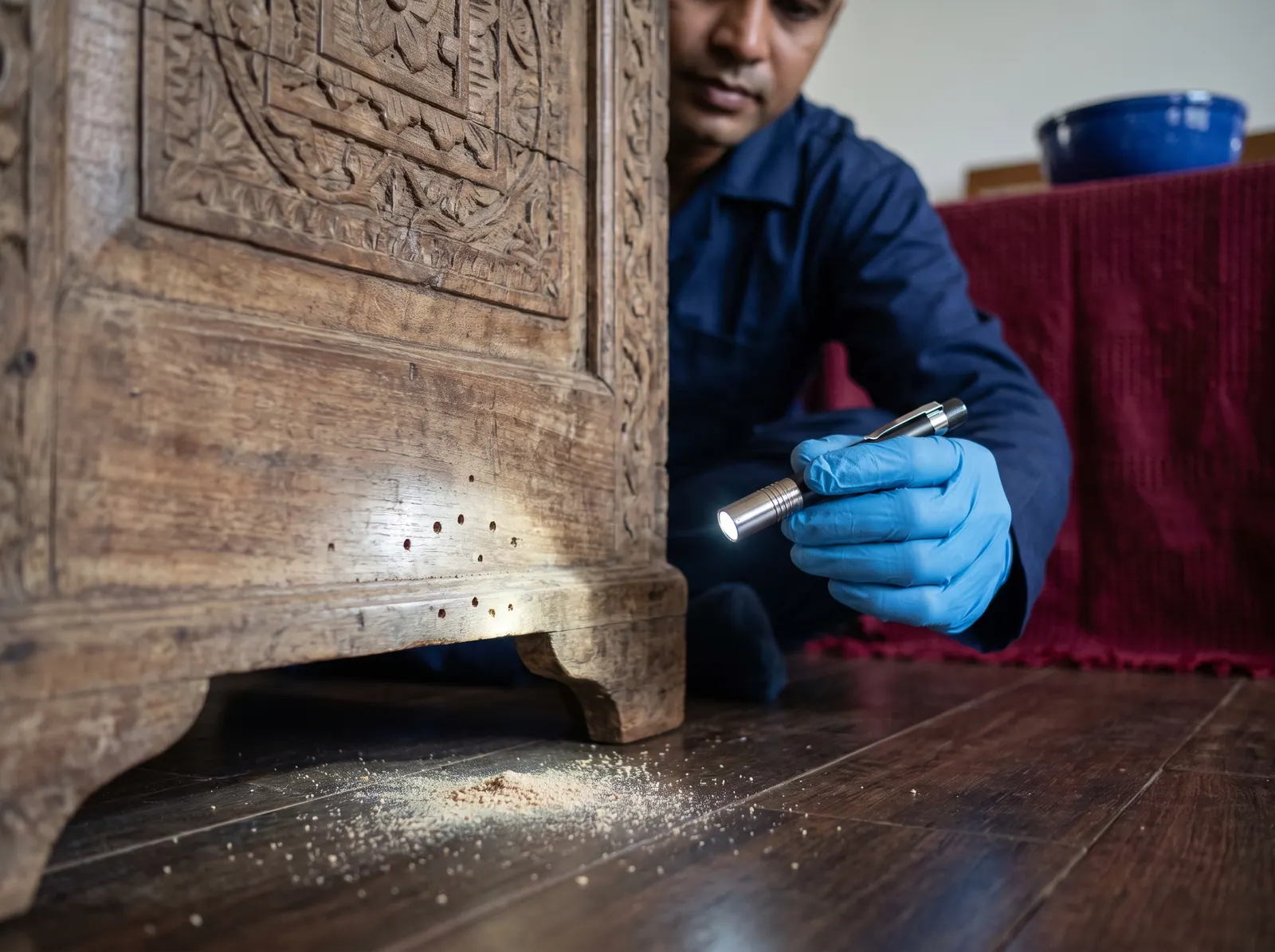
Wood borers are beetles whose larvae live inside wood. They feed and tunnel for months before the adults chew their way out. The round exit holes and the fine, flour-like powder (called frass) are the signs you see. Most of the damage is hidden inside.
- Neat, round, pin-sized holes on the surface, often on unpolished backs, edges and undersides
- Fine, pale powder collecting below the wood that returns after you clean it
- A hollow or soft feel when you press or tap the wood
- Loose joints, crumbling edges or shelves that bend under normal weight
Old holes do not always mean there is a current problem. Here is a simple check: wipe away all the powder, then look again after a week or two. Fresh, light-coloured powder means the larvae are still feeding. Dark, settled dust with no new powder may be old damage that only needs filling and polishing.
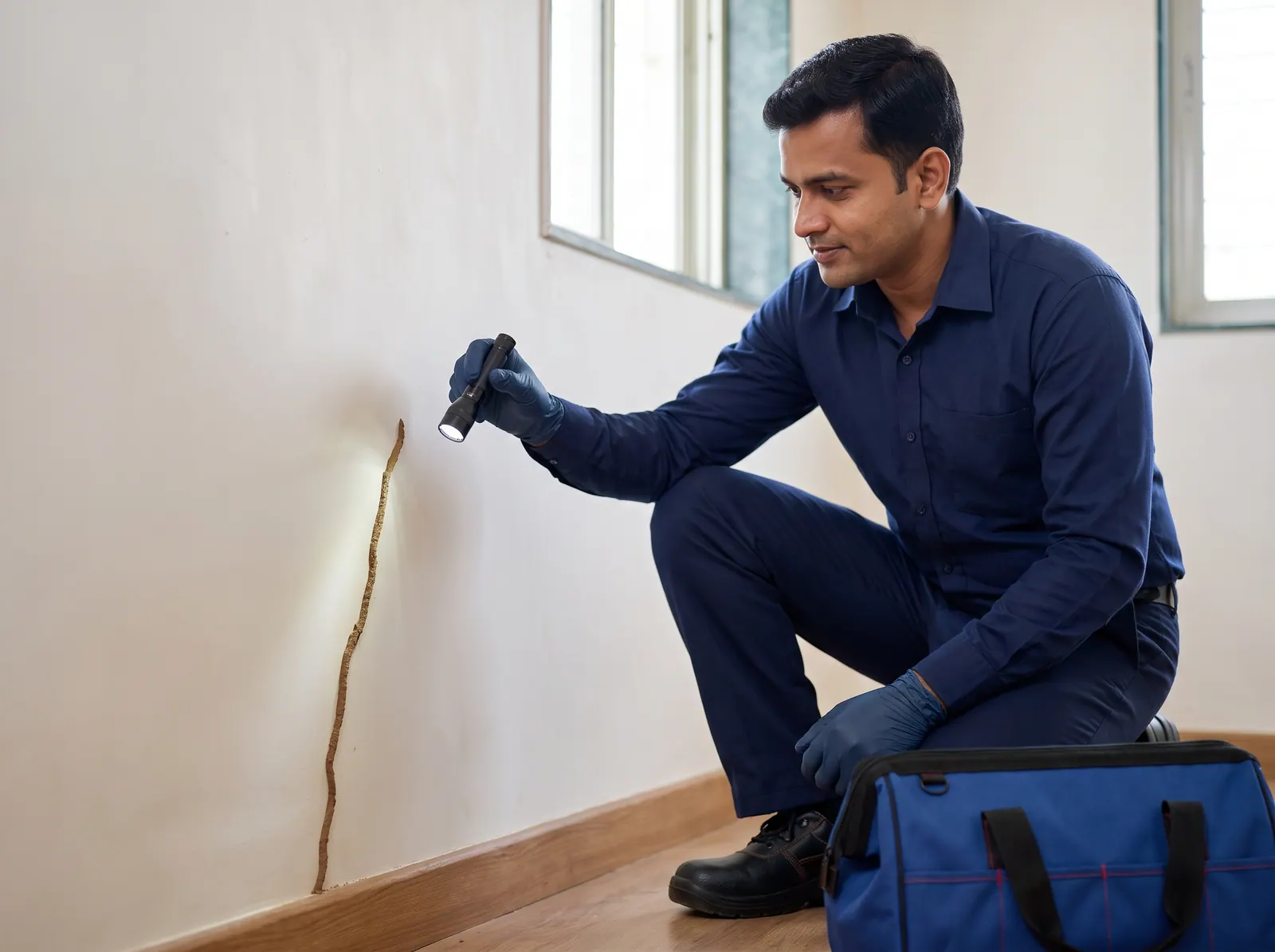
Termites behave differently. They usually travel through mud tubes, leave soil-like material in their galleries, and can spread from the ground into walls, frames and furniture. If you see mud lines, you need termite treatment rather than borer treatment. Read how to tell termites from wood borer, or see our page on termite control in Porvorim.
Where does wood borer show up in Porvorim properties?
Porvorim sits across the Mandovi from Panaji. It has a mix of apartment blocks and housing societies, independent houses and villas, and offices and shops along its main roads. Older village homes are common in Socorro, Sangolda and Penha de França.
Each type of property has its own weak spots. Goa's long, humid south-west monsoon also keeps woodwork damp for months, and several kinds of borer thrive in those conditions.
| Property type | Woodwork we check first | Why it matters |
|---|---|---|
| Flats in housing societies | Wardrobes, bed boxes, modular kitchen carcasses, door frames | Plywood and board backs are often unpolished, and cupboards against bathroom or external walls stay damp |
| Independent houses and villas | Main doors, window frames, staircases, wooden ceilings, inherited furniture | Large timber pieces can hold activity for a long time before it shows |
| Older homes in the villages around Porvorim | Roof rafters, beams, old almirahs and chests | Old timber and antique furniture may carry earlier infestations |
| Offices and shops | Display units, storage racks, wooden partitions, stored pallets | Wood that is stacked or rarely moved goes unnoticed |
New furniture is not automatically safe. Borers can arrive in untreated timber or plywood and only emerge months later. If you have just moved into a flat or renovated, check the new woodwork during its first year, especially after the monsoon.
If you own heirloom pieces, our guide to wood borer in teak and rosewood furniture explains what to look for.
How do we treat wood borer in an occupied home or office?
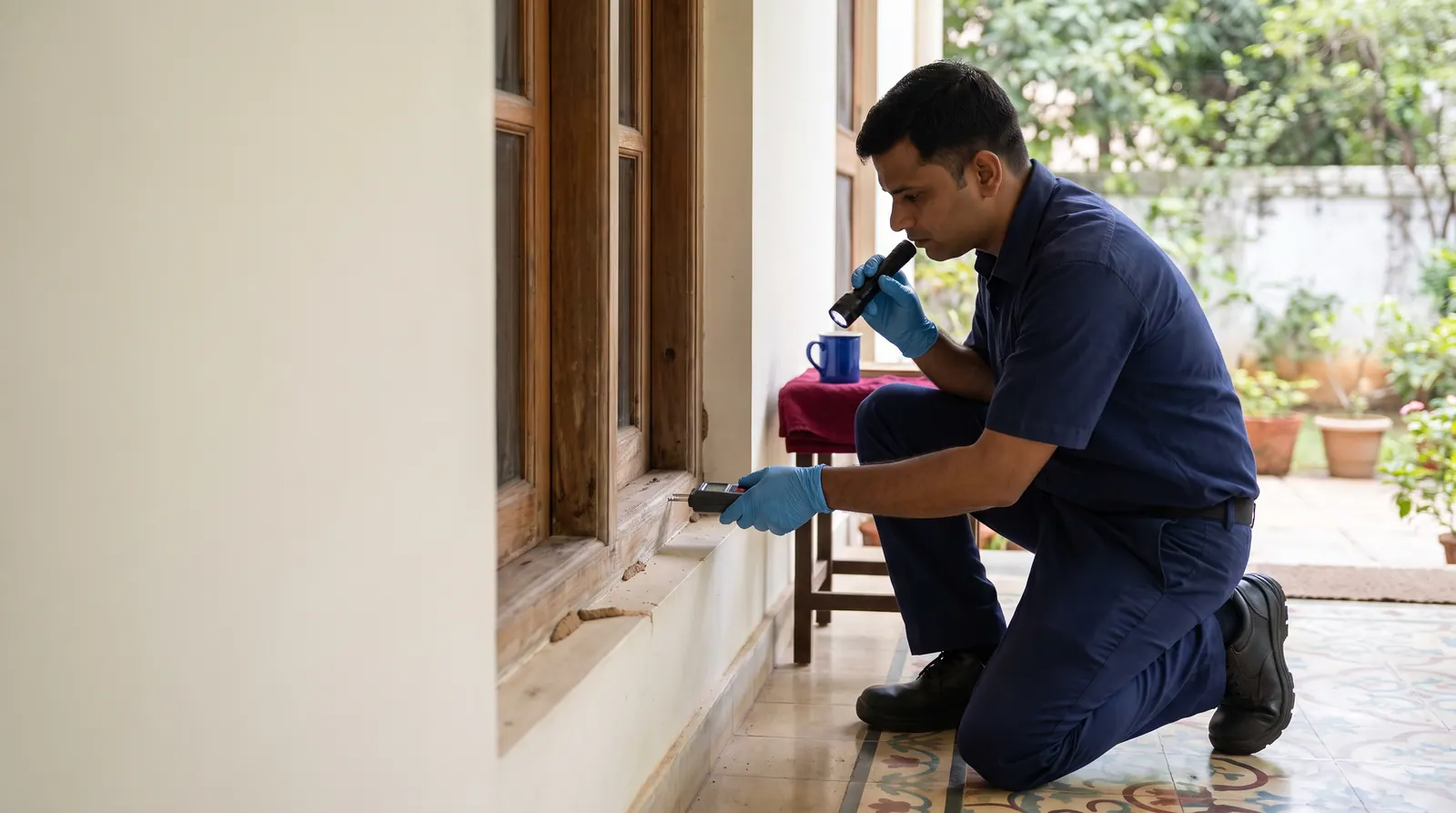
- Inspection: The technician checks holes, powder and soft spots, then taps and probes the wood. They note which pieces show active signs. Hidden areas get particular attention, such as cupboard backs, bed undersides, joints and frame edges.
- Finding the cause: We look for conditions that keep the problem going. These include damp walls, seepage, wood touching the floor and wood stored in wet corners.
- Agreeing the scope: You are told which items need treatment and which only need monitoring. We also tell you if any timber is too weak to save and should be seen by a carpenter.
- Targeted application: Treatment goes into exit holes and galleries and onto bare, unpolished surfaces. This way it reaches where larvae feed instead of just coating the outside. We use CIB&RC-registered products and follow label directions and safety data sheets.
- Fumigation where it fits: Fumigation may be the right method for heavily infested movable items, or where surface treatment cannot reach. It is planned separately because the items or space must be sealed.
- Report and aftercare: You receive a service report and clear instructions. These cover drying time, when you can use the furniture again and what to watch for.
This follows our Integrated Pest Management approach: inspection first, then sanitation and proofing advice, then targeted treatment. For more about the method, see our main wood borer treatment service page.
What should you do before the technician arrives?
- Avoid spraying household insecticides. Surface sprays rarely reach larvae deep inside the wood, and some can stain or damage polish.
- Do not move infested pieces into other rooms or next to sound furniture. Leave them where they are, or move them slightly apart from other items if you can.
- Leave some powder in place, or photograph it before cleaning. It helps us judge how active the infestation is.
- Empty the cupboards and drawers that need treatment, and clear space around beds and frames.
- Note any seepage or damp walls near the affected furniture.
Is wood borer treatment safe with family and pets at home?
We are a licensed pest control operator (Directorate of Agriculture, Goa) and use CIB&RC-registered products. We maintain Material Safety Data Sheets for the products we use. The technician will explain any precautions for your home before starting.
As a general rule, keep children and pets away from treated furniture and areas until surfaces are dry, or for as long as the technician advises. Keep rooms ventilated and avoid touching treated wood; wash your hands if you do. Put clothes, food and utensils back in cupboards only when you have been told it is fine. If anyone feels unwell after any pest treatment, see a doctor.
Which parts of Porvorim do we cover?
Our company records list Porvorim and these nearby localities as covered by the Goa branch:
- Alto Porvorim
- Socorro
- Sangolda
- Penha de França
If you live just across the river, see our page on wood borer treatment in Panaji. Further north, there is a page on wood borer treatment in Mapusa. For other pests in the area, see pest control in Porvorim.
How is the cost worked out, and is there a warranty?
There is no fixed rate, because jobs vary a lot. The quote depends on four things:
- the number of items
- the type and size of the woodwork
- how far the infestation has spread
- whether fumigation is needed
We confirm the scope after inspection, so you pay only for what actually needs treatment.
For specific services, a warranty applies to the treated area, as set out in your service agreement. It does not cover infested furniture brought in later, structural changes or cases where the post-service instructions were not followed.
To get started, contact our Goa branch in Chimbel. Tell us your locality in Porvorim and what you have noticed, and send a few photos of the holes and powder. We will suggest the next step, which is usually an inspection visit.
Frequently asked questions
QWill the borer holes disappear after treatment?
No. Treatment targets the insects inside the wood, so existing exit holes stay. Once activity has stopped, a carpenter or polisher can fill the holes and refinish the piece. You can confirm this by checking that no fresh powder appears. In the first weeks after treatment, you may occasionally see a new hole or a little powder if an adult already close to the surface emerges. Let us know so we can check.
QCan laminated or polished furniture in my flat be treated?
Yes, in most cases. Polish, paint and laminate slow down how far treatment soaks in, so we focus on unfinished surfaces and on the exit holes themselves. Unfinished surfaces include backs, undersides, inner edges and joints. Many wardrobes and modular kitchens have bare plywood or board inside, which is often where borer starts. The technician will tell you if a piece needs a different approach or is too damaged to be worth treating.
QDo I need to leave my home during wood borer treatment?
For furniture and frame treatment, most families do not need to move out. You may be asked to keep certain rooms clear and ventilated until surfaces dry. Fumigation is different: the items or space must be sealed and kept unoccupied for the period the technician specifies. You will be told exactly what applies to your job before work begins.
QDo you treat older homes in Socorro, Sangolda and Penha de França?
Yes, these localities are covered by our Goa branch. Older homes often have roof timber, beams and heirloom furniture, so the inspection takes in more than the obvious pieces. If any timber is structurally weak, we will say so plainly and suggest you involve a carpenter. Treatment stops the insects, but it cannot restore strength the wood has already lost.
QHow often should woodwork be checked after treatment?
It depends on the property and on what the first visit found. A sensible habit is to look over treated pieces after each monsoon, since the damp months favour borers. Businesses and larger homes sometimes prefer an annual maintenance contract, which includes scheduled visits and service reports. Ask us whether that suits your premises.
QCan offices and shops in Porvorim get service records?
Yes. We share a service report after each visit, recording what was inspected and treated. This helps facility managers keep track of woodwork across racks, partitions and fittings. Restaurants and other food businesses can also ask for documentation aligned with HACCP and FSSAI audit expectations as part of a wider pest management programme.
QWhat details should I share when I contact you?
Share your locality, such as Alto Porvorim or Socorro, and the type of property. Tell us which items are affected and send a few clear photos of the holes and any powder. Mention whether the furniture is new, inherited or recently moved, and whether there are damp walls nearby. This helps the team plan the inspection properly.
Last updated 13 October 2026. Information on this page is general guidance; your technician will advise on your specific property after inspection.