Quick answer
Small dark beetles with a pointed snout in your rice are usually rice weevils. In Goan kitchens they are often joined by flour beetles, grain moths and spice beetles, all of which multiply faster in warm, humid months. Remove and check every packet, discard heavily infested food, vacuum and dry the shelves, and store dry goods in airtight containers. Seek professional help if pests keep returning after a thorough clean-out.
Key points
- Rice weevils lay eggs inside individual grains, so infestations often arrive hidden in newly bought rice.
- Pantry pests develop faster in warm, humid conditions such as Goa's monsoon months.
- Airtight containers, smaller purchases and using older stock first prevent most pantry infestations.
- A full clean-out means checking every item, discarding infested food, vacuuming cracks and drying shelves completely.
- Household insecticide sprays and fumigant tablets should never be used on food shelves or stored food at home.
What are the small insects in my rice?
If you have opened a dabba of rice and found tiny dark-brown beetles with a long, pointed snout, you are most likely looking at rice weevils. Finding a rice weevil in a Goa kitchen is very ordinary, especially after the monsoon sets in, and it does not mean your home is dirty. The female lays eggs inside individual grains, the larvae feed hidden inside, and adults chew their way out, leaving small round holes and powdery dust.
Rice weevils rarely travel alone. The same cupboard can hold flour beetles in the atta, moths webbing the cashews and tiny beetles boring into spices. This guide explains how to tell them apart, why humidity makes them worse, how to clean out a pantry properly and when it is worth getting professional help.
Which pantry pests are you likely to find in a Goan kitchen?
Stored-product pests are a group of small insects that live in dry foods rather than around them. Knowing which one you have tells you where to look and what to throw away.
| Pest | What it looks like | Foods it favours | Typical signs |
|---|---|---|---|
| Rice weevil | Small dark-brown beetle with a distinct snout | Whole rice, wheat, other whole grains | Hollowed grains with exit holes, fine powder, adults walking on the container lid |
| Lesser grain borer | Small, cylindrical dark beetle, head tucked under its body | Whole grains, rice, wheat | Lots of floury dust, grains bored through |
| Flour beetles (red or confused flour beetle) | Flat, reddish-brown, slightly larger than a weevil, no snout | Atta, maida, rava, besan, broken grain, biscuits | Flour turns greyish, may smell sharp or musty; beetles in cupboard corners |
| Saw-toothed grain beetle | Slim, flat brown beetle with tiny ‘teeth’ along the sides | Dried fruit, nuts, cereals, flour | Beetles in sealed-looking packets, often in cashews and raisins |
| Pulse beetles | Small, rounded, mottled beetles | Dals and whole pulses such as chana and moong | Round holes in individual pulses, beetles flying out when the jar is opened |
| Indian meal moth and rice moth | Small moths; cream-coloured caterpillars | Cashews, dried fruit, cereals, rice, poha | Silky webbing, clumped food, small moths fluttering in the kitchen at dusk |
| Cigarette and drugstore beetles | Tiny, rounded, light-brown beetles | Chilli powder, turmeric, whole spices, dried herbs, tea | Pinholes in spice packets, fine dust at the bottom of jars |
| Flour mites | Barely visible pale specks | Damp flour, grain, cereals | Flour that seems to ‘move’, a sweetish or minty musty smell |
Cashews, dried fish and other Goan stores
Many Goan households keep cashews, raisins, kokum, dried chillies and dried fish or prawns for months. Nuts and dried fruit attract meal moths and saw-toothed grain beetles. Dried fish and other dried animal products can attract larder or hide beetles, whose hairy larvae may also wander into other cupboards. Store these items separately and check them as often as your grains.
If the insects you are finding are not in the food at all, they may be something else. Tiny pale insects on damp walls and old papers are often booklice, described in our guide to silverfish and booklice in humid Goan homes, while trails of ants to a sugar jar need a different approach, covered in ants in Goa kitchens during the monsoon.
Why do pantry pests get worse in the humid months?
Stored-product insects develop faster when it is warm and their food is slightly moist. Goa's heavy south-west monsoon and humid coastal air mean that rice, flour and spices kept in ordinary bags or loosely closed tins slowly absorb moisture. Damp grain also encourages mould and flour mites, which add to the problem.
Kitchens make this worse in predictable ways. Cupboards against an outer wall, under the sink or beside the cooking range stay warmer and damper than the rest of the house. If a wall has seepage, the cupboard in front of it will too; our guide to damp walls and pests in Goan homes explains how to spot and deal with that moisture. For a wider view of what the rainy season brings, see monsoon pests in Goa from June to September.
How should you store rice, flour, spices and cashews in Goa?
Good storage prevents most pantry infestations and limits the damage when one starts. The aim is to keep food dry, sealed and turned over regularly.
- Use airtight containers. Glass jars, steel dabbas with tight lids or food-grade plastic containers with seals keep insects out and moisture down. Paper and thin plastic bags do neither.
- Buy what you will use. Large stocks bought before the monsoon sit for months in humid air. Smaller quantities, used within a few weeks, give insects less time to build up.
- Check purchases on arrival. Look for holes, webbing, dust or live insects before decanting. Many infestations come home already inside the grain.
- First in, first out. Finish older stock before opening new, and never top up an old container with fresh grain without emptying and cleaning it first.
- Keep stores cool and off damp surfaces. Choose a shelf away from the stove, sink and outer walls, and keep sacks raised off the floor.
- Refrigerate or freeze small, slow-use items. Specialty flours, nuts, dried fruit and whole spices keep better in the fridge in sealed containers during the monsoon.
- Dry, do not wash, before storing. Grains that are washed should be cooked, not returned to the jar. Sun-drying grain on a clear day before storing is a common local habit and helps keep it dry.
Many families add dried neem leaves, bay leaves or whole red chillies to grain. These traditions do no harm, but they are not a reliable substitute for airtight containers, quick turnover and regular checks.
How do you clean out an infested pantry?
Once you find pantry pests, assume they have spread to nearby packets. A thorough, one-time clean-out is far more effective than picking out insects week after week.
- Empty the whole cupboard. Take out every item, including spices, biscuits, pet food, birdseed and anything at the back of the shelf.
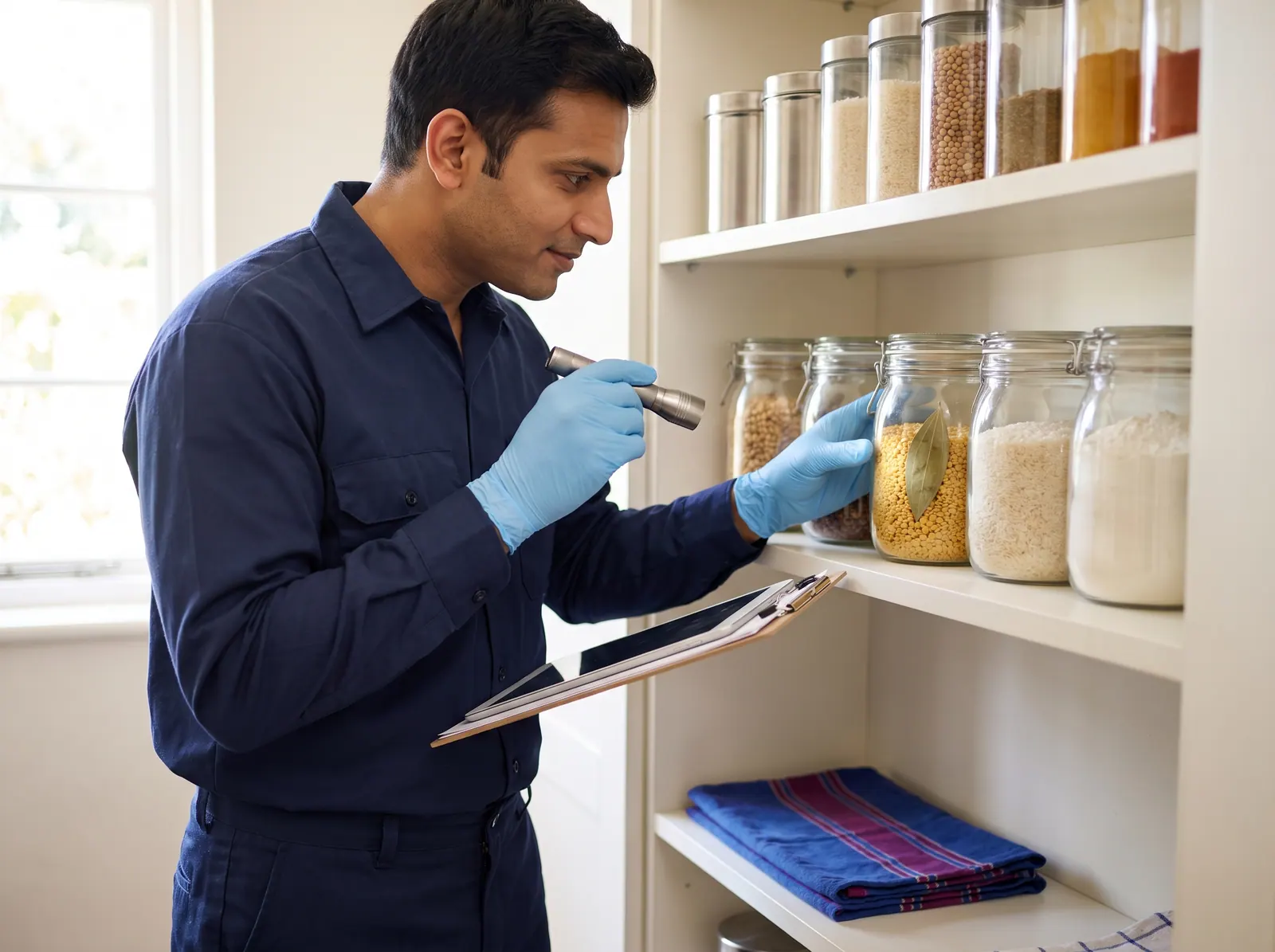
- Inspect each item. Look for live insects, holes, webbing, clumping, dust at the bottom of jars or an unusual smell. Open sealed packets too, as many pests chew through thin packaging.
- Discard what is clearly infested. Seal heavily infested, mouldy or musty food in a bag and remove it from the house the same day so insects cannot crawl back.
- Deal with doubtful items. Small quantities of food that look clean but sat beside infested packets can be sealed and kept in the freezer for several days, then allowed to return to room temperature before opening to avoid condensation.
- Vacuum the shelves. Pay attention to corners, shelf joints, hinge gaps and cracks where flour dust and larvae collect. Empty the vacuum outside afterwards.
- Wash and dry everything. Wipe shelves with warm soapy water, wash containers and lids, and let everything dry completely before refilling. Moisture left behind invites mites and mould.
- Restock with checked food in sealed containers. Label containers with the date so you know which to use first.
- Monitor for a few weeks. Check the shelf every few days. A few stragglers emerging soon after a clean-out are normal; a steady stream is not. Pheromone-based moth traps can help show whether moths are still active, but they monitor rather than solve an infestation.
What should you avoid doing?
- Do not spray household insecticide on food shelves or into containers. It contaminates food and surfaces and does not reach larvae inside grains.
- Never use fumigant tablets or pellets at home. They release highly toxic gas and are meant only for trained, licensed operators working under controlled conditions.
- Do not mix old and new stock. Topping up a jar simply passes the infestation to the new grain.
- Do not ignore mould. Grain or flour that is mouldy, discoloured or musty should be thrown away, not sieved and used. If anyone feels unwell after eating food you suspect was spoiled, see a doctor.
When is it time to get professional help?
Most household pantry problems are solved by a careful clean-out and better storage. It is worth asking for an inspection when:
- Insects keep returning after two or more thorough clean-outs.
- Beetles or moths are turning up in several rooms, not just one cupboard.
- Pests are living in the structure itself, such as cracks in old wooden cupboards, wall gaps or a false ceiling above the kitchen.
- You are seeing signs of other kitchen pests at the same time, such as droppings or gnawed packets, which point to rodents (see identifying rodents around Goan homes).
- You run a food business, bakery, hotel store or warehouse holding bulk grain, flour, nuts or spices.
For bakeries, restaurants and other food businesses, stored-product pests are also a hygiene and audit issue. Raw-material stores need regular inspection, stock rotation and documented pest management that fits FSSAI Schedule 4 hygiene requirements and HACCP plans. Our guide to pest control for Goan bakeries covers this in more detail.
How do we approach pantry pest problems in Goa?
Our Goa branch follows an Integrated Pest Management approach: we start with an inspection to identify the pest and where it is breeding, give sanitation, storage and proofing advice, and use targeted treatment only where it is needed. In kitchens, food is removed or covered before any treatment of cracks and crevices, and nothing is applied to food itself.
We are a licensed pest control operator with the Directorate of Agriculture, Goa, and use CIB&RC-registered products, with Material Safety Data Sheets maintained for the products we use. Service reports are shared after visits, and for food businesses we provide documentation aligned with HACCP and FSSAI audit expectations. Where stored goods or consignments genuinely need fumigation, that is handled as a specialist service with the appropriate precautions.
If pantry pests keep coming back in your home or business, contact our Goa branch in Chimbel. Tell us where you are, what you are finding and in which foods, and we will advise on the next step. You can also reach us through our contact page.
Frequently asked questions
QIs rice that had weevils in it still safe to cook?
Many households sieve and wash lightly affected rice before cooking, but this is a judgement call. Rice that is heavily infested, powdery, clumped, discoloured, mouldy or musty-smelling should be thrown away rather than salvaged. If you are unsure, discard it. If anyone feels unwell after eating food you suspect was spoiled, please see a doctor rather than treating it at home.
QWhere do weevils come from if the rice bag was sealed?
Rice weevils lay their eggs inside individual grains, so an infestation can already be present when you buy the rice, long before you see adults. Warm, humid storage at home then lets the hidden larvae develop and emerge. Adults can also enter loosely closed containers from another infested packet nearby, which is why checking new purchases and using airtight containers matter so much.
QDo neem leaves or dried chillies keep pantry pests away?
Adding dried neem leaves, bay leaves or whole red chillies to grain is a long-standing tradition in many Indian kitchens, and it does no harm. However, it should not be relied on as protection by itself. Airtight containers, buying smaller quantities, using older stock first and checking jars regularly during the monsoon do far more to prevent an infestation.
QDoes freezing kill weevils and flour beetles?
Freezing small quantities of flour, rava, nuts or spices in a sealed container for several days is a widely used way to kill insects and their eggs. Let the container return to room temperature before opening it, so moisture does not condense on the food. Freezing is practical for small amounts, not for large sacks of rice or bulk commercial stock.
QAre the moths in my kitchen the same as the ones in my wardrobe?
Usually not. Moths that fly around the kitchen at dusk are typically pantry moths whose caterpillars feed on cashews, dried fruit, cereals and rice, leaving silky webbing. Clothes moths are smaller, avoid light and feed on wool, silk and other natural fibres. If you find damage to clothes or carpets, check your wardrobes separately as well as your food cupboards.
QHow is pantry pest control different for a bakery or restaurant?
Food businesses hold larger quantities of flour, grain, nuts and spices, so a small problem can spread quickly and affect stock and audits. Control relies on goods-inward checks, stock rotation, clean stores, regular inspection and documented pest management that supports FSSAI and HACCP requirements. Our Goa branch can discuss scheduled programmes and service records for commercial kitchens and stores.
Last updated 13 October 2026. Information on this page is general guidance; your technician will advise on your specific property after inspection.