Quick answer
Office pest control in the Hyderabad region works best when a campus is treated as a set of zones rather than one building. Cafeterias and pantries need cockroach, fly and rodent control backed by good sanitation. Cable trays, false ceilings and server rooms need rodent monitoring and proofing, without sprays near equipment. Landscaped grounds need attention to termites, mosquitoes and burrows. Schedule treatments after hours and insist on clear, dated service reports.
Key points
- Campus pest management works best zone by zone: cafeterias, cable trays and server rooms, grounds, washrooms and stores.
- Rodents gnaw constantly because their incisors keep growing, putting cables in trays and ceiling voids at risk.
- Gel baiting and crack-and-crevice treatment are generally preferred over broad spraying in food areas.
- Cafeterias run by caterers are food businesses under FSSAI, and Schedule 4 hygiene requirements include pest control.
- Useful service reports record areas treated, pests seen, CIB&RC-registered products used, station readings and recommendations.
Office pest control in Hyderabad looks very different on a campus than in a single rented office. A modern office park, IT campus or industrial site can include cafeterias and vendor kitchens, floor pantries, server and electrical rooms, long runs of cable trays and false ceilings, loading bays, parking and large landscaped grounds. Each of these zones attracts different pests and needs a different approach.
This guide is for facility managers, admin teams and EHS staff who want to plan pest management properly. It covers the areas that carry the most risk, how to treat without disrupting work, and what a useful service report should contain.
Why should a campus be planned zone by zone?
Pests do not respect building boundaries. A rat sheltering in a landscaped bank can feed at the cafeteria bin yard at night and travel along a cable trench into the main block. Treating one area in isolation often just moves the problem somewhere else.
An Integrated Pest Management (IPM) approach suits campuses well: inspect first, fix the sanitation and entry points that are attracting pests, and then apply targeted treatment where it is actually needed. The table below summarises the main zones.
| Zone | Typical pests | Main concern | Typical measures |
|---|---|---|---|
| Cafeterias, pantries, food courts | Cockroaches, rodents, flies, ants | Food contamination, hygiene audits | Sanitation, gel baiting, crack-and-crevice treatment, external bait stations |
| Cable trays, false ceilings, server and electrical rooms | Rats and mice | Gnawed cables, faults, downtime | Monitoring, traps, sealing cable entries |
| Landscaped grounds and perimeter | Termites, ants, mosquitoes, rodents | Damage to timber and structures, breeding sites, burrows | Inspection, water management, perimeter bait stations |
| Washrooms, drains, utility shafts | Cockroaches, drain flies | Hygiene, occupant complaints | Drain cleaning, targeted treatment |
| Stores, loading bays, scrap yards | Rodents, cockroaches, birds | Damaged goods, open entry points | Door seals, housekeeping, bird-proofing |
Cafeterias and pantries: where most problems start
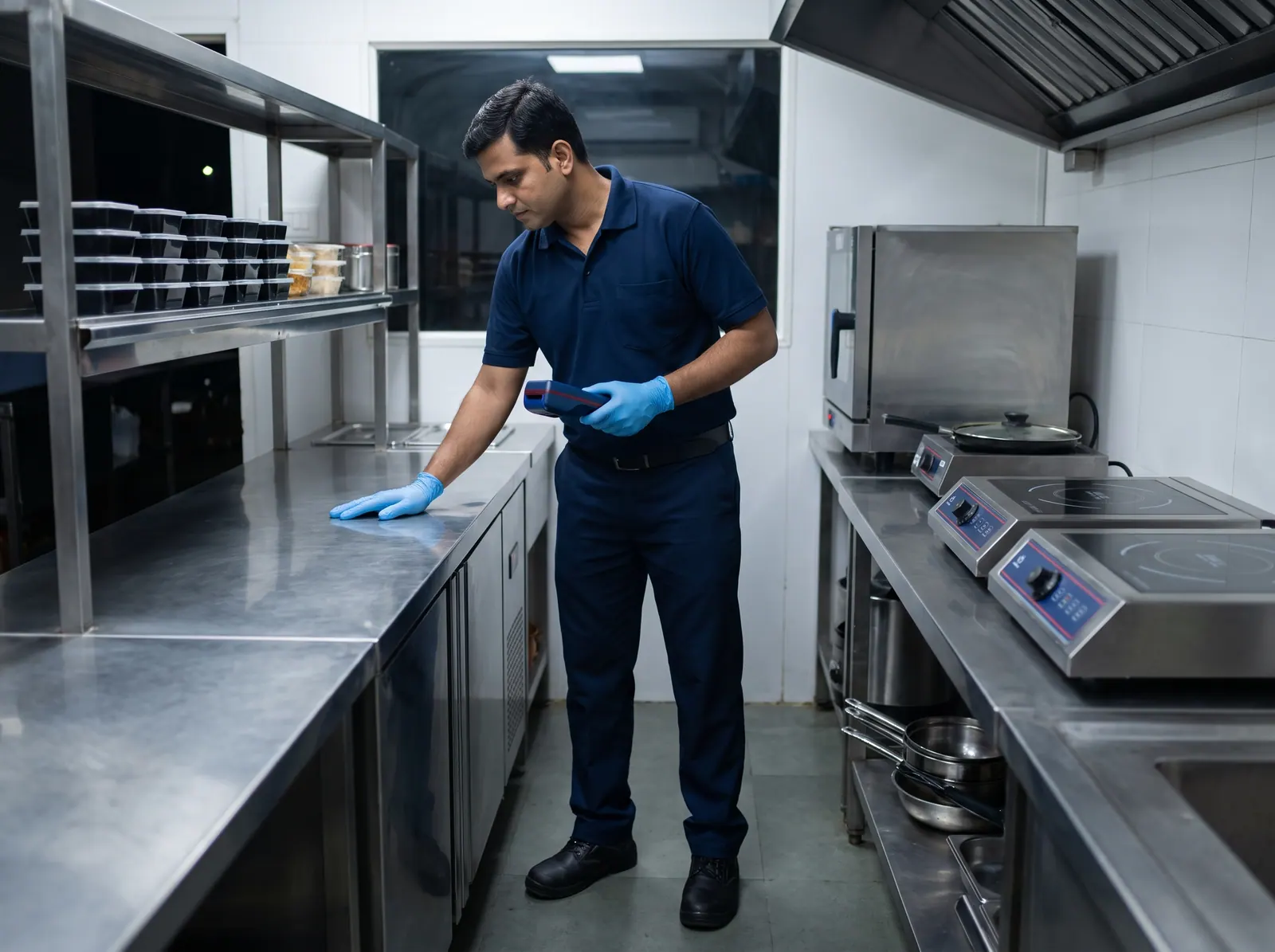
Cafeterias combine everything pests need: food, water, warmth and hiding places inside equipment. Cockroaches, especially the small German cockroach, live in motor housings, under counters, behind dishwashers and inside electrical boxes. Floor pantries with coffee machines, water dispensers and microwaves create the same conditions on a smaller scale, often spread across every floor.
Housekeeping makes the biggest difference. A practical checklist:
- Clean under and behind equipment, not only the visible surfaces.
- Repair leaking taps, dispenser trays and drain covers; moisture sustains cockroaches and drain flies.
- Empty and wash bins daily, keep them lidded, and site bin yards away from doors.
- Store food in sealed containers, and discourage staff from leaving food in desk drawers.
- Keep kitchen and service doors closed, and check that any screens or air curtains are working.
- Inspect incoming deliveries; cockroaches often arrive in cardboard cartons.
For treatment, gel baiting and targeted crack-and-crevice application are generally preferred over broad spraying, which can contaminate food-contact surfaces and scatter cockroaches into new areas. Our guide to German cockroaches in Hyderabad restaurant kitchens explains why these infestations build so quickly.
If your cafeteria is run by an outside caterer, it operates as a food business under FSSAI, and the Schedule 4 hygiene requirements include pest control. Agree in writing who arranges treatment in the kitchen and who keeps the records. Our article on pest control records for food businesses in Telangana covers what auditors usually look for.
Rodents in cable trays, false ceilings and server rooms
Rats and mice have incisors that grow continuously, so they gnaw constantly. Cable insulation, PVC conduit and fibre jackets are easy targets. Gnawed cables can cause short circuits, network outages and a fire risk. Cable trays, risers, raised floors and ceiling voids also give rodents quiet, connected routes through a building.
Signs to look for
- Droppings on cable trays, ceiling tiles or raised-floor panels.
- Gnaw marks on cables, conduits or ceiling board edges.
- Dark grease smudges along beams and trays where rodents run.
- Scratching sounds in ceilings during quiet hours.
- Unexplained network or electrical faults in one area.
- A persistent musty or decaying smell.
How should rodents be managed in sensitive areas?
- Inspect ceiling voids, risers, cable trenches and floor voids, with permission and an escort from the IT or electrical team.
- Inside buildings and near equipment, traps and monitoring devices are usually preferred over toxic baits, because a poisoned rodent may die in an inaccessible void and cause odour and flies.
- Place secured, numbered, tamper-resistant bait stations around the external perimeter, bin yards and loading areas.
- Seal gaps around cable penetrations, conduits and pipe entries, and coordinate any sealing with the fire-stopping requirements of your electrical and fire safety teams.
- Do not allow liquid sprays or fogging inside server rooms or near live equipment.
- Clear cardboard, packaging and clutter from electrical rooms and stores.
Campuses with warehouses or logistics operations face additional pressure from stored goods and frequent deliveries; see our guide to rodent risks in airport-area warehouses and logistics parks.
Landscaped grounds and the building perimeter
Lawns, hedges, mulch beds and water features make a campus pleasant, but they also harbour pests close to buildings. In Hyderabad's hot, dry summer, irrigated landscaping is often the only moist ground around, which draws ants, termites and rodents towards the buildings. During the monsoon, blocked drains, puddles, neglected water features and stacked materials can turn into mosquito breeding sites.
- Keep mulch and soil from piling up against building walls, and avoid timber in direct contact with soil.
- Check wooden pergolas, benches, planters and old tree stumps for termite mud tubes.
- Clean water features regularly and clear storm drains before the rains.
- Trim hedges and creepers back from walls and windows; they act as bridges for rodents, ants and lizards.
- Look for burrows along boundary walls, under slabs and near bin areas.
- Stack scrap, pallets and construction materials off the ground and away from buildings.
Small containers of water such as discarded cups, tyres and plant saucers are enough for the mosquitoes that spread dengue. Our page on dengue season mosquito prevention in Hyderabad has a practical checklist for grounds teams. Subterranean termites can also travel from landscaped soil into buildings through expansion joints and service entries; our guide to termite risk in Hyderabad soils and new construction explains how.
How does the season change campus pest pressure?
| Season | What to watch on a campus |
|---|---|
| Hot, dry summer | Pests moving towards irrigated landscaping, pantries and cool indoor spaces; ants and cockroaches around water sources |
| Monsoon | Mosquito breeding in drains and water features, flies near bins, rodents and insects pushed indoors by waterlogging |
| Mild winter | A good window for inspections, proofing work and grounds clean-up before the next summer |
For more on the rainy months, read monsoon pests in Hyderabad.
Planning after-hours and weekend servicing
Most campuses prefer treatments outside working hours so that staff are not disturbed and treated areas have time to dry or air out. That needs some planning on your side as well as the provider's.
- Agree a schedule with security, and arrange access passes and escorts for restricted areas such as server rooms.
- Coordinate with the HVAC team; some treatments need ventilation, and re-entry should follow label directions.
- Treat cafeterias after closing and before cleaning and preparation; cover or remove food and utensils, and clean food-contact surfaces before use as advised.
- If the campus has a crèche, keep children away from treated areas until they are dry or as advised.
- Inform occupants which areas were treated, and keep Material Safety Data Sheets for the products used available to your EHS team.
Anyone who feels unwell after a treatment, or after a bite or sting on the grounds, should see a doctor.
What should pest control reporting include?
For audits, EHS reviews and internal reporting, the record of a visit matters almost as much as the visit itself. A useful service report should show:
- Date, time and the name of the technician.
- Areas inspected and areas treated.
- Pests observed and how much activity was seen.
- Products used, with CIB&RC registration, and the method of application.
- A map of numbered traps and bait stations, with readings for each.
- Recommendations for proofing or sanitation, with who is responsible.
- Follow-up on recommendations from earlier visits.
- Photographs where they help explain a finding.
Reviewed over several months, these reports show which zones keep recurring. That is usually where a structural fix or a housekeeping change will help more than another round of treatment.
Questions to ask before you appoint a provider
- Do you hold a state pest control operator licence under the Insecticides Act, 1968 framework for work in this state?
- Are your products CIB&RC-registered, and can you share Material Safety Data Sheets?
- How will you inspect the campus before proposing treatment?
- Can you work after hours and within our security and IT protocols?
- What will your reports contain, and how will they be shared?
- How will you coordinate with our cafeteria caterer on food-area records?
Talking to our Shamshabad branch
Efficacy Pest Control was founded in Goa. Our established Goa operation follows an IPM approach, shares service reports after visits, and prepares documentation for food businesses aligned with HACCP and FSSAI audit expectations. We maintain Material Safety Data Sheets for the products we use.
Our Shamshabad branch has recently opened. Tell us where your campus is and what problem you are seeing, and we'll confirm whether we can help.
Frequently asked questions
QIs it safe to treat a server room for rodents?
It can be managed safely if the approach suits the space. Liquid sprays and fogging should not be used near live equipment. Inspection, traps, monitoring devices and sealing of cable entries are the usual tools, carried out with an escort from your IT or electrical team. Toxic baits are usually kept outdoors or in external stations, so that rodents do not die inside inaccessible floor or ceiling voids.
QHow often should an office or industrial campus have pest control visits?
There is no single answer, because frequency depends on the pests involved and the risk in each zone. Cafeterias, vendor kitchens and bin yards usually need more frequent attention than general office floors. A sensible plan starts with a full inspection and then sets a regular schedule for each zone. That schedule can be adjusted as service reports show where activity is rising or falling.
QWho should arrange pest control in a cafeteria run by an outside caterer?
This should be agreed in writing in the catering contract. The caterer runs a food business under FSSAI and needs pest control records for its kitchen, while the facility team controls the building, drains, ceilings and perimeter. Problems often fall between the two. Many campuses use one coordinated programme with shared reports, so that kitchen and building findings are seen together.
QWhy do rats chew through cables?
Rats and mice have front teeth that keep growing throughout their lives, so they gnaw constantly to keep them worn down. Cable insulation and plastic conduit are soft enough to chew and are often found along the routes rodents already travel, such as cable trays and ceiling voids. Damaged cables can cause faults, outages and a fire risk, which is why early signs should be reported promptly.
QDo staff need to leave the building during treatment?
Not usually for targeted treatments such as gel baiting or trap placement, but many campuses still prefer after-hours visits. Where a treatment needs drying or ventilation time, occupants should stay out of the area until it is dry or for the time advised, following label directions. Keep children away from treated areas, and inform staff which areas were treated.
QCan the Shamshabad branch help with our campus?
Our Shamshabad branch has recently opened, and services and coverage are being confirmed area by area. Share your campus location, the type of site and the pest problem you are facing, and the team will confirm whether and how it can help. Our approach draws on the practices of our established Goa operation.
Last updated 13 October 2026. Information on this page is general guidance; your technician will advise on your specific property after inspection.