Quick answer
When a guest reports a pest, look after the guest first. Listen, apologise and move them to a room that is not adjacent. Take the affected room out of inventory, bag the linen inside the room and do not spray. Have a trained technician inspect the room and its neighbours and treat for the specific pest. Re-check the room before it is resold, and record every step so patterns can be spotted.
Key points
- Care for the guest first: move them to a room that is not adjacent, and suggest they see a doctor for any bites or reactions.
- Do not spray a guest room with household aerosols; it can scatter pests and makes inspection harder.
- Block the room in the system, bag the linen inside the room, and inspect the rooms on either side, above and below.
- Return a room to service only after the technician confirms it is ready, the room has been ventilated and cleaned, and a manager has signed off.
- Log every sighting and review the log monthly to find shared causes such as drains, linen stores or kitchens.
Sooner or later, every hotel team gets this call. A guest rings the front desk about a cockroach in the bathroom, or about bites after a night's sleep. How the next hour is handled shapes the guest's stay and the review they write. It also decides whether a small problem spreads to other rooms. A written hotel guest room pest protocol means staff do not have to improvise.
This guide sets out a practical sequence for Goa hotels, resorts and guesthouses: guest care, room isolation, inspection, treatment, documentation and follow-up. Adapt it to your property's size and standard operating procedures. Make sure every shift knows who owns each step.
The first 30 minutes: what front office and housekeeping should do
The first half hour is about the guest and about protecting the evidence. Treatment comes later.
Look after the guest
- Listen and acknowledge. Thank the guest, apologise for the experience and do not argue about what they saw. A calm, respectful response matters more than an explanation.
- Offer a different room. Choose one that is not next to, above or below the affected room. If bed bugs are suspected, use a room in a different section where possible.
- Protect their belongings. If bed bugs are suspected, offer to launder the guest's clothing on a hot wash and hot tumble-dry cycle, as far as your laundry equipment and the fabrics allow. In the new room, suggest keeping luggage on a hard luggage rack, away from beds and walls.
- Take health concerns seriously. If the guest has bites, a rash or any other reaction, offer to help them see a doctor. Staff should not diagnose bites or suggest remedies.
Capture the evidence
- Note the room number, date and time, what was seen and where it was seen (bed, bathroom, wardrobe, balcony door).
- Take clear photographs, ideally with a coin or ruler in the frame for scale.
- Collect a specimen if it can be done safely, for example an insect on a sheet. Lift it with clear tape or seal it in a plastic bag or small container. Correct identification decides the treatment.
- Inform the duty manager and the person responsible for pest control, often the executive housekeeper or the engineering head.
What not to do
- Do not spray the room with a household aerosol. It leaves residue for the next occupant and can drive bed bugs and cockroaches deeper into furniture and wall gaps. It also makes inspection harder.
- Do not strip the bed and carry loose linen down the corridor.
- Do not move mattresses, furniture or soft furnishings to other rooms or stores.
- Do not tell the guest something you cannot yet confirm, such as “the room has been treated”.
How should the room be isolated?
Isolation stops a problem in one room from becoming a problem across a floor. This matters most with bed bugs, which travel in luggage, linen and furniture.
- Take the room out of inventory. Block it in your property management system and record a clear reason, so it is not resold on a busy evening.
- Bag linen inside the room. Seal sheets, pillowcases and towels in plastic bags before they leave the room. Add curtains and other soft furnishings if bed bugs are suspected. Label the bags and send them straight to the laundry for a hot cycle.
- Keep the housekeeping trolley out. Service the room last or with separate equipment. Vacuum only if the vacuum bag can be sealed and thrown away immediately afterwards.
- Close and mark the room. Keep the door shut and limit entry to the people who need to inspect or treat it.
- Flag the neighbouring rooms. Mark the rooms on either side, above and below for inspection. If bed bugs were reported, also check the guest's new room after a day or two.
Inspecting the room and its neighbours
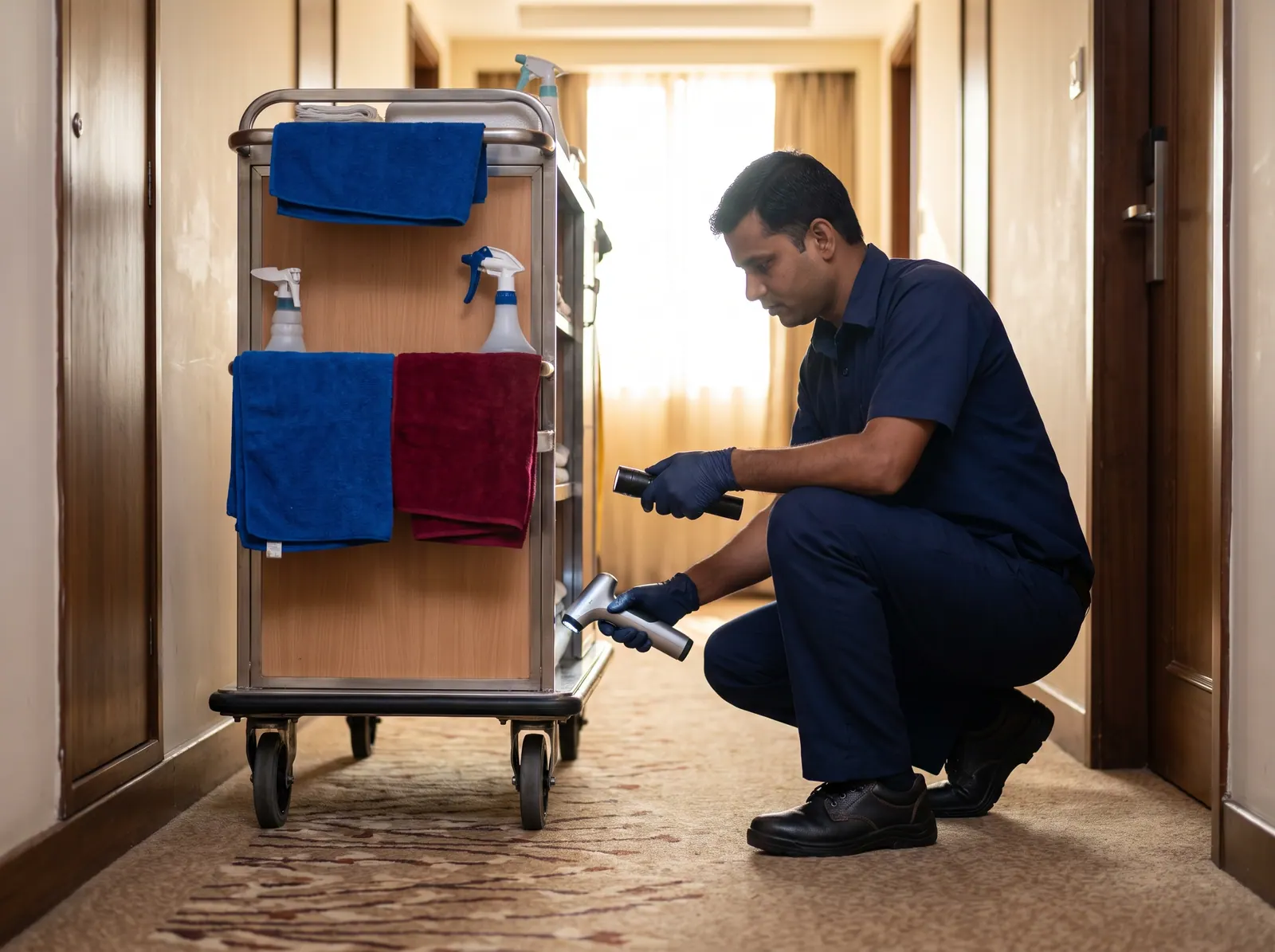
A thorough inspection confirms what the pest is, how far the problem extends and why it appeared. Under an Integrated Pest Management (IPM) approach, inspection comes before any treatment. The table shows where trained technicians typically look for the pests most often reported in guest rooms.
| Pest | Where to look | Typical signs |
|---|---|---|
| Bed bugs | Mattress seams and piping, bed base, headboard and frame joints, bedside tables, skirting, curtain folds, picture frames | Live bugs, pale shed skins, tiny dark spots on fabric, eggs in crevices |
| Cockroaches | Bathroom floor traps and drains, under the vanity, around the minibar or fridge motor, wardrobe hinges, kettle tray | Droppings like ground pepper, egg cases, a musty smell |
| Rats and mice | False ceilings, openings around AC ducts and pipes, behind minibar units, balcony gaps | Droppings, gnaw marks, greasy marks along walls, scratching at night |
| Ants | Window frames, skirting, sugar sachets, fruit bowls, room-service trays | Visible trails leading to food or water |
| Mosquitoes | Balcony doors, window mesh, potted plants, AC drip trays, nearby drains | Bites reported at night, standing water nearby |
| Wood borers | Wooden furniture, door frames, wardrobe backs | Small round holes, fine powder beneath the wood |
Inspection should also look for causes. Common ones are gaps around pipes and cables, torn window mesh, room-service leftovers and leaking fittings. It is also worth tracing the routes that linen and furniture take through the building.
For rodents, sightings in guest areas often trace back to kitchens, stores or waste areas. Our guide to rodent control in hotel guest areas and back of house explains how the two are linked.
Treatment and follow-up
Treatment should suit the confirmed pest and the fact that guests will soon use the room again. That generally means targeted treatment rather than blanket spraying.
- Bed bugs: careful inspection and treatment of the bed, furniture and nearby crevices, followed by return visits, because eggs can hatch after the first treatment. Read more about bed bug control in Goa.
- Cockroaches: gel baiting and crack-and-crevice treatment in bathrooms, minibars and furniture gaps, with checks of drains and service shafts.
- Rodents: finding and closing entry points, with traps or bait stations placed only where they are appropriate and safe for guests.
- Ants, mosquitoes and others: removing what attracts them (food, water, light, gaps) and treating trails, nests or breeding sites.
Whatever the pest, products should be registered with the CIB&RC and applied by trained staff according to label directions. Keep guests and staff out of treated rooms until surfaces are dry, or for as long as the technician advises. Ventilate the room before it is made up, and make sure housekeeping staff wash their hands after handling treated areas.
When can the room go back on sale?
Set a clear return-to-service rule rather than relying on judgement on the day. A practical checklist:
- The technician has confirmed that this stage of treatment is complete and the room can be reoccupied.
- The room has been ventilated, cleaned and made up with fresh linen.
- Repairs found during inspection have been done or scheduled, such as sealing gaps, fixing mesh or replacing damaged furniture.
- For bed bugs, follow-up inspections are booked, and the room will be checked again after the next stay.
- A named manager has signed off.
Records and learning: turning one sighting into prevention
Good records show auditors, owners and your own team that an issue was handled properly. They also reveal patterns that a single incident hides.
For each incident, record:
- Date, time, room and who reported it
- The pest identified and how it was identified (photo, specimen or technician)
- Guest care actions taken
- Inspection findings in the room and the neighbouring rooms
- Treatment carried out, by whom, and the service report reference
- Follow-up dates and outcomes
- The date the room returned to service and who signed it off
Review the log every month. Repeated reports on one floor, in one wing or near one service shaft point to a shared cause, such as a linen store, a drainage line, a kitchen or a waste area. Use what you learn to update housekeeping checklists and to train new staff to spot early signs during room turns.
The log can also show whether your routine service needs to be more frequent. Our guide on how often Goa hotels should schedule pest control can help with that decision.
Points to build in for Goa properties
- Monsoon conditions. Goa's heavy south-west monsoon and humid coastal climate bring damp, and many insects shelter indoors or gather around lights during the rains. Check window mesh, door seals and balcony drains before the monsoon arrives.
- Peak-season pressure. When the property is full, there is pressure to put a room back on sale quickly. Agree in advance that the return-to-service rule applies whatever the occupancy.
- Timber furniture and older buildings. Wooden furniture, frames and ceilings are common in Goa properties, and timber kept in humid conditions can be vulnerable to wood borers. Include woodwork in room inspections.
- Gardens and open-air areas. Resorts with gardens, water features or outdoor dining should check breeding sites and outdoor nests routinely, not only rooms.
- Staff accommodation. Bed bugs can move between staff quarters and guest areas through linen and belongings. Include staff housing in inspections.
Working with a pest control partner in Goa
A protocol works best when your pest control provider knows your property and works within an agreed programme. Our Goa branch in Chimbel provides hotel and resort pest management in Goa, covering guest rooms, kitchens, stores and staff accommodation.
We follow an IPM approach and are a licensed pest control operator with the Directorate of Agriculture, Goa. We use CIB&RC-registered products and maintain Material Safety Data Sheets for the products we use. After each visit we share a service report, and clients receive updates on WhatsApp. For hotel kitchens, our documentation is aligned with HACCP and FSSAI audit expectations.
In a published testimonial, Mr. Sunil Ambokar, a purchase manager in Goa, writes that bed bugs in his organisation's staff accommodation were resolved within the first three months. He also mentions cockroach, lizard and rodent treatment.
If you would like help drafting or reviewing a guest room pest protocol, contact our Goa branch in Chimbel. Tell us where your property is and briefly describe what was seen, and we will discuss how we can help.
Frequently asked questions
QShould we move the guest to the room next door?
It is better not to. Pests such as bed bugs and cockroaches can move between neighbouring rooms through wall gaps, shared service shafts and plumbing. Offer a room in a different part of the building, not beside, above or below the affected one. If bed bugs are suspected, help the guest keep their luggage off beds and carpets in the new room, and offer to launder their clothing.
QCan housekeeping spray the room before the technician arrives?
No. Household aerosols leave residue on surfaces that the next guest will touch. They can also push bed bugs and cockroaches deeper into furniture and wall gaps, which makes inspection and treatment harder. Close the room, bag the linen inside the room and leave treatment to a trained technician using registered products according to label directions.
QHow long should a room stay out of service after a bed bug report?
There is no fixed period. It depends on how widespread the problem is, which furniture is affected and what the technician advises after inspection. Bed bug treatment usually needs follow-up visits, because eggs can hatch after the first treatment. Use a written return-to-service checklist and get a manager's sign-off rather than reopening the room on a set date.
QWhat should staff say to the guest?
Be honest, calm and respectful. Thank the guest for telling you, apologise, and explain what happens next: a new room, care for their belongings, and an inspection of the original room. Do not blame the guest or play down what they saw. Any compensation should follow your hotel's own policy. If the guest has bites or a reaction, offer to help them see a doctor.
QDo we need to inspect neighbouring rooms if only one cockroach was seen?
A single cockroach may have come up from a drain or a service shaft, but it can also be the first sign of a wider problem. At a minimum, inspect the affected room, its bathroom drains and the shared service areas, and log the sighting. If reports repeat on the same floor or near the same shaft, inspect the neighbouring rooms too and look for a shared cause.
QWhat pest control records should we keep for audits?
Keep an incident log for guest rooms, along with service reports for each visit. These should show the date, the areas treated, what was done and any recommendations. For hotel kitchens and food areas, FSSAI hygiene requirements and HACCP-based systems expect documented pest control, so keep reports, product safety data sheets and follow-up records together and easy to find.
QDoes a treatment warranty cover a room where the pest comes back?
For specific services, a warranty applies to the treated area as set out in the service agreement, and the terms vary by pest and treatment. Pests brought in fresh, for example in a guest's luggage or from a neighbouring property, may need separate attention. It is worth discussing prevention steps with the technician after treatment.
Last updated 13 October 2026. Information on this page is general guidance; your technician will advise on your specific property after inspection.