


Quick answer
Efficacy Pest Control's Goa branch provides commercial pest control in Margao, including Fatorda, Navelim, Aquem, Borda, Gogol and Comba. Programmes for shops, offices, restaurants, hotels, clinics and warehouses start with a site inspection. This is followed by targeted treatment, proofing and sanitation advice under an Integrated Pest Management approach. Visits are scheduled and service reports are shared afterwards. Documentation for food businesses is aligned with HACCP and FSSAI audit expectations.
Key points
- Our Goa branch provides commercial pest control in Margao, including Fatorda, Navelim, Aquem, Borda, Gogol and Comba.
- Programmes follow an Integrated Pest Management approach: inspection, sanitation and proofing advice, then targeted treatment.
- Service reports are shared after visits, and documentation for food businesses is aligned with HACCP and FSSAI audit expectations.
- The company is a licensed pest control operator with the Directorate of Agriculture, Goa, using CIB&RC-registered products.
- Pricing is quoted after inspection; a warranty applies to the treated area for specific services, as set out in the service agreement.
Our Goa branch in Chimbel handles commercial pest control in Margao, providing scheduled, documented pest management for businesses across the town (also called Madgaon). Margao is South Goa's main commercial centre. Its markets, shops, eateries, clinics and storage spaces each carry different pest risks.
A plan that suits a showroom will not suit a bakery or a godown. That is why every commercial programme starts with an inspection of your actual premises, not a standard package.
Which Margao businesses do we plan programmes for?
We work with commercial premises in the Margao town centre and in Fatorda, Navelim, Aquem, Borda, Gogol and Comba. Typical sites include:
- Shops, showrooms and units in commercial complexes and market areas
- Offices
- Restaurants, bakeries, cafés and food processing units
- Hotels and guest houses
- Clinics, hospitals and healthcare centres
- Warehouses, godowns and industrial sheds
If your premises are just outside these localities, tell us where they are and we will confirm whether we can cover them. For an overview of what the service includes across Goa, see our commercial pest control service page.
What pests do different Margao premises need to watch for?
The pests a business deals with depend far more on what happens inside the building than on the street it is on. Food, water, waste, clutter and gaps in the structure are what draw pests in. The table below is a general guide; your inspection will show what applies to your site.
| Type of premises | Pests to watch for | Where the plan usually focuses |
|---|---|---|
| Restaurants, bakeries and food units | Cockroaches, flies, rats and mice, ants | Kitchens, drains, dry stores, waste areas and service records |
| Shops and market-area units | Rats and mice, cockroaches, ants | Stock rooms, shared walls, gaps under shutters, bins and back lanes |
| Offices and clinics | Cockroaches, ants, occasionally rodents | Pantries, washrooms, cable and pipe ducts, low-disruption treatment |
| Hotels and guest houses | Bed bugs, cockroaches, rodents, mosquitoes | Guest rooms, kitchens, stores and staff accommodation |
| Warehouses and industrial sheds | Rats and mice, stored-product insects, termites | Perimeter, entry points, pallets, stored goods and timber |
For detail on individual pests, see our pages on cockroach treatment in Margao, rodent control in Margao and fly control in Margao.
How does a commercial programme work?
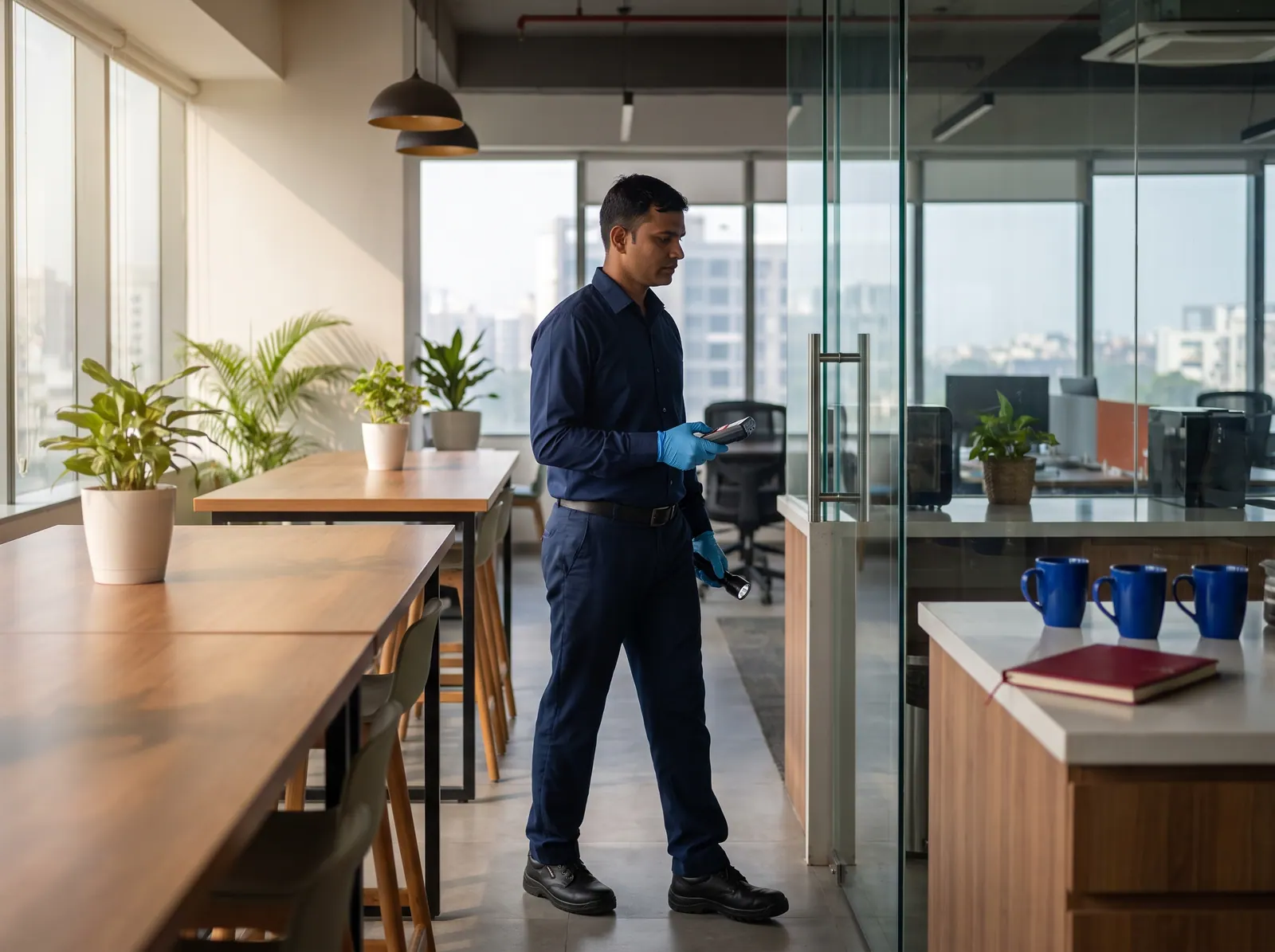
- Site inspection – A trained technician walks through the premises with your representative. They check entry points, hiding places, drains, storage, waste areas and signs of pest activity.
- Mapping risk areas – We note where pests are active or likely to enter, so that treatment can be targeted rather than spread across the whole site.
- Written proposal – You receive a plan covering the areas to treat, methods, visit frequency and precautions, along with a quotation.
- Safety information – We maintain Material Safety Data Sheets for the products we use. We explain the precautions to your team and tell you how long to keep each area clear.
- Initial treatment – Methods are matched to the pest. Examples include gel baiting and crack-and-crevice treatment for cockroaches, tamper-resistant bait stations and traps for rodents, and source reduction for flies.
- Proofing and housekeeping advice – We point out gaps to seal, drains to cover and storage or waste habits to change, so that pests have fewer reasons to return.
- Scheduled follow-up visits – Technicians check activity, adjust baits and traps, and change the plan as pest pressure changes.
- Service reports – A report or proof of service is shared after visits, with WhatsApp updates for clients.
What records will you have for audits and inspections?
Food businesses must meet the hygiene requirements of FSSAI Schedule 4, which include pest control. Many also run HACCP-based food safety systems. Hotels and larger retailers often face audits from head offices or clients as well.
For food businesses, our documentation is aligned with HACCP and FSSAI audit expectations. You can also ask for safety data sheets for the products used. We are a licensed pest control operator with the Directorate of Agriculture, Goa, and we use CIB&RC-registered products.
Keep our service reports together with your own cleaning and maintenance records. Auditors usually want to see that pest control and housekeeping work together.
How does the monsoon change pest pressure in Margao?
Goa's very heavy south-west monsoon and humid coastal climate affect commercial buildings every year. During the rains, rats and mice look for dry shelter indoors. Drains can back up, and standing water in compounds, on terraces and in discarded containers can breed mosquitoes. Damp walls and timber also suit termites and wood-boring beetles.
- Before the rains: check proofing, clear gutters and drains, and review where rodent bait stations are placed.
- During the rains: watch stores and stock rooms for rodent signs, and remove standing water after heavy spells.
- After the rains: inspect timber, door frames and wall bases for termite mud tubes or wood dust.
If you are building or extending premises, our termite control in Margao page explains pre-construction soil treatment and post-construction drill-fill-seal treatment, in line with IS 6313.
How do we keep treatment safe for staff, customers and stock?
We follow an Integrated Pest Management approach: inspection, sanitation and proofing advice first, then targeted treatment. Where gels, baits or traps placed in precise spots will work, we use them instead of broad spraying.
- Remove or cover food, utensils, packaging and open stock before treatment, as advised.
- Keep staff, customers, children and pets away from treated areas until they are dry, or for as long as the technician advises.
- Ventilate treated rooms and wash hands after handling anything in a treated area.
- If anyone feels unwell after a treatment, they should see a doctor.
Tell us your trading hours and busy periods when you enquire, so that visit timing can be discussed with your operations in mind.
How is a commercial plan priced?
There is no single rate for commercial work, because no two sites are alike. After the inspection, we share a quotation based on:
- The size and layout of the premises
- The pests involved and how established they are
- How many visits are needed in a month or year
- Whether termite treatment for new or existing construction is required
- The documentation your business needs for audits
Many businesses choose an Annual Maintenance Contract, which gives year-round scheduled visits with service reports. For specific services, a warranty applies to the treated area as set out in the service agreement. It varies by pest and treatment, and does not cover structural changes, new construction or cases where post-service instructions were not followed.
What do Goa businesses say about our work?
Mr Sunil Ambokar, a purchase manager in Goa, wrote that a bed bug problem in his organisation's staff accommodation was solved within the first three months. He added that they were also happy with the cockroach, lizard and rodent treatment. In 2026 the company received the Indian Eminence Award (Goa), Certificate of Excellence, accepted by our director, Hasan Raza.
How do I arrange a visit in Margao?
Get in touch with our Goa branch and tell us the type of business, its locality in Margao, the pests you are seeing and any audit you are preparing for. We will arrange an inspection and send a proposal. For other services in the town, see pest control in Margao.
Frequently asked questions
QHow often should a commercial premises in Margao be serviced?
It depends on the pests involved, how busy the site is and how much food is handled. Offices and shops may need fewer visits than kitchens, bakeries or food processing units, where pests can build up quickly and audits expect regular service. After the inspection, we suggest a visit frequency, which might be weekly, monthly or quarterly. We review it as pest activity changes.
QWill pest treatment disrupt our business?
Most treatments take a few hours, depending on the pest and the size of the area. Some areas may need to be kept clear until they are dry or for as long as the technician advises. Tell us your trading hours and busy periods when you enquire, so that visits and preparation can be planned with your operations in mind.
QCan you help us prepare for an FSSAI inspection?
For food businesses, our documentation is aligned with HACCP and FSSAI audit expectations. A service report or proof of service is shared after visits, and safety data sheets are available for the products we use. Keep these records alongside your own cleaning logs. Inspectors look at hygiene as a whole, and the responsibility for meeting requirements stays with the food business.
QWhat happens if pests come back after treatment?
For specific services, a warranty applies to the treated area, as set out in your service agreement. It varies by pest and treatment. It does not cover structural changes, new construction or cases where post-service instructions were not followed. Pests can also arrive from neighbouring units, so ask the technician about proofing steps that reduce re-entry from outside.
QWhat should we do before the first visit?
Clear the areas to be treated, store or cover food and open stock, and make sure staff know which rooms will be out of use. A representative from your business should accompany the technician during the service, so that questions about the premises can be answered on the spot. If you need to cancel, please do so at least 48 hours before the visit, as a late-cancellation fee may apply.
QHow can we pay for commercial pest control?
Payment is made as per the quotation or invoice. We accept cash, UPI transfer, card, net banking and bank transfer. For businesses on an Annual Maintenance Contract, the terms, scheduled visits and service reports are set out in the agreement, so you know what is covered over the year before work begins.
Last updated 13 October 2026. Information on this page is general guidance; your technician will advise on your specific property after inspection.




