Quick answer
Efficacy Pest Control's Goa branch in Chimbel provides mosquito control in Calangute for homes, villas, guesthouses, restaurants and shops. Each visit starts with an inspection to find where mosquitoes breed and rest. We then advise on removing breeding water, larvicide water that cannot be emptied, apply targeted indoor residual treatment and, where it suits the site, fog or ULV-treat outdoor areas. We also give prevention advice and can schedule repeat visits through the monsoon.
Key points
- Mosquitoes in warm weather can develop from egg to adult in roughly a week, so standing water needs regular attention.
- Fogging and ULV treatment mainly affect adult mosquitoes flying at the time and do not replace removing breeding water.
- Aedes mosquitoes breed in small containers of fairly clean water and bite mainly in the daytime; Culex breed in drains and dirty water.
- Treatment uses CIB&RC-registered products applied to label directions, with Material Safety Data Sheets maintained.
- A client representative, such as a caretaker, must be present while technicians carry out the service.
If mosquitoes are keeping you awake, biting guests on the verandah or bothering diners at your restaurant, the answer is rarely a single spray. Effective mosquito control in Calangute – Goa means finding where mosquitoes breed on and around your property, cutting off that water, and treating the places where adult mosquitoes rest. Calangute is one of the areas our Goa branch in Chimbel covers, and this page explains how we approach the work here.
We follow an Integrated Pest Management (IPM) approach: inspection first, then sanitation and proofing advice, then targeted treatment. For an overview of the methods themselves, see our main mosquito control service page.
Why do mosquitoes build up around Calangute properties?
Calangute sits on the North Goa coast, with a warm, humid climate and a very heavy south-west monsoon. Rain fills every container, gutter and hollow, and the warmth lets mosquitoes develop from egg to adult quickly, in roughly a week in hot weather. Breeding often continues after the rains stop, because water lingers in tanks, pots and blocked drains.
The kind of buildings found in Calangute adds to this. Guesthouses, homestays, rented villas and small apartment blocks often have overhead tanks, plant-filled courtyards and balconies, and rooms that stay empty between bookings, where a forgotten bucket or an unused bathroom can quietly breed mosquitoes. Restaurants and cafés near the beach and the market lanes deal with crates, cans and cups that collect rainwater, and with garden seating that attracts evening biters. Renovation work is common too, and materials left in the open hold water.
Different mosquitoes favour different water. Aedes mosquitoes, which can spread dengue and chikungunya, lay eggs in small containers of fairly clean water and bite mainly during the day. Culex mosquitoes breed in drains, soak pits and dirty standing water and bite mostly at night. Anopheles mosquitoes, which can carry malaria, prefer cleaner pools and puddles. Knowing which type is biting helps us decide where to focus.
Where do we look for breeding on a Calangute property?
Most mosquito problems trace back to a handful of spots. These are the places we check first:
| Area | What we look for | Usual response |
|---|---|---|
| Overhead tanks and sumps | Loose or missing lids, torn mesh, open overflow pipes | Advice on covering and meshing; larviciding where water cannot be emptied |
| Gardens, courtyards and terraces | Pot saucers, ornamental containers, coconut shells, tree holes, folded tarpaulins | Emptying and removal; checking corners after each spell of rain |
| Drains, gutters and soak pits | Blocked or slow-moving water, broken covers | Clearing advice; larviciding of drains and pits |
| Pools and water features | Pool covers holding rainwater, unused pools, features that are switched off | Maintenance advice; treatment of non-circulating water where appropriate |
| Restaurant back areas and stores | Crates, cans, cups, used containers, AC and fridge drip trays | A simple housekeeping routine; removal of water-holding waste |
| Empty guest rooms and bathrooms | Unused drains, vases, buckets, dark resting spots under beds and behind curtains | A flushing and checking routine; targeted treatment of resting areas |
| Renovation or building work | Curing water, open drums, materials holding rain | Covering, draining and scheduled checks |
For a walk-round you can do yourself between visits, our mosquito breeding checklist for Goan gardens and terraces is a useful companion.
What happens during a mosquito control visit?
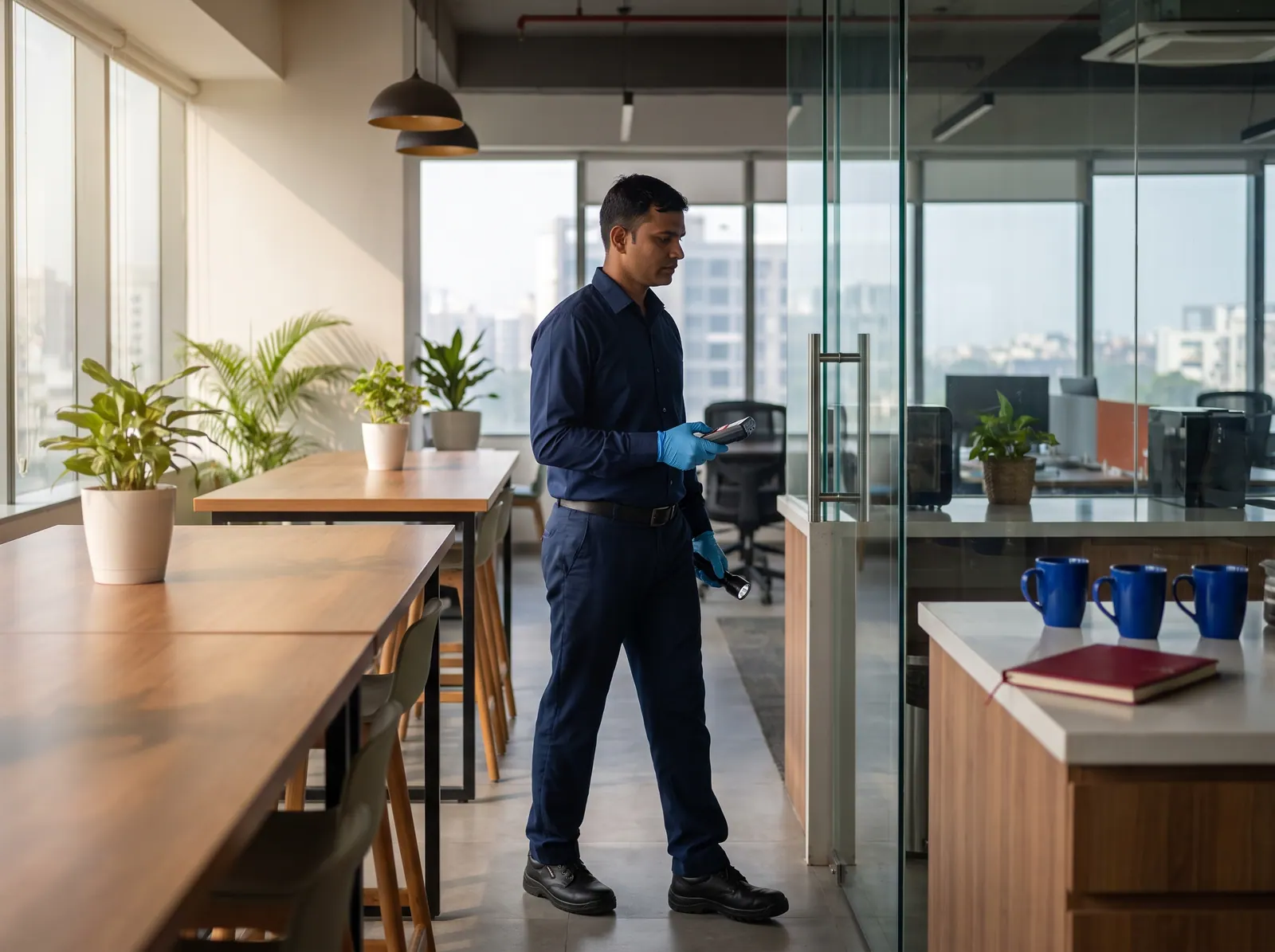
- Inspection. Our technician walks the indoor and outdoor areas with you or your caretaker, looking for breeding water, adult resting places (shaded, humid, undisturbed spots) and the ways mosquitoes get into rooms.
- Marking the problem areas. We note the high-risk points, such as tanks, drains, garden corners and stores, so treatment goes where it matters rather than everywhere.
- Source reduction. We show you what to empty, cover, clear or throw away. This step usually makes the biggest difference and costs little to keep up.
- Larviciding. Water that cannot be emptied, such as drains, soak pits and some tanks or features, is treated to stop larvae developing into adults.
- Targeted residual treatment. Where suitable, we treat indoor surfaces where adult mosquitoes rest, using CIB&RC-registered products applied according to their labels.
- Fogging or ULV, where appropriate. For gardens and outdoor seating, space treatment can bring down the number of adult mosquitoes. More on this below.
- Report and advice. After the visit you receive a service report, and clients can receive updates on WhatsApp. We leave you with a short list of habits to keep breeding down until the next visit.
Does fogging alone solve a mosquito problem?
No. Fogging and ULV treatment act mainly on adult mosquitoes flying at the time of treatment, and the effect is short-lived. If a tank or drain keeps producing new mosquitoes, numbers climb again within days. That is why we use space treatment as one part of a plan, alongside source reduction and larviciding, never as a substitute. Our page on mosquito fogging and ULV treatment in Goa explains when it is and is not a good fit.
Mosquito plans for homes, guest stays and restaurants
A family home, a small guesthouse and a beach-side restaurant in Calangute need different things, so we shape the plan around the property.
- Homes, villas and housing societies: attention to tanks, terraces, garden pots and shared drains. In a society, breeding in one common area affects every flat, so shared spaces matter as much as individual homes.
- Guesthouses, homestays and resorts: room checks, including rooms that have been empty, plus gardens, pool surrounds and staff quarters. Our guide to mosquito control for resort gardens and pools covers the outdoor side in more detail.
- Restaurants, cafés and shops: back-of-house areas, stores and outdoor seating, with treatment timed around service hours. Food businesses can have documentation aligned with HACCP and FSSAI audit expectations, and mosquito work can sit inside a wider commercial pest control plan in Calangute.
Where mosquito pressure is ongoing, for example through the monsoon and the weeks after it, an Annual Maintenance Contract with scheduled visits and service reports is often more practical than one-off calls.
Is mosquito treatment safe for family, guests and pets?
Treatment is planned to keep exposure low. We use CIB&RC-registered products, maintain Material Safety Data Sheets for the products we use, and apply them according to label directions. Our Goa operation is a licensed pest control operator with the Directorate of Agriculture, Goa.
A few simple precautions help:
- Cover or put away food, drinking water, utensils and pet bowls before treatment.
- Keep children and pets away from treated areas until surfaces are dry, or for as long as the technician advises.
- Cover fish tanks and garden ponds with fish if the technician asks you to.
- Ventilate rooms afterwards and wash your hands if you touch treated surfaces.
- For guest rooms, plan treatment around check-outs so rooms can air before the next arrival.
If anyone develops a fever, rash or other symptoms after mosquito bites, please see a doctor promptly rather than waiting.
What affects the cost of mosquito control in Calangute?
We quote after understanding the site, so the price reflects the actual work involved. The main factors are:
- Size and layout: a flat with a balcony takes far less time than a villa with a large garden or a resort spread over several blocks.
- Breeding pressure: many tanks, drains or water features mean more larviciding and closer follow-up.
- Indoor, outdoor or both: outdoor space treatment adds time and equipment.
- One visit or a schedule: a single treatment, a series of visits through the monsoon, or a year-round contract.
Payment is as per the quotation or invoice, and cash, UPI, card, net banking and bank transfer are accepted.
Arranging mosquito control in Calangute
To get started, contact our Goa branch in Chimbel with your property type, a rough idea of its size and where you notice the most mosquitoes: indoors at night, in the garden at dusk, or around a kitchen or store. We will explain what the visit involves and how to prepare.
A client representative needs to be present while our technicians work, which matters for villas and holiday homes whose owners live elsewhere; a caretaker or manager can usually fill this role. If you also have cockroaches, ants, termites or rodents to deal with, see our overview of pest control in Calangute.
Frequently asked questions
QWhen is the best time to book mosquito control in Calangute?
Ideally before the south-west monsoon sets in, so tanks, gutters and drains are checked and covered before they fill. Breeding usually stays high through the rains and often for some weeks afterwards, as water lingers in pots, drains and tanks. If bites are already a problem, there is no need to wait for a particular season; start by emptying any standing water and arrange an inspection.
QCan you treat a villa or holiday home when the owner is not in Goa?
Yes, provided someone can be there for the visit. Our terms require a client representative to accompany technicians during service, so a caretaker, property manager or trusted neighbour can let us in, walk the property with the technician and receive the advice. The service report is shared after the visit, so the owner can see what was found and done.
QDo guests or diners need to leave during treatment?
Not usually from the whole property, but treated areas need to be kept clear until surfaces are dry or for as long as the technician advises. For guesthouses we plan room treatment around check-outs, and for restaurants we time work around service hours. Outdoor fogging is normally scheduled when gardens and seating areas are empty.
QHow many visits will my property need?
It depends on the property and the amount of breeding water. A flat with a few problem spots may need only a single treatment plus good habits. A villa with a large garden, or a guesthouse with tanks and water features, often benefits from several visits through the monsoon or an Annual Maintenance Contract with scheduled visits and service reports.
QWhy do mosquitoes keep coming back even though my property is clean?
Mosquitoes can fly in from nearby plots, open drains, construction sites or neglected gardens, so a tidy property can still see bites. Treating your own premises reduces breeding and resting sites, while window and door screens help keep mosquitoes out of rooms. In a housing society, shared areas and common drains need attention too, otherwise one neglected corner keeps feeding the problem.
QDo swimming pools breed mosquitoes?
A pool that is well maintained, with working filtration and circulation, is not usually a breeding site. Problems tend to come from pool covers that hold rainwater, pools left unused during the off-season, and water features that are switched off. We advise on maintenance and can treat water that cannot be kept circulating, where that is appropriate.
Last updated 13 October 2026. Information on this page is general guidance; your technician will advise on your specific property after inspection.