Quick answer
Our Goa branch treats bed bugs in staff accommodation room by room. We inspect every shared room, not just those with complaints, and treat beds, bunks, lockers and nearby crevices. We then return for follow-up visits to catch bugs hatching from eggs. Lasting results also depend on staff checking luggage after leave, handling laundry carefully and reporting bites early. We share service reports after visits, so management has a clear record.
Key points
- Bed bugs spread in shared accommodation mainly through luggage, moved furniture and partial treatment of only the rooms with complaints.
- Bed bug eggs can survive a single treatment, so follow-up visits are part of an effective programme.
- Staff habits around luggage, laundry and prompt, blame-free reporting strongly affect whether bed bugs return.
- Our Goa branch is a licensed pest control operator (Directorate of Agriculture, Goa) using CIB&RC-registered products.
- Service reports are shared after visits, and a room register kept by management helps track any recurrence.
Bed bug treatment for staff accommodation in Goa needs a different plan from treating a single bedroom. When several people share a room, sleep in bunk beds and come and go on leave, bed bugs can move between beds and rooms faster than a one-off spray can deal with them. Our Goa branch in Chimbel works with hotels, restaurants and other businesses that house staff. We use a room-by-room approach with follow-up visits and clear records.
This page explains:
- why shared rooms keep getting re-infested
- how we organise treatment across a whole block
- what staff need to do
- what records management receives
For bed bugs in a family home, see our main bed bug treatment service.
Why do bed bugs keep coming back in shared staff rooms?
Bed bugs are small, flat, wingless insects. They feed on blood, mostly at night, and hide in seams, joints and cracks close to where people sleep. They are not caused by dirt; they arrive on people and their belongings. Staff accommodation gives them many ways in and many places to hide.
- Constant movement of people and bags. Staff return from home leave and new joiners arrive with luggage. Goa's hospitality trade also often takes on extra staff for the tourist season. Every bag is a possible carrier.
- Bunk beds and frames. Bolted joints, hollow tubes, slats and the underside of the upper bunk give bed bugs plenty of shelter.
- Shared and moved furniture. Mattresses, lockers and chairs moved from one room to another carry bed bugs and eggs with them.
- Partial treatment. Treating only the room where someone complained leaves bugs in neighbouring rooms, ready to move back in.
- Late reporting. Staff may not report bites for fear of blame or of losing their bed, so a small problem has time to spread.
- Home-made fixes. Household sprays used by residents tend to miss eggs and hidden bugs. They can also push bugs into new hiding places.
Bed bug eggs are tiny and well hidden, and they can survive a single treatment. That is why one visit is rarely enough in a shared building, and why follow-ups are part of the service.
How does our room-by-room treatment work?
We follow an Integrated Pest Management approach. We inspect first, then advise on the conditions that help bed bugs spread, then treat where the bugs actually are. For a staff block, the process looks like this:
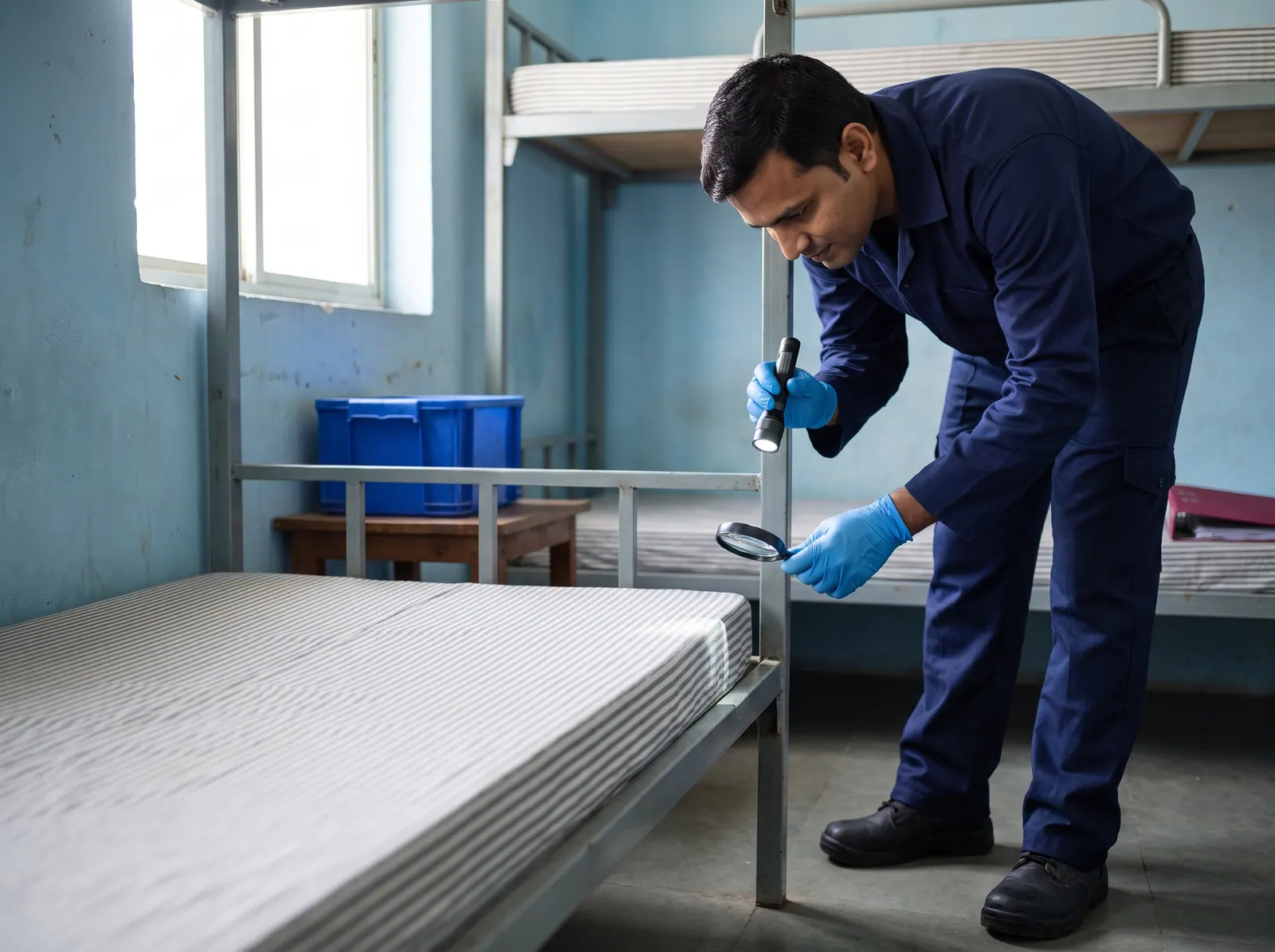
- Survey every room, not just the complaint rooms. We check beds, bunk joints, mattress seams, lockers, cupboards, skirting gaps, wall cracks and furniture in each room. We note where we find live bugs, eggs, cast skins or dark spotting.
- Map the problem. Each room is marked as active, at risk or clear. A room is at risk if it is next to an active room or shares furniture with one. Treatment then covers the spread, not just the symptom.
- Agree a preparation plan. The facility manager and staff receive clear instructions on bagging linen and clothes, clearing under beds and emptying lockers where needed. Our bed bug treatment preparation checklist is a useful starting point.
- Treat room by room. Technicians treat bed frames, bunk joints, slats, mattress seams, lockers and nearby cracks. Products are applied according to label directions. Where practical, active and at-risk rooms are treated in the same round.
- Return for follow-up visits. Follow-ups are timed to catch bugs that hatch after the first treatment. We re-inspect each room, treat where activity remains and update its status.
- Hand over and keep watch. Once activity has stopped, we agree what supervisors should look out for. We also discuss whether regular inspections make sense for your block.
The number of visits depends on how many rooms are affected and how heavily. The technician will explain the schedule after the first inspection.
What do we need from staff and supervisors?
In shared accommodation, treatment only works with cooperation. Even a thorough treatment can be undone by one infested bag or by a mattress carried in from another room. These habits make the biggest difference.
Luggage
- Check bags, especially seams and zips, when staff join or return from leave. Do this outside the sleeping room if possible.
- Keep bags off beds and away from bed frames. A rack or a sealed plastic box is better than storing luggage under a bunk.
- Do not bring old mattresses, bedding or second-hand furniture into the block without checking it first.
Laundry
- Bag bedding and clothes inside the room before carrying them out, so bugs are not dropped in corridors.
- Wash on the hottest setting the fabric allows and dry thoroughly. Use high heat if a dryer is available.
- Keep clean linen sealed and separate from used linen until it goes back on the bed.
Reporting
- Make reporting blame-free. Staff who notice any of these signs should tell a supervisor the same day:
- bites
- small blood spots on sheets
- tiny dark spots on mattress seams
- Ask staff not to move mattresses or swap beds without permission, and not to use their own sprays.
- Anyone with a strong skin reaction or other health concern should see a doctor.
Our technicians can share prevention tips with supervisors during visits. For wider habits, see our guide to staff training for pest prevention in hotels and restaurants. Our guide on bed bugs after travel by bus, train or hotel stay is worth sharing with staff who travel home on leave.
What records does management receive?
For hotels and businesses, bed bugs in staff housing are a welfare issue as well as a pest problem. Our Goa branch shares service reports as proof of service after visits, and sends WhatsApp updates to clients. Material Safety Data Sheets are maintained for the products we use.
We suggest management also keeps a simple room register alongside our reports. Here is an example layout:
| Room | Date inspected | Finding | Action taken | Next check | Staff report received? |
|---|---|---|---|---|---|
| B-12 | (date) | Live bugs and eggs on lower bunk joints | Treated; linen bagged and washed | Follow-up visit | Yes, two residents |
| B-13 | (date) | No activity seen; shares a wall and locker with B-12 | Treated as at-risk | Follow-up visit | No |
| B-14 | (date) | No activity seen | Inspected only | Next routine check | No |
Together, the register and our reports show when a problem started, which rooms were treated and whether it is returning. This helps with internal reviews and with planning room allocations. It also helps you decide whether scheduled inspections under an annual maintenance contract would suit your accommodation.
How do we keep treatment safe in rooms people live in?
Staff accommodation is someone's home. Our Goa branch is a licensed pest control operator under the Directorate of Agriculture, Goa. We use CIB&RC-registered products, applied according to label directions.
- Residents should stay out of treated rooms until surfaces are dry, or for as long as the technician advises.
- Ventilate rooms well before people return.
- Remove food, drinking water and personal items such as toothbrushes from rooms being treated, or seal them away.
- Wash hands after handling items from treated rooms.
- A client representative should accompany our technicians during the service, as set out in our terms.
We can plan the order of rooms with the manager. Staff who need to move temporarily should take only laundered, bagged belongings, so the move does not carry bugs to a clean room.
What has a client in Goa told us?
Mr. Sunil Ambokar, a purchase manager at one of our Goa clients, wrote to us about bed bugs in their staff accommodation:
“My most of the Pest problem solved in the first three months like Bed Bugs in Staff Accommodation which was really headache for us and efficacy solved the problem, now there is no Bed Bugs in Staff Accommodation.”
This is one client's experience. Every building is different, and results depend on how far the infestation has spread and on staff following the steps above.
How do I arrange bed bug treatment for staff accommodation in Goa?
Our Goa branch covers towns including Panaji, Margao, Vasco da Gama, Mapusa, Porvorim, Ponda, Calangute, Candolim and Baga. If your staff block is elsewhere in Goa, ask us and we will confirm whether we can help.
When you contact our Goa branch, it helps to tell us:
- how many rooms and beds the block has
- whether bunk beds are used
- which rooms have complaints
- whether any treatment has already been tried
You can also read more about our Goa branch in Chimbel.
Frequently asked questions
QDo you need to treat rooms where nobody has complained?
Not always, but we do need to inspect them. In shared accommodation, bed bugs often spread to neighbouring rooms before anyone notices bites, and some people react very little to bites. Rooms next to an active room, or rooms that share furniture with it, are usually treated as at risk. Rooms with no signs and no shared furniture may simply be inspected and checked again at the follow-up visit.
QHow many visits will our staff accommodation need?
It depends on how many rooms are affected, how heavy the infestation is and how well preparation is done. Our bed bug service includes follow-up visits, because eggs can survive a first treatment and hatch afterwards. After the initial room-by-room inspection, the technician will explain the likely schedule and update it based on what each follow-up finds.
QCan staff keep living in the block during treatment?
Usually most of the block stays in use. Staff need to keep out of a room while it is being treated, and afterwards until surfaces are dry or for as long as the technician advises. We can plan the order of rooms with your manager. Anyone moving temporarily should take only washed, bagged belongings so that bugs are not carried into clean rooms.
QIs there a warranty on bed bug treatment for staff rooms?
For specific services, a warranty applies to the treated area as set out in your service agreement. Terms vary by pest and treatment. The warranty does not cover cases where post-service instructions are not followed. If bed bugs are brought back in on luggage or furniture from outside, that has to be managed through the luggage, laundry and reporting habits described on this page.
QShould we throw away infested mattresses?
Not automatically. Many mattresses can be treated, and the decision is best made after inspection. A badly damaged or heavily infested mattress may be worth replacing. If you discard one, wrap it fully before carrying it out and make it unusable, so nobody takes it into another room. Do not bring replacement or second-hand furniture into the block without checking it first.
QCan staff accommodation be covered under an annual contract?
Yes. Our Goa branch offers Annual Maintenance Contracts with year-round scheduled visits and service reports. For hotels and other businesses that house staff, scheduled inspections of accommodation can sit alongside wider pest management for kitchens, stores and guest areas. They help pick up early signs of bed bugs before they spread through a block.
Last updated 13 October 2026. Information on this page is general guidance; your technician will advise on your specific property after inspection.