Quick answer
The red ants on mango and cashew trees in Goa are usually weaver ants, which stitch living leaves into nests with silk. They bite and spray formic acid when disturbed, but they rarely nest indoors and they prey on other tree insects. Leave nests that are away from the house alone. Prune branches that touch walls, roofs or wires. Remove or treat only the nests that hang over paths, doors or play areas.
Key points
- The red ants that build leaf nests in mango and cashew trees in Goa are usually weaver ants.
- Weaver ants bind living leaves together with silk produced by their larvae, and a colony can have many nests.
- They hunt other tree insects, so nests away from the house are generally best left alone.
- Pruning branches and removing cables that touch the house is the most effective way to keep them out.
- Burning nests or spraying insecticide into fruiting trees is unsafe and damages the tree and beneficial insects.
If you have a mango or cashew tree in your Goan compound, you have probably met them: long-legged, orange-red ants that rush out of a ball of leaves and bite the moment you reach for fruit. People searching for red ants on a mango tree in Goa are almost always dealing with weaver ants. This guide explains how to recognise them, why they are often worth tolerating, and what to do when they come too close to the house.
What are the red ants on mango and cashew trees?
Weaver ants are tree-dwelling ants found across tropical Asia, including India's west coast. The workers are orange to reddish-brown, slender, and noticeably larger than the small ants that raid kitchens. They move quickly and often raise their bodies in a threatening posture when disturbed.
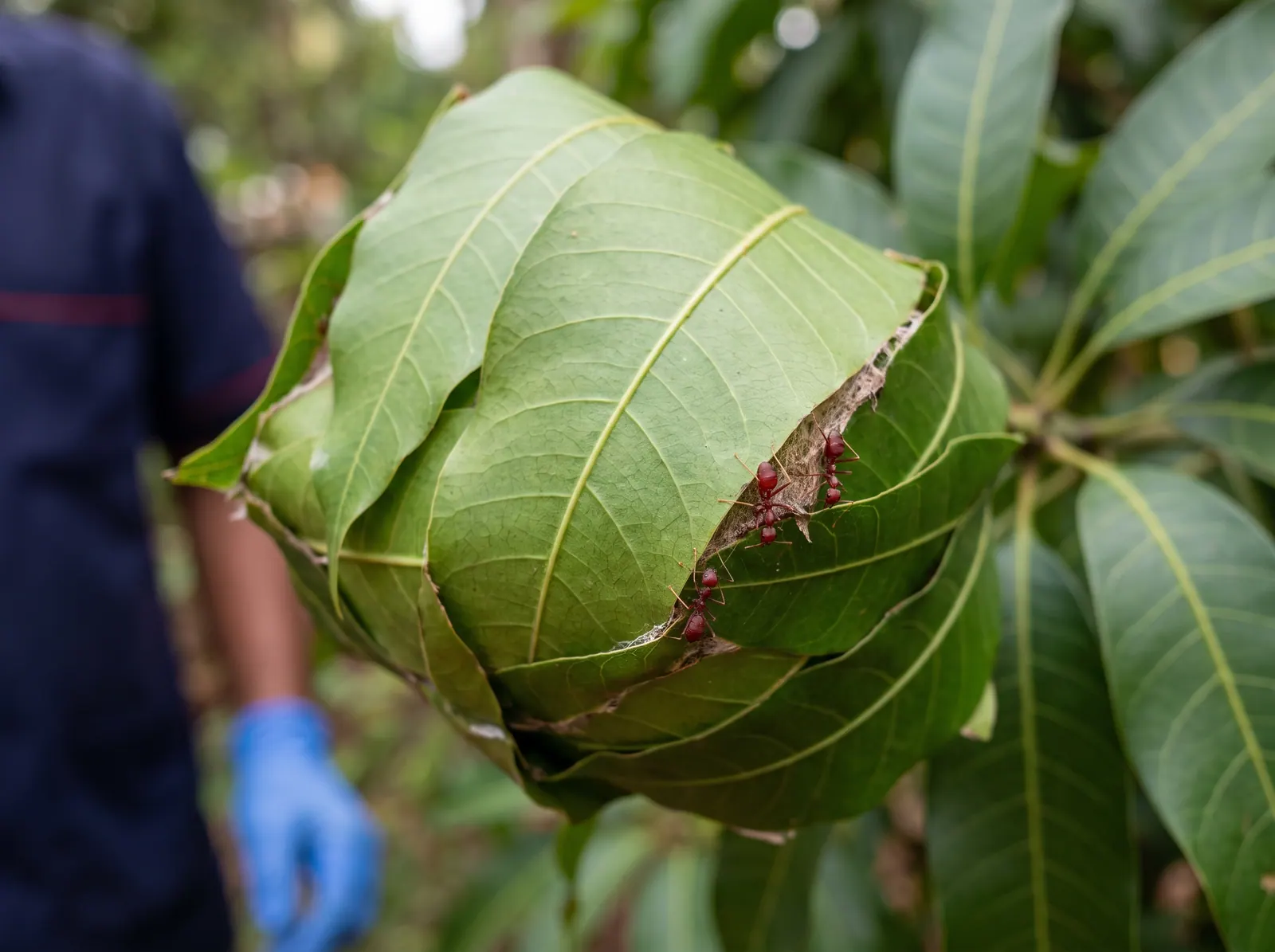
What makes them unusual is how they build. Worker ants pull living leaves together, and other workers hold larvae against the leaf edges. The larvae produce silk that glues the leaves into a closed nest. A single colony can have many nests spread across one large tree or several neighbouring trees, all linked by trails along branches.
Mango, cashew, jackfruit, citrus and other leafy garden trees suit them well. They forage on the ground at times, but their home is in the canopy, which is why they seldom set up nests inside buildings.
How do you identify a weaver ant nest?
Look for these signs:
- Leaves bound together: a cluster of green leaves, from fist-sized to much larger, drawn into a pouch or ball.
- Whitish silk: a thin, papery sheet of silk visible between the leaf edges, especially at the openings.
- Ants on guard: red ants patrolling the outside of the nest and pouring out when a branch is shaken.
- Busy trails: steady lines of ants along branches, the trunk, and anything that bridges to the next tree or a wall.
- Several nests: more than one leaf nest in the same tree, often towards the outer branches.
Things that can look similar
Some caterpillars roll or tie leaves, and some spiders spin silk shelters among leaves. These usually have no ants swarming around them. If you are unsure what a silk retreat belongs to, our guide to spiders in Goan homes and which are harmless may help. And if you see winged insects emerging near the house rather than ants on a tree, check whether they are flying ants or flying termites, because termites need a very different response.
Are weaver ants helpful or a nuisance?
The benefits
Weaver ants are active hunters. They capture caterpillars, beetles, bugs and other insects that feed on leaves and fruit. In parts of Asia, fruit growers have long kept weaver ants in their orchards as a natural form of pest control. A tree with a healthy colony is often a tree with fewer leaf-chewing insects.
The nuisances
- Bites: they bite and spray formic acid into the wound, which stings sharply. This is most annoying during mango and cashew picking in the months before the monsoon, or when pruning.
- Ants dropping on people: branches over a gate, car or sit-out mean ants can fall onto anyone passing underneath.
- Indoor wandering: where branches touch a wall, roof, window grille or cable, foragers walk straight into the house.
- Sap-sucking insects: weaver ants protect scale insects and mealybugs for their sweet honeydew, which can lead to sticky leaves and black sooty mould on some trees.
When should you leave them alone, and when is control reasonable?
For most Goan homes, the sensible approach is to live with weaver ants in trees that are away from daily activity and to act only where they create a real problem.
| Situation | Suggested approach |
|---|---|
| Nests high in a tree at the back of the compound | Leave them; they are protecting the tree |
| Occasional ants on the ground beneath the tree | Usually no action needed |
| Branches touching the roof, walls, windows or wires | Prune to break the bridge |
| Nests over a gate, path, parking spot or sit-out | Remove those nests or the branches carrying them |
| Children, elderly residents or guests regularly bitten | Targeted control near the affected area is reasonable |
| Ants trailing inside the house daily | Cut access routes; consider professional treatment of the entry points |
| Heavy sticky residue and sooty mould on leaves | Get the tree checked for scale insects or mealybugs |
How can you keep weaver ants away from the house?
Weaver ants prefer to travel along branches, so the most effective step is to remove their bridges. This avoids chemicals entirely and keeps the colony working in the garden, where it is useful.
- Create a gap: prune so that no branch touches the roof, walls, balcony, window grilles or compound wall. Leave a clear gap, keeping in mind that branches grow quickly once the rains begin.
- Check cables and lines: electricity, internet and clothes lines strung from a tree are favourite highways into a house. Reroute them where you can.
- Watch climbing plants: creepers that link a tree to the house can carry ants across.
- Close entry points: seal gaps around window frames and where pipes and cables enter walls.
- Use trunk barriers thoughtfully: a sticky barrier band on a protective wrap around the trunk can slow ants, but only if the tree has no other route through touching branches. Check and renew it regularly, as it collects debris and can trap other small creatures.
- Time your pruning: fold this into your pre-monsoon pest checklist, before heavy growth makes new bridges.
If the ants coming indoors are small, brown or black and heading for sugar or food, they are probably a different species. Our guide to ants in Goa kitchens during the monsoon covers those.
What are the safe ways to control weaver ants?
Removing a low nest yourself
A single nest on a low, easily reached branch can sometimes be removed by pruning that twig. Wear gloves, long sleeves and full trousers, tuck your trousers into your socks, and work in the cool early morning when the ants are slower. Cut the branch cleanly and move it well away from the house. Expect a lot of angry ants, and do not climb ladders while being bitten.
What not to do
- Do not burn nests. Burning leaves on a tree is a fire risk near roofs and dry grass, and it damages the tree.
- Do not spray household insecticide into fruiting trees. It can leave residues on mangoes and cashew apples and will kill beneficial insects too.
- Do not pour kerosene, petrol or chemical mixtures on the trunk or roots. This can harm the tree and contaminate soil, and many Goan compounds have a well nearby.
When professional help makes sense
Call in help when nests are high or over a roof, when ants are entering the house despite pruning, or when someone in the household reacts badly to bites. A professional approach follows Integrated Pest Management: inspecting the property, identifying the routes the ants use, advising on pruning and proofing, and treating only where it is needed, such as entry points and the nests directly over occupied areas, rather than spraying the whole tree.
Our Goa branch is a licensed pest control operator with the Directorate of Agriculture, Goa, and uses CIB&RC-registered products, with Material Safety Data Sheets maintained for them. Follow any instructions given after a treatment, keep children and pets away from treated areas until they are dry or as advised, and wash hands after gardening. You can read more about our pest control service for house ants in Goa, or about care for villas and holiday homes with large gardens.
What should you do if you are bitten?
Most weaver ant bites cause a short, sharp sting and mild redness. Move away from the tree, brush the ants off, and wash the area with soap and water. If you notice swelling that spreads, difficulty breathing, or a reaction that worries you, or if a child has been bitten many times, see a doctor promptly.
Need advice about ants in your garden?
If weaver ants are making your gate, sit-out or harvest a daily battle, contact our Goa branch in Chimbel. Tell us your locality, where the nests are and how the ants are reaching the house, and we will let you know how we can help.
Frequently asked questions
QAre weaver ant bites dangerous?
For most people, a weaver ant bite is painful but short-lived. The ant bites and sprays formic acid into the skin, which causes a burning sting and some redness. Wash the area with soap and water. If there is spreading swelling, breathing difficulty, or many bites on a small child or an elderly person, see a doctor rather than treating it at home.
QDo weaver ants damage mango or cashew fruit?
Weaver ants do not normally eat the fruit. They hunt other insects on the tree, which can actually reduce damage to leaves and fruit. The main issue is that they make picking unpleasant. They can also protect sap-sucking insects like scale and mealybugs, so if leaves turn sticky or black, have the tree checked. Wash fruit as usual before eating.
QCan I just spray the whole tree to get rid of them?
Spraying a fruiting tree is not a good idea. It can leave residues on mangoes or cashew apples, kill the useful insects the ants were controlling, and drift onto people, pets or a nearby well. It is better to break the branch bridges to your house and deal only with the nests that hang over paths, doors or seating areas.
QWhy do red ants from the tree keep coming into my house?
Weaver ants travel along branches, so they enter wherever the tree touches your roof, walls, window grilles, balcony, or a cable leading to the house. Pruning to create a clear gap is usually the most effective fix. Sealing gaps around window frames and pipe entries helps too. If ants still get in, a targeted treatment of the entry points may be needed.
QIf I cut down one nest, will the colony go away?
Usually not. A weaver ant colony often has many nests spread across the tree or neighbouring trees, and the workers can rebuild a nest quickly. Removing a nest is useful when that particular nest is over a gate or path, but it will not remove the colony from the garden. That is often fine, since the ants are beneficial away from the house.
QAre these the same red ants I see in my kitchen?
Generally not. Weaver ants are large, long-legged, orange-red ants that live in trees and build leaf nests. The ants that queue along kitchen counters and raid sugar are usually much smaller and belong to different species that nest in walls, floors or soil. They need different control, so it helps to identify which ant you have before acting.
Last updated 13 October 2026. Information on this page is general guidance; your technician will advise on your specific property after inspection.