Quick answer
Pharma pest control in Goa should be a documented, inspection-led programme, not routine spraying. Our Goa branch plans commercial programmes around Integrated Pest Management. That means zoned monitoring, non-chemical controls inside clean and production areas, and tamper-resistant rodent stations on the external perimeter. We are a licensed operator using CIB&RC-registered products, we share service reports after visits, and changes go through your site's change control.
Key points
- Pharmaceutical pest programmes are usually zoned, with toxic rodent baits kept in locked stations on the external perimeter and non-chemical monitoring inside clean areas.
- A typical documentation set includes a scope, a version-controlled device map, an approved product list with MSDS, service reports, a sighting log and trend reviews.
- Changes to devices, products or frequency should go through the site's change control, with the device map reissued under a new version.
- Efficacy Pest Control's Goa branch is a licensed pest control operator (Directorate of Agriculture, Goa) using CIB&RC-registered products.
- Goa's heavy south-west monsoon drives seasonal shifts in rodent, crawling-insect and flying-insect activity, so pre-monsoon checks and season-to-season trend comparison help.
What does a pharmaceutical facility need from pest control?
Pharma pest control in Goa is less about treatment and more about control you can demonstrate. Goa is home to a number of pharmaceutical manufacturing and packaging units. Sites working to Good Manufacturing Practice (GMP) expectations generally need a pest programme that is planned, documented, monitored and reviewed. With that in place, QA can show that pests are being kept away from materials, products and clean areas.
Our Goa branch in Chimbel offers scheduled, documented commercial pest control for industrial sites. It is built on Integrated Pest Management (IPM): inspection first, then sanitation and proofing advice, then targeted treatment only where it is needed.
We are a licensed pest control operator (Directorate of Agriculture, Goa) and use CIB&RC-registered products. Material Safety Data Sheets are maintained for the products we use.
This page explains how a pest programme is usually structured for a pharmaceutical facility. It also covers what your QA team can expect to see from us.
How is a pharma site zoned: clean areas vs the external perimeter?
A sound programme treats the site as a series of layers. The aim is to:
- stop pests at the boundary;
- detect anything that gets past it before it reaches materials;
- keep chemical use out of product-contact and clean areas.
| Zone | Main aim | Typical controls | Chemical use |
|---|---|---|---|
| External perimeter and grounds | Intercept rodents and crawling insects before they reach buildings | Tamper-resistant rodent bait stations at fixed, numbered points; drainage and vegetation advice; termite inspection | Registered products used as per label, contained in locked stations or applied as targeted spot treatment |
| Warehouses, stores, dispatch and utilities | Detect and stop pests arriving with goods, pallets and vehicles | Mechanical traps and monitors along walls and dock doors; checks on door seals, gaps and drains | Limited and targeted, agreed with QA, kept away from stored materials |
| Production, packaging and clean areas | Monitor and exclude without introducing contaminants | Non-toxic monitors such as glue boards; mechanical traps; fly monitoring; proofing | Normally none inside; any exception only through change control and QA approval |
| Admin, canteen and washrooms | Routine control with a hygiene focus | Gel baiting, crack-and-crevice treatment, sanitation advice | Targeted, scheduled when areas are unoccupied where possible |
Why toxic baits stay on the perimeter
Inside manufacturing areas, a rodent that has eaten bait may carry it elsewhere. It may also die somewhere inaccessible, which creates a contamination and odour risk of its own.
For this reason, GMP-style programmes usually keep toxic bait in locked stations outside the building. Indoors they rely on traps and monitors that show activity without adding anything to the environment.
Why non-chemical methods are preferred in clean areas
In clean and production areas, the priority is that nothing from the pest programme becomes a contaminant. That includes residues, bait fragments and insect parts.
Glue-board monitors and sealed mechanical traps are therefore generally preferred. Fly-control devices that scatter insect fragments are avoided near open product. Good proofing, such as door seals, air curtains, screened openings and sealed service penetrations, does most of the work.
Stores, dispatch and utility areas
Goods-receiving bays, pallet stores and utility blocks are where most pests try to get in. Many of the principles are the same as in our warehouse and godown pest control. The difference on a pharma site is that monitoring here feeds directly into the site's documented programme and trend review.
Programme documentation and device maps
A pharmaceutical pest programme is only as strong as its paperwork. A typical documentation set includes the following:
- Scope and service plan: zones covered, target pests, visit frequency, and who is responsible for what (provider, QA, housekeeping, engineering).
- Site plan or device map: every bait station, trap and monitor numbered and marked by type and zone, with a version number and date.
- Approved product list: each product's CIB&RC registration, its Material Safety Data Sheet and the zones where it may and may not be used.
- Service reports: date, devices checked, activity found by device number, action taken and recommendations for the site.
- Pest sighting log: how staff record a sighting between visits, and how it is followed up.
- Trend review: periodic summaries of activity by zone and device, so that rising activity is spotted early.
We share service reports after visits, with WhatsApp updates for clients who want them. The exact format of maps, logs and trend summaries is agreed with your QA team at the start. That way the records fit into your document system rather than sitting alongside it.
How do change control and records work?
On a GMP site, the pest programme is a controlled system. Moving a monitor, introducing a new product or changing visit frequency should not happen informally. A typical sequence looks like this:
- Proposal: we recommend a change and explain why. Examples include adding monitors after repeated activity near a dock door or relocating a station after a layout change.
- Review: your QA and engineering teams assess the change against product and process risk.
- Approval and implementation: once approved, the change is made. The device map is reissued with a new version number and date.
- Record: the change is noted in the next service report. The superseded map is archived according to your own SOP.
Common triggers for change include:
- new production lines;
- building works or new construction nearby;
- a change of approved product;
- a seasonal shift in activity;
- a recurring finding at the same device.
Keeping device numbers stable across versions matters. It allows trend data to be compared over months rather than resetting every time the map changes.
What do QA teams usually ask for?
Before appointing or auditing a pest control provider, QA teams commonly ask for:
- a copy of the provider's pest control operator licence;
- the list of products to be used, with CIB&RC registration details and MSDS;
- the agreed scope, service plan and visit schedule;
- the current, version-controlled device map;
- dated service reports showing findings and actions by device;
- trend analysis and the activity levels that trigger corrective action;
- a record of corrective actions and how each was closed;
- who the visiting technicians are, and confirmation that they have completed your site induction.
Some of these we hold already: our licence, product registration details and MSDS, and service reports after each visit. Others, such as action thresholds and trend formats, are best set jointly with your QA team, because they depend on your site's risk assessment and SOPs.
If your site has a staff canteen, that is a food area with its own hygiene expectations. Our approach to kitchens and food units is described under pest management for food processing units in Goa.
How does Goa's climate affect a pharma pest programme?
Goa's very heavy south-west monsoon and humid coastal climate shape pest pressure through the year. During the monsoon, rodents and crawling insects move into buildings looking for dry shelter. Flying insects increase around drains, standing water and external lighting.
Damp timber, pallets and packaging stores can also attract termites and wood-boring beetles. Pre-monsoon checks are therefore worth building into the plan, covering proofing, drainage, door seals and perimeter stations. Trend reviews are more useful when they compare the same season year on year.
How do we set up a programme with your QA team?
Every site is different, so we start with a survey rather than a standard package. You can read about our general approach on how we work. For a pharmaceutical facility, the process usually runs as follows:
- Initial discussion: you tell us the site location, the type of operation, the zones involved and any existing pest programme or audit observations.
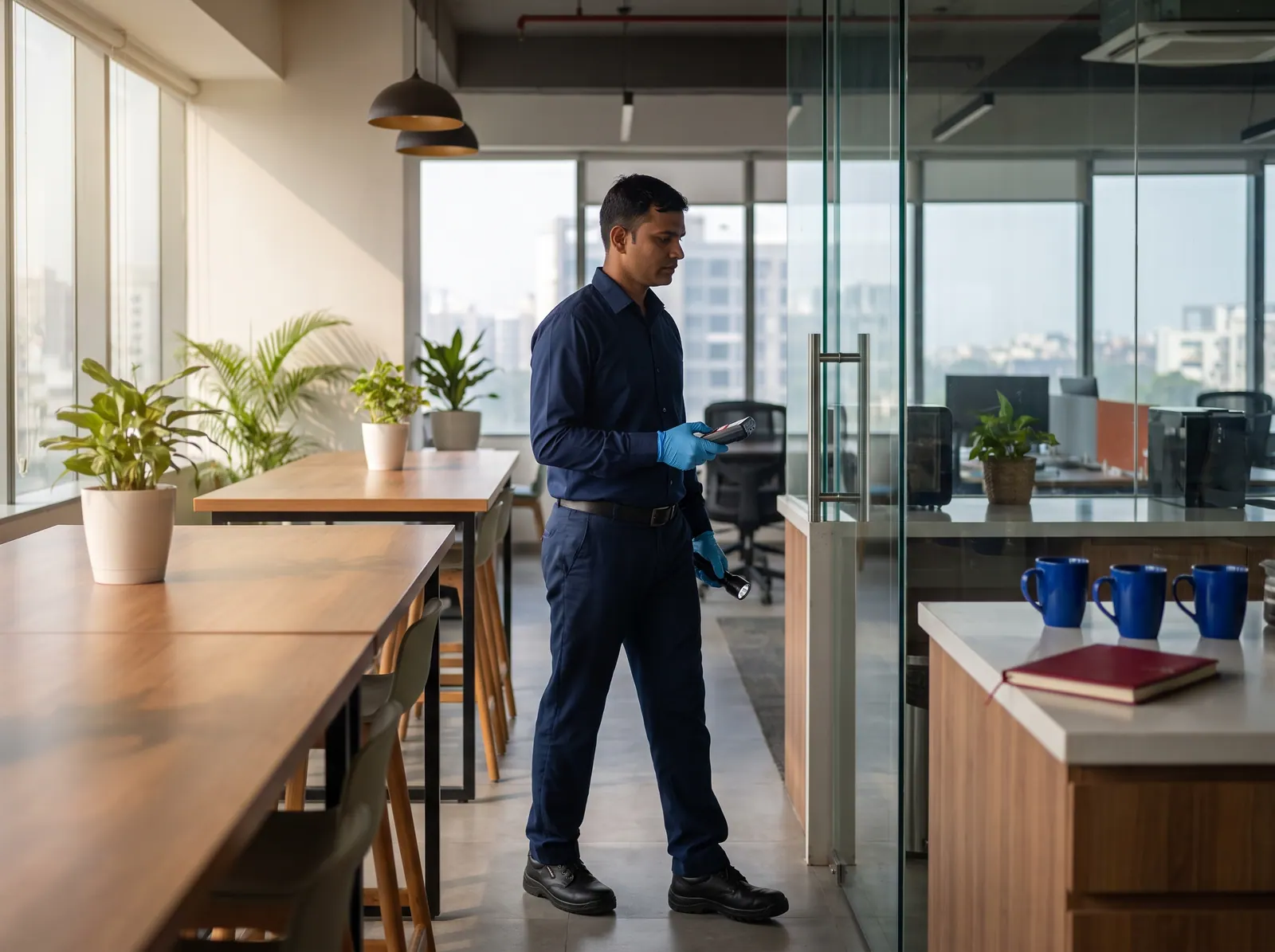
- Site survey: we walk the site with your QA and engineering contacts, following your entry, gowning and restricted-area rules.
- Proposal: we set out zoning, device types and positions, an approved product list, visit frequency and the documents you will receive.
- Approval and start: once QA approves, devices are installed and the first version of the device map is issued.
- Ongoing review: service reports after each visit, plus periodic trend reviews where recommendations and changes are agreed.
Wherever a product is used in admin, canteen or outdoor areas, it is applied according to label directions. Staff should keep away from treated surfaces until they are dry or as advised, and rooms should be ventilated before reuse.
If your unit is in the Ponda area, you may also find our page on commercial pest control in Ponda useful.
To discuss a programme, contact our Goa branch in Chimbel. Tell us your site location, the areas involved and what your QA team needs from a pest control provider. We'll confirm how we can help and arrange a site survey.
Frequently asked questions
QDo you use rodenticide baits inside production or clean areas?
Generally no. Inside manufacturing, packaging and clean areas, the usual GMP-style approach is non-toxic monitoring and mechanical traps. These show activity without adding anything that could contaminate materials. Toxic bait is normally kept in locked, tamper-resistant stations on the external perimeter. Any exception would only be considered through your change control process, with QA approval and a documented reason.
QCan you work with our existing device numbering and pest control SOP?
We aim to fit into your system rather than replace it. During the site survey, we review your current device map, numbering and SOP, along with any recent audit observations. Where we recommend changes, such as additional monitors or relocated stations, we propose them through your change control. Device numbers stay consistent so that your historical trend data remains comparable.
QWhat will we receive after each service visit?
After each visit we share a service report. It records the devices checked, any activity found, the actions taken and recommendations for the site, and clients can also receive WhatsApp updates. The exact layout is agreed with your QA team at the start. That includes how findings are recorded by device number and how corrective actions are tracked, so the reports fit your document system.
QHow often should a pharmaceutical site be serviced?
There is no single answer. Frequency depends on your risk assessment, the zones involved, the site's pest history and the season. Perimeter stations and indoor monitors are typically checked on a fixed schedule, which is written into the service plan and reviewed against trend data. For year-round scheduled visits with service reports, our Goa branch offers Annual Maintenance Contracts.
QWill your technicians follow our gowning, induction and entry rules?
They should, and we plan for it from the start. Tell us your induction requirements, gowning procedures, restricted areas and any escort rules during the initial discussion. Visits are then scheduled around them. A client representative accompanying technicians during service is part of our standard terms, which suits controlled sites well.
QIs fumigation part of a routine pharma pest programme?
Usually not. Fumigation is a specialist method for stored goods, specific spaces or consignments where it is the appropriate choice. It is not something to schedule routinely in a manufacturing facility. Our Goa branch offers fumigation services, but any use on a pharmaceutical site would be assessed case by case and agreed with your QA team in advance.
Last updated 13 October 2026. Information on this page is general guidance; your technician will advise on your specific property after inspection.