Quick answer
Efficacy Pest Control's Goa branch in Chimbel provides ant control in Calangute for flats, villas, holiday homes, guest houses, hotels, restaurants and shops. We inspect to find trails, entry points and nests. We then use gel baits that worker ants carry back to the colony, spot treatment where needed and practical proofing advice. Because baits work through the colony, activity usually falls over several days rather than overnight.
Key points
- Ant control in Calangute is provided by Efficacy Pest Control's Goa branch in Chimbel.
- Treatment is inspection-led: trails, entry points and nests are located before gel baiting and spot treatment.
- Gel baits act through the colony, so activity usually drops over several days, not overnight.
- Food businesses can receive service documentation aligned with HACCP and FSSAI audit expectations.
- Ants have a pinched waist and elbowed antennae; termites have broad bodies, straight antennae and build mud tubes.
If ants are trailing across your kitchen platform, into a restaurant's dry store or through a holiday villa that has been shut for a few weeks, spraying the ants you can see rarely solves it. The lasting fix is to find where they nest and how they get in. Our Goa branch in Chimbel provides ant control in Calangute for homes, guest houses, hotels, restaurants and shops, using inspection-led baiting and targeted spot treatment.
What does our ant control in Calangute involve?
We follow an Integrated Pest Management (IPM) approach: inspect first, advise on sanitation and proofing, then treat only where treatment is needed. For ants, this usually means gel baits placed along active trails, with spot treatment at outdoor nests and entry points.
The aim is to reach the colony, not just the workers on your wall. You can read more about the method on our ant control service page.
Why do ants keep coming back in Calangute properties?
Calangute's setting gives ants plenty of reasons to move indoors. A few patterns come up again and again on coastal properties in North Goa:
- Humidity and the monsoon. Goa's humid coastal climate and heavy south-west monsoon push ground-nesting ants towards dry, sheltered spots, often under tiles, behind skirting and inside kitchen cabinets.
- Sandy soil and gardens. Villas and guest houses with lawns, potted plants and garden beds give ants easy nesting sites right next to doors and verandahs. Tree branches touching walls or roofs act as bridges.
- The tourist season. Many Calangute kitchens run flat out for part of the year and slow down for the rest. Holiday homes can stay closed for months. Ants settle in quietly when nobody is around to notice.
- Shop-bought sprays. Sprays kill the foragers you see but leave the nest untouched. With some indoor species, repellent sprays can make a colony split into several smaller nests, which spreads the problem.
For more on why ants rush into kitchens once the rains begin, see our guide to ants in Goa kitchens during the monsoon.
Where do we look on different Calangute properties?
Calangute has a mix of residential lanes, apartments, villas, holiday homes, guest houses, resorts, restaurants and market-side shops. Each type has its own weak spots, so the inspection changes with the property.
| Property type | Where ants usually show up | What we focus on |
|---|---|---|
| Flats and apartments | Kitchen platform, under the sink, window frames, bathroom ducts | Trails along shared walls and service ducts, entry from neighbouring flats |
| Villas and holiday homes | Garden edges, verandahs, door thresholds, pantry, roof timber | Outdoor nests, gaps at doors and windows, checks before and after long vacancies |
| Guest houses, hotels and resorts | Guest rooms where snacks are left, pantries, kitchens, staff accommodation, garden paths | Room-by-room checks, food areas, service records |
| Restaurants, cafés and bars | Sugar and syrup stations, dry stores, dishwash areas, bar counters, drains | Bait placement away from food-contact surfaces, documentation |
| Shops and stores near the market | Packaged food and sweets, back storerooms, shelving | Gaps behind shelves, stock storage and rotation advice |
How do we treat ants, step by step?
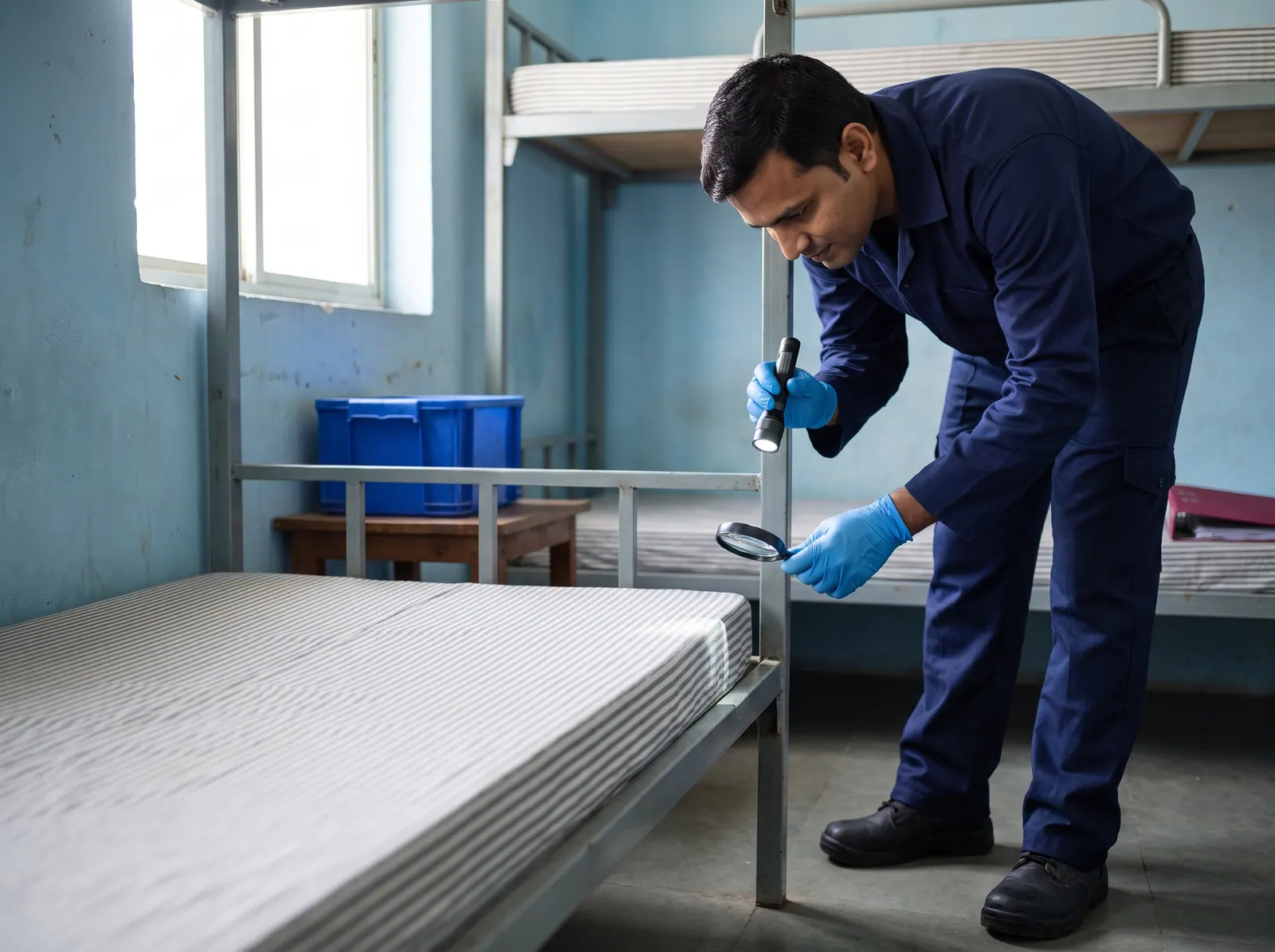
- Inspection. We follow the trails back as far as we can, checking kitchens, stores, wash areas, drains, window edges, damp walls and garden borders. We note moisture, cracks and food sources.
- Plan and safety briefing. We explain what we will treat, where and why, and what you need to do before and after. Material Safety Data Sheets are maintained for every product we use.
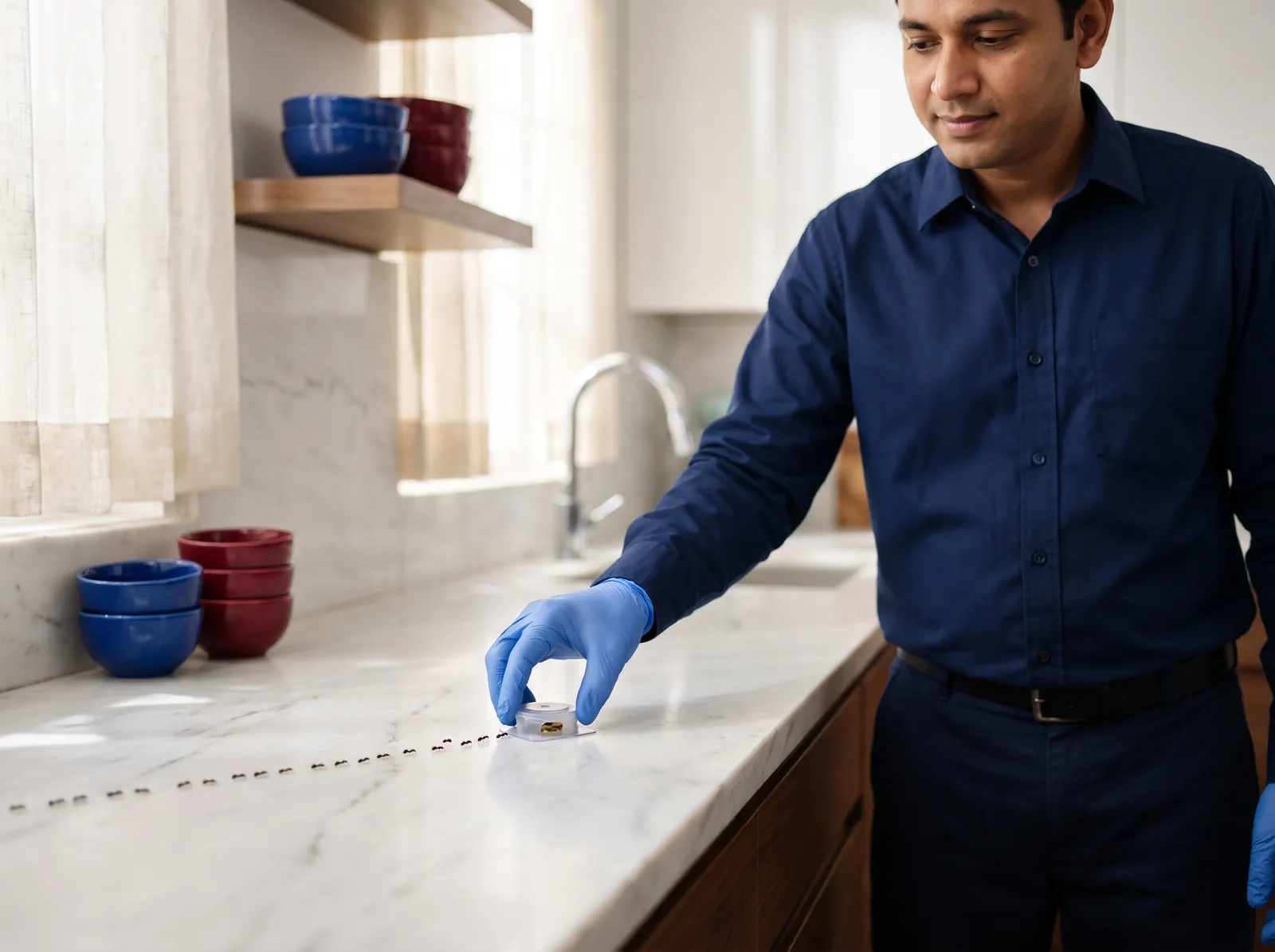
- Targeted baiting. Gel bait is placed in small amounts in cracks and along trails, out of reach of children and pets and away from food-contact surfaces. Worker ants carry it back and share it through the colony.
- Spot treatment. Where nests or entry points are outdoors, such as garden edges, wall bases and thresholds, we may treat those spots directly rather than spraying whole rooms.
- Proofing and housekeeping advice. We point out cracks to seal, leaks to fix and storage changes that cut off food. This is what keeps ants from returning.
- Service report. After the visit we share a service report and keep you updated on WhatsApp, so you have a record of what was done.
As our terms require, a client representative accompanies the technician during the service. For a holiday home, this can be someone you have authorised, such as a caretaker.
What should you expect after treatment?
For the first day or two you may see more ants near the bait. That is the bait working, so please do not wipe it away or spray over it. Activity normally drops over the following days as the colony takes in the bait. If it does not, let us know so we can review the placement.
Is it ants or termites in your woodwork?
Older Calangute houses often have timber rafters, doors and frames. Large black ants sometimes nest in damp wood, and winged ants appear in swarms after rain, so they are easily mistaken for termites. A few differences help:
- Ants have a narrow, pinched waist. Termites have a broad, straight body.
- Ant antennae are bent at an elbow. Termite antennae are straight and bead-like.
- Winged ants have front wings longer than the back wings. Winged termites have four wings of similar length.
- Termites build mud tubes along walls. Ants do not.
If you spot mud tubes or hollow-sounding wood, read about termite control in Calangute, as that needs a different treatment.
Ant control for Calangute hotels, restaurants and shops
In a busy kitchen, ants rarely turn up alone. They usually share the same cracks, spills and drains as cockroaches. For food businesses, we provide documentation aligned with HACCP and FSSAI audit expectations, so your service records are ready when an inspector or auditor asks.
Seasonal businesses benefit from planning treatment before reopening, when stores are restocked and kitchens restart. Annual Maintenance Contracts give scheduled visits through the year with service reports. For wider programmes, see commercial pest control in Calangute and cockroach treatment in Calangute.
How do we keep your family, guests and pets safe?
Our Goa operation is a licensed pest control operator under the Directorate of Agriculture, Goa, and uses CIB&RC-registered products. Baits are used in small, targeted amounts rather than broadcast sprays, which keeps exposure low.
- Keep children and pets away from treated areas until they are dry, or for as long as the technician advises.
- Ventilate rooms after any spray treatment.
- Wash hands after handling items from treated areas.
- Do not move or clean bait spots unless asked to.
Some ants, including the red ants found in garden trees, can give a painful bite. If anyone has swelling, breathing difficulty or any reaction that worries you, see a doctor.
What affects the cost of ant control?
We give a quotation once we understand the property. The main factors are:
- The size and type of property, from a single flat to a resort with gardens
- How widespread the activity is, and whether nests are indoors, outdoors or both
- Whether follow-up visits or an Annual Maintenance Contract suit you
- Whether you need documentation for food-safety audits
A warranty applies to the treated area for specific services, as set out in your service agreement. Ants coming in from a neighbouring property or open land are a separate matter, so we will advise you on prevention.
How to arrange ant control in Calangute
Contact our Goa branch in Chimbel and tell us where in Calangute you are, the type of property, and where you are seeing ants. Photos of the trail help. If you have other pest concerns too, our Calangute pest control page covers all the services available in the area.
Frequently asked questions
QWill the ants disappear after the first visit?
Usually not instantly. Gel baits work by being carried back to the nest and shared through the colony, so activity normally falls over several days. You may even see more ants at the bait spots for a day or two at first. Large outdoor colonies or several nests in one building can take longer, and a follow-up visit may be suggested. If activity has not dropped, tell us so we can recheck the placement.
QDo I need to empty my kitchen before ant treatment?
You do not need to empty it completely. Put away open food, clear the platform and the area under the sink, and make sure cabinets and corners where you have seen ants are easy to reach. Keep pets secured during the visit. The technician will tell you about any extra preparation for your property, and which spots to leave untouched afterwards.
QOur holiday home in Calangute is empty for much of the year. How can we manage ants?
Empty homes give ants time to settle undisturbed, so checking the property before you arrive and treating any activity works well. A client representative needs to be present during the service, so you can authorise a caretaker or neighbour to let the technician in. Remove food from the pantry before you leave, and ask us about scheduled visits under an Annual Maintenance Contract.
QIs ant treatment safe in a guest house with families and pets?
We use small, targeted amounts of bait in cracks and along trails, out of reach of children and pets, and avoid spraying whole rooms. Material Safety Data Sheets are maintained for every product. Keep children and pets away from any treated area until it is dry or as advised, ventilate after sprays and wash hands. Tell us about guests with allergies so we can plan around them.
QCan you provide records for our restaurant's food-safety audits?
Yes. For food businesses, our Goa branch provides service documentation aligned with HACCP and FSSAI audit expectations, and a service report is shared after each visit. For a restaurant, café or bar, regular scheduled visits usually make more sense than one-off treatment, because ants, cockroaches and flies share the same food sources and hiding places.
QWhat happens if ants come back after treatment?
A warranty applies to the treated area for specific services, as set out in your service agreement. It does not cover ants arriving from a neighbouring property or open land, or problems caused by structural changes or by not following post-service instructions. Sealing gaps, fixing leaks and keeping food covered make a big difference, and we can advise on prevention.
Last updated 13 October 2026. Information on this page is general guidance; your technician will advise on your specific property after inspection.