Quick answer
A large, single comb hanging openly from a high ledge, balcony slab or water tank on a Hyderabad apartment building is usually a rock bee (giant honeybee) colony. Keep people away from the area below. Do not throw objects, spray or use smoke, and keep nearby windows closed. Then have the colony professionally assessed. Amateur removal at height can provoke a mass stinging attack and risks dangerous falls.
Key points
- Large, single exposed combs hanging from high ledges, slabs or water tanks are typically rock bee (giant honeybee) colonies.
- Rock bees defend their nest strongly; disturbing the comb can trigger many bees to sting at once.
- Throwing objects, smoke, fire and household sprays tend to provoke the colony and add risks such as fire or falls at height.
- Colonies often move on with the seasons, and some may be safely left alone if they are away from people.
- Cleaning off old comb and fixing terrace water leaks can make a building less attractive to returning bees.
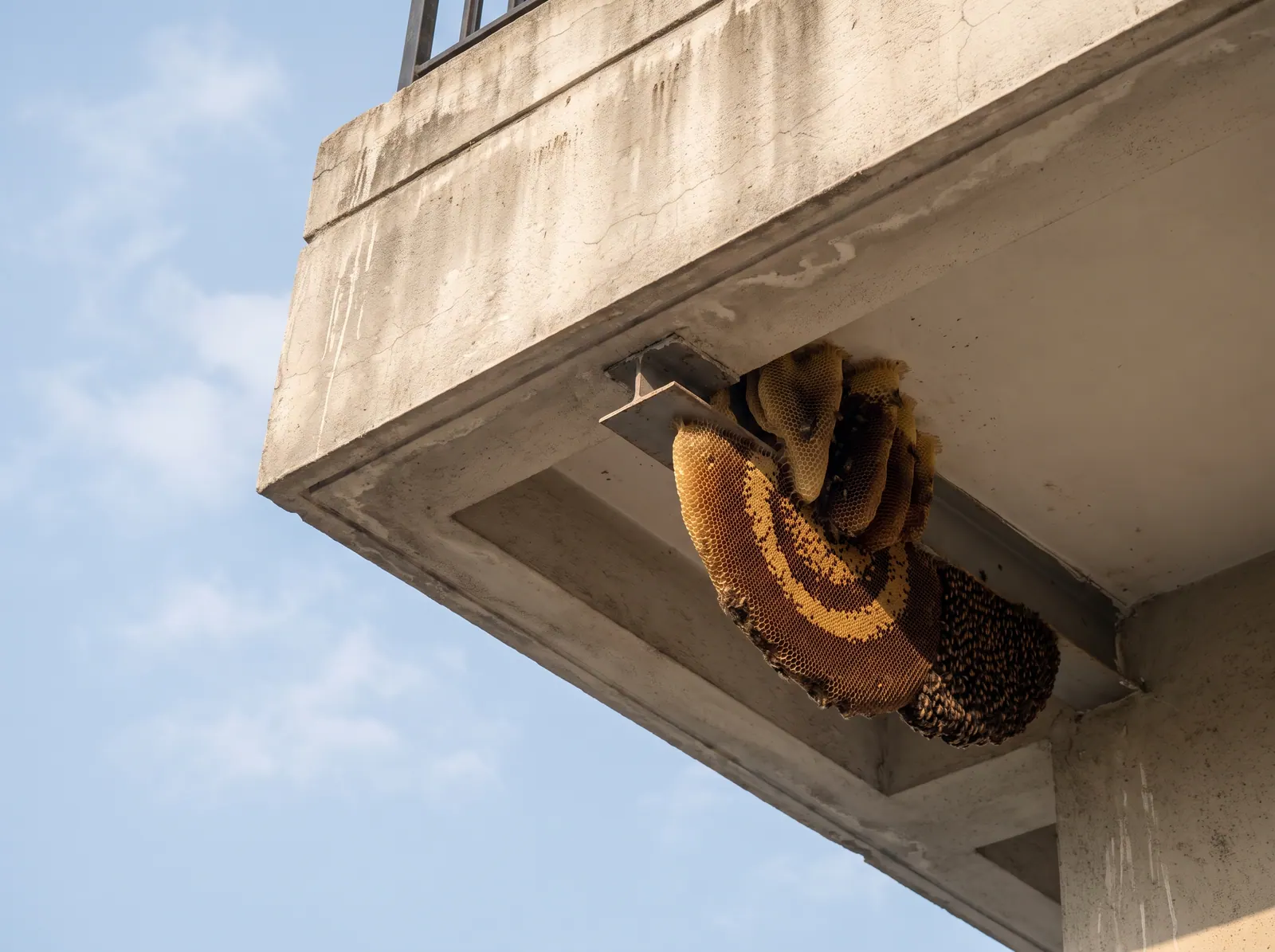
A honey bee hive on an apartment building in Hyderabad can alarm residents. It is often a large, dark comb hanging under a ledge on an upper floor, or beside the overhead water tank. Combs like these, built in the open and high up, are usually the work of rock bees, also called giant honeybees (Apis dorsata).
This guide is for residents, apartment associations and facility managers. It explains how to recognise a rock bee colony and how to keep people safe while it is there. It also covers what a professional assessment involves, what can reduce the chance of bees returning, and why removing a hive yourself is a serious risk.
What is a rock bee hive, and why does it appear on tall buildings?
Most honeybees nest inside cavities. Rock bees do not. Each colony builds a single, large, exposed comb that hangs from a sheltered overhang. In nature that might be a cliff face or a high tree branch. In a city, the underside of a balcony slab, a sunshade (chajja), a terrace parapet or a water tank stand can serve just as well.
Tall buildings offer height, shelter from rain and an open flight path, which suits these bees. Sometimes several colonies settle on the same building, or even under the same ledge.
Rock bee colonies also tend to move with the seasons as flowering changes. A colony may stay for weeks or months and then leave. The Hyderabad pest calendar gives a broader picture of how pest activity shifts through the year.
How do you identify a rock bee colony?
Look from a safe distance, ideally through a closed window or with binoculars. Rock bee colonies have a few clear signs:
- One large comb in the open. It is often semicircular, hanging from an overhang, and can be a metre or more across when mature.
- A living curtain of bees. The comb is usually covered by layers of bees, so you may see a dark, moving mass rather than wax cells.
- Height. Combs are typically on upper floors, terraces, water tanks and other high, sheltered spots.
- Large bees. The workers are noticeably bigger than the honeybees that nest in wall cavities.
- A shimmering wave. When disturbed, the bee curtain can ripple across the comb in a wave. This is a defensive display and a sign to stay well back.
Rock bees compared with other nests you might find
| Nest type | What it looks like | Where it is usually found |
|---|---|---|
| Rock bee (giant honeybee) | Single large exposed comb covered in a thick layer of large bees | High ledges, balcony slabs, water tanks, terraces |
| Indian hive bee | Several parallel combs hidden inside a cavity; bees seen entering a small opening | Wall voids, meter boxes, unused cupboards, hollow spaces |
| Dwarf honeybee | Small single comb, often wrapped around a thin branch; small bees | Shrubs, hedges and low branches in gardens |
| Paper wasp | Small grey, papery nest with open cells; relatively few insects | Under eaves, window frames, grilles |
Some situations call for caution even before anyone knows the species for certain: a large comb high on the building, or bees flying in numbers near a terrace or tank. Treat them as rock bees until someone qualified has looked.
Why is amateur removal so dangerous?
Rock bees defend their colony strongly. A single large colony holds a very large number of bees. If the comb is disturbed, many of them can attack at once and chase people some distance. Several common do-it-yourself approaches make things worse:
- Throwing stones or poking the comb with a pole provokes the whole colony. Bees often target whoever is nearest, including passers-by below.
- Smoke, burning rags or fire can set curtains, AC units or stored items alight, and still enrage the bees.
- Spraying household insecticide rarely reaches the inner layers of bees. It agitates the colony and can leave dying bees, contaminated honey and wax falling onto balconies and walkways.
- Working at height without proper equipment is the biggest risk of all. A person stung repeatedly while leaning out of a window or standing on a parapet can fall.
Be wary of anyone who offers to "take the honey" from a high-rise comb without proper safety equipment, a plan for the residents below and safe access at height. Rock bees are also important pollinators. That is one more reason to have a qualified person decide what is needed, rather than destroying a colony that may pose little risk where it is.
How should residents stay safe while a colony is present?
Most rock bee colonies do not bother people who keep their distance. Problems usually start when the comb is disturbed. These simple precautions help.
Do
- Keep windows and balcony doors near the comb closed. Use fine mesh screens if you have them.
- Keep children and pets away from balconies, terraces and ground areas directly below the comb.
- Avoid loud noise, vibration and strong smoke near the colony, such as drilling, hammering or burning waste.
- Tell your association or facility manager, and share a photo taken from a safe distance.
- Switch off outdoor lights near the comb at night if bees are drawn to them.
Do not
- Throw anything at the comb, or try to knock it down.
- Spray insecticide, use a fogging machine or light fires near it.
- Stand directly beneath the comb or linger on the terrace near it.
- Run a water jet or pressure washer at it.
If bees start attacking
- Move away quickly and get indoors or into a closed vehicle, then shut doors and windows.
- Cover your face and head with clothing as you go. Do not stop to swat at bees.
- Do not jump into a water tank or pool to escape. Bees may wait above the water.
- If someone has been stung many times, or has swelling of the face or throat, difficulty breathing, dizziness or feels unwell, get medical help immediately. For any sting reaction, see a doctor.
A checklist for apartment associations and facility managers
In a housing society, the hive is usually on common property: the terrace, tank area, staircase headroom or outer walls. A clear plan from the association keeps residents calm and avoids risky individual attempts.
- Name one point of contact so residents know who is handling it and do not act on their own.
- Restrict access to the terrace or tank area near the comb. Put up a simple notice at the terrace door and lift lobby.
- Cordon off the ground area directly below the comb, including parking spots, play areas and walkways.
- Inform security and housekeeping staff, who are often the first to go onto terraces or clean ledges.
- Postpone nearby work such as painting, tank cleaning, waterproofing or facade repairs until the colony has been assessed.
- Record details: the floor, which face of the building, approximate comb size, and when it was first noticed. Photos taken from a distance help a professional plan.
- Arrange a professional assessment rather than accepting the cheapest offer to "cut it down".
Shared terraces, ducts and shafts tend to be where several building pest issues meet. Our guide to cockroaches in Hyderabad high-rise apartments covers another common problem in these shared spaces.
What does a professional assessment involve?
A good assessment starts by looking and planning, not by spraying. This follows the inspection-first principle of Integrated Pest Management that we apply across the company. You can read more about our approach on how we work. For a rock bee colony, an assessor will usually consider:
- Species and nest type. They confirm whether it really is a rock bee colony, or a cavity-nesting hive or wasp nest, which are handled quite differently.
- Risk to people. They look at how close the comb is to windows, doors, walkways, children's play areas and the water tank people need to reach.
- Whether action is needed at all. A colony far from regular human activity may be left alone and allowed to move on naturally, with precautions in place.
- Safe access at height. Upper-floor and facade combs may need proper access equipment and fall protection, not a ladder balanced on a parapet.
- Timing and preparation. Bees are generally less active after dark, so work is often planned for then. Residents may be asked to keep windows shut and stay indoors.
- Clean-up. Any comb, wax and honey left behind needs removing so it does not drip, attract other insects or draw bees back.
Rock bees are not kept in boxes the way some other honeybees are, so "relocation" is not as simple as it sounds. A responsible professional will explain the realistic options for your building. You can read more about our bee and wasp nest removal service, which is part of our established work in Goa.
Can you stop rock bees from returning?
No method can guarantee that bees will never settle on a tall building again. A few measures, though, can make your building less inviting:
- Remove old comb traces. Wax and residue left on a ledge can attract new colonies, so make sure old comb is cleaned off properly once a colony has gone.
- Fix water sources. During Hyderabad's hot, dry summer, bees look for water. Leaking tank overflows, dripping taps and AC drain lines on terraces can draw them in.
- Reduce sheltered hanging points. Where it is practical and structurally sound, netting or closing off favoured overhangs and ledges can make them less usable. Ideas from installing bird netting at home can apply to some of these spots, but get advice first so access, ventilation and fire safety are not compromised.
- Inspect regularly. Ask security or housekeeping staff to check terraces, tank stands and upper ledges periodically. A small, newly started comb is far easier to deal with than a mature colony.
- Report early. Encourage residents to tell the association as soon as they notice bees gathering, rather than waiting until the comb is large.
Getting help in the Hyderabad region
Our Shamshabad branch has recently opened, and we are confirming services and coverage area by area. Tell us your location and the problem, and we'll confirm whether we can help. It helps to include the floor, where the comb is, its rough size and a photo taken from a safe distance.
Until a qualified person has assessed it, keep people away from the comb and do not attempt removal yourself. For other common questions about the new branch, see our Hyderabad branch FAQ.
Frequently asked questions
QIs it safe to leave a rock bee hive on our building alone?
Often, yes, as long as the comb is away from windows, walkways and areas people use regularly, and nobody disturbs it. Rock bee colonies usually become dangerous when provoked by noise, vibration, smoke or objects thrown at them. Keep nearby windows closed and restrict access to the area below. If the comb sits close to doors, balconies, a play area or the water tank people must reach, get it professionally assessed.
QWho should deal with a rock bee hive in an apartment complex, the association or the flat owner?
If the comb is on a terrace, tank stand, outer wall or other common area, the association or facility manager is usually best placed to coordinate. Individual owners should not try to remove it themselves, even from their own balcony, because disturbing the colony affects everyone nearby. A single point of contact, clear notices and a professional assessment work better than several residents acting separately.
QWill the rock bees leave on their own?
They may. Rock bee colonies tend to move with the seasons as flowering changes, and many abandon a site after some weeks or months. There is no reliable way to predict exactly when, though. If the colony poses little risk where it is, waiting with sensible precautions can be a reasonable option. Once it leaves, have the old comb cleaned off so it does not attract a new colony.
QCan we spray the hive with insecticide at night when the bees are calm?
This is not advisable. Household sprays rarely reach the inner layers of bees on a large comb, so they tend to agitate the colony rather than control it. Dying bees, wax and contaminated honey can also fall onto balconies and walkways, and spraying at height carries a fall risk. Leave any intervention to a qualified professional who can plan access, timing and clean-up safely.
QWhy do bees keep coming back to the same part of our building?
The same features that attracted the first colony are still there: height, shelter from rain and an open flight path. Wax traces left on the ledge can also draw bees back. Water sources such as leaking tank overflows or AC drain lines matter too, especially in summer. Cleaning old comb residue properly, fixing leaks and, where practical, blocking off favoured overhangs can reduce the chance of repeat visits.
QDoes Efficacy Pest Control remove rock bee hives in Hyderabad?
Bee and wasp nest removal is one of our established services in Goa. Our Shamshabad branch has only recently opened, and services and coverage in the Hyderabad region are being confirmed area by area. Share your location, the floor and position of the comb, and a photo taken from a safe distance. We'll confirm whether we can help.
Last updated 13 October 2026. Information on this page is general guidance; your technician will advise on your specific property after inspection.