Quick answer
Pigeons settle on Hyderabad balconies, AC ledges and ducts because high-rises mimic the sheltered cliff ledges they naturally nest on. Accumulated droppings and nests raise hygiene concerns and block drains and ducts. Physical exclusion lasts longest: netting for open balconies and ducts, and spikes or covers for narrow ledges and AC units. Clean safely first, never harm birds or active nests, and agree a common approach across the society.
Key points
- City pigeons descend from cliff-nesting rock doves, so balconies, AC ledges and ducts on high-rises suit them naturally.
- Accumulated dried droppings are the main hygiene concern; avoid dry sweeping and wear gloves and a mask when cleaning.
- Netting suits open balconies and ducts; spikes and covers suit narrow ledges and AC unit tops.
- Scaring devices usually lose effect as pigeons get used to them; physical exclusion lasts longer.
- A society-wide approach prevents birds from simply moving to the neighbouring flat.
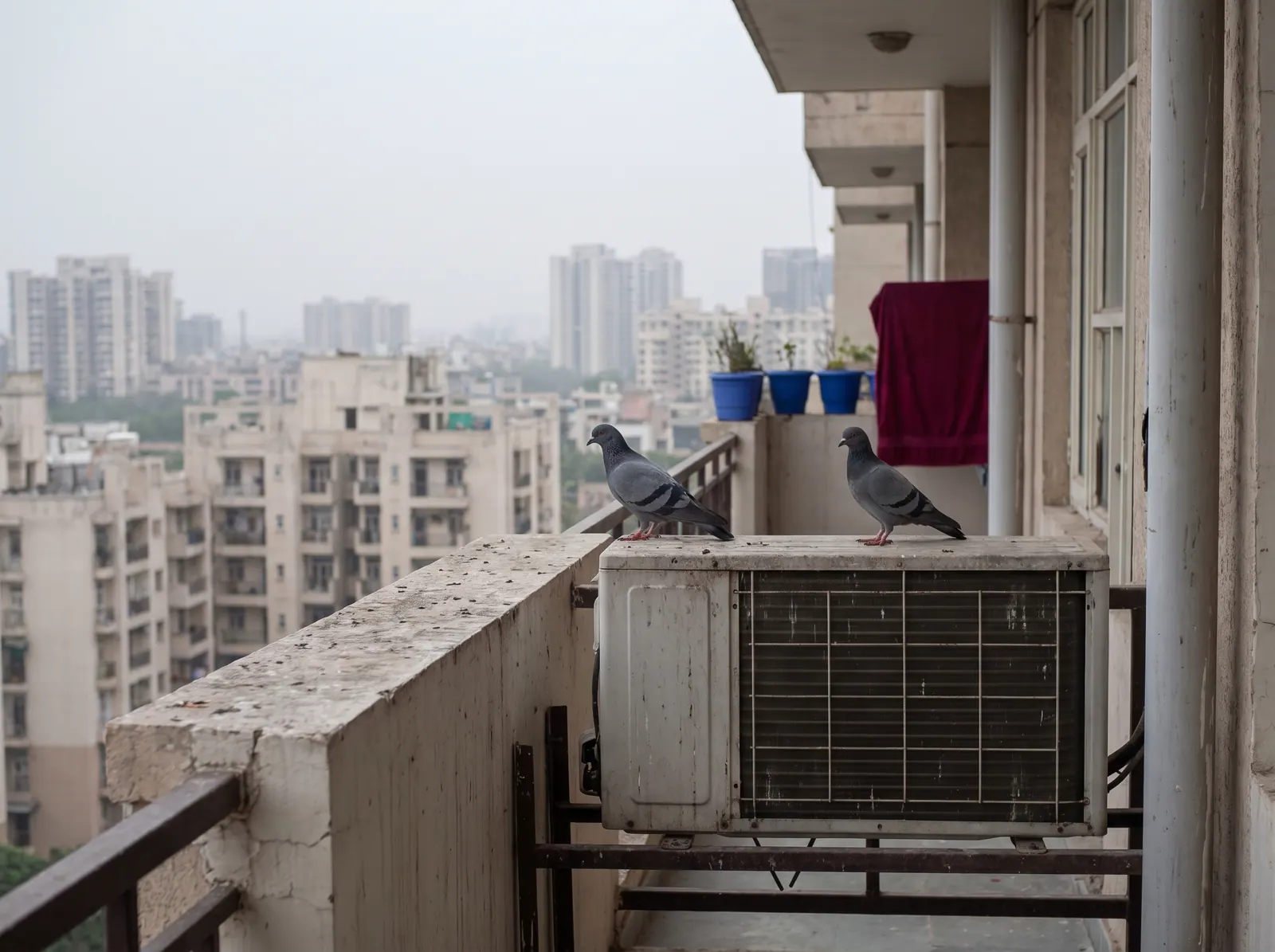
A pigeon problem on a Hyderabad balcony usually starts small. A pair rests on the AC outdoor unit, a few twigs appear behind a flower pot, and within weeks there are droppings on the railing, a nest in the duct and birds that return however often you shoo them away.
This guide explains why pigeons favour high-rise flats, what the hygiene concerns are, how the main deterrent options compare, and what a housing society should agree on so that one flat's fix does not simply move the birds next door.
Why do pigeons choose high-rise balconies, AC ledges and ducts?
City pigeons descend from the rock dove, a bird that naturally nests on cliff ledges and in rock crevices. To a pigeon, a tower of balconies, sills, AC ledges and service ducts looks much like a cliff face: high, sheltered and hard for predators to reach.
- Shelter and shade: the space behind or under an AC unit, inside duct shafts and under sunshades stays out of the harsh summer sun and out of the monsoon rain.
- Flat places to nest: pigeons build loose, untidy nests and need only a flat ledge. Pots, stored boxes and unused corners all qualify.
- Food nearby: deliberate feeding, spilled grain and open bins keep birds close to a building.
- Quiet spots: vacant flats and rarely used utility balconies are left undisturbed for weeks.
- Site loyalty: pigeons tend to return to the same nesting site and can breed several times a year in a warm climate, so a ledge used once is likely to be used again.
Ducts and shafts that shelter pigeons can also carry other pests between floors. Our guide to cockroaches in Hyderabad high-rise shafts, ducts and drains covers that side of apartment living.
What are the hygiene concerns with pigeon droppings and nests?
The concern is less the occasional bird and more what builds up over time: droppings, feathers and nest material collecting on ledges, inside ducts and behind units.
- Health: dried droppings can harbour fungi and bacteria that have been linked to some respiratory and other infections. The risk mainly arises when dried material is disturbed and the dust is breathed in.
- Irritation and allergies: feather dust and droppings can irritate the airways, particularly for people with asthma or allergies.
- Mites and insects: nests can carry bird mites and attract beetles and other insects. When a nest is abandoned, mites may wander indoors looking for a host.
- Damage and blockages: droppings stain and corrode paint, metal railings and AC units, and nest material blocks balcony drain outlets and ducts.
- Smell and slips: wet droppings on tiled balconies are slippery and unpleasant, especially during the monsoon.
If anyone at home develops a persistent cough, breathing difficulty, fever or skin irritation that you think may be linked to birds, please see a doctor. Young children, older people and anyone with a lung condition or weakened immunity should not clean droppings themselves.
How should droppings be cleaned safely?
- Do not dry-sweep, brush or blow droppings away; this raises dust.
- Wear disposable gloves and a well-fitting mask; eye protection helps too.
- Lightly dampen the droppings with water before scraping. If you use a household cleaner, follow its label directions.
- Bag the material and nest debris, seal the bag and dispose of it with household waste.
- Wash the surface, then wash your hands and change your clothes.
- Keep children and pets off the balcony until cleaning is finished and surfaces are dry.
For heavy build-up inside ducts or anywhere that means leaning over a railing at height, do not attempt it yourself. Arrange trained help with proper safety equipment.
Netting, spikes or something else: which deterrent works where?
The right option depends on where the birds land and nest. As a rule, physically denying access lasts longer than trying to scare birds away, because pigeons quickly get used to anything that does not actually stop them.
| Option | Best suited to | Strengths | Limitations |
|---|---|---|---|
| Bird netting | Open balconies, utility areas, duct openings, shafts | Keeps birds out of the whole space; lets light and air through; durable when properly fixed | Needs secure fixing and the right mesh; changes the façade; usually needs society approval |
| Bird spikes | AC unit tops, parapets, sills, pipes, signboards | Discreet; stops landing on narrow surfaces | Not suitable for open balconies; debris can collect between spikes; poorly fitted spikes can become a nest base |
| Covers and mesh for gaps | Space behind AC units, pipe gaps, vents | Removes specific nesting spots at low cost | Must not block AC airflow or ventilation |
| Visual or sound scarers | Short-term use only | Cheap and easy to try | Birds usually get used to them within weeks |
| Sticky gel repellents | Rarely advisable on balconies | Can deter landing on some ledges | Messy, collect dust and can harm birds; not recommended |
When is bird netting the better choice?
If birds are using the balcony itself, a utility area or a duct opening, netting is usually the only option that keeps them out entirely. It must be fixed taut with no gaps at the edges, as pigeons find even small openings. It should never block an escape route or access needed for AC servicing. Our article on the benefits of installing bird netting at home explains more.
When do spikes make sense?
Spikes suit narrow surfaces where pigeons perch or roost but which do not need enclosing, such as the top of an AC outdoor unit or a parapet edge. They need to cover the full width of the ledge, and any debris should be cleared from between them from time to time.
What should you avoid?
- Poisons, glue traps or anything intended to injure or kill birds.
- Removing a nest with eggs or chicks in it. Wait until the young have left, then clean and proof the area.
- Feeding pigeons on or near the balcony, which undoes any deterrent.
Practical steps before installing anything
- Check for active nests and wait if eggs or chicks are present.
- Clean thoroughly using the precautions above, so old droppings and nest material do not draw birds back.
- Remove attractions: stored clutter, spilled food, standing water and unused pots.
- Close small gaps behind AC units and around pipes.
- Choose the main deterrent for each surface: netting for open spaces, spikes or covers for ledges.
- Check your society's rules before making any change to the exterior.
For broader habits that keep homes pest-resistant, see our dos and don'ts of pest control.
What should housing societies agree on?
Pigeons move. If one flat nets its balcony and the neighbouring flat does not, the birds simply shift sideways. A building-wide approach works far better than flat-by-flat fixes.
- An approved netting standard: colour, material and fixing method, so the façade stays uniform and owners can proceed without fresh approval every time.
- A clear feeding policy: agree whether and where bird feeding is permitted within the premises, keeping it away from towers, terraces and balconies.
- Common-area responsibility: who cleans and proofs terraces, duct shafts, water-tank areas and parking ceilings, and how often.
- Vacant and rented flats: owners should remain responsible for proofing their balconies, since empty flats often become nesting sites.
- Work-at-height safety: any vendor working on exteriors should use trained staff and proper safety equipment. Committees should ask about this before approving work.
- Access and costs: how access to shafts is arranged and how costs for common areas are shared.
- Simple records: what was installed where, and when, so gaps can be found later.
Planning common-area work around the seasons helps too; our Hyderabad pest calendar gives a month-by-month view.
How does Efficacy Pest Control approach bird problems?
Bird netting for balconies, ducts and building ledges is one of the services offered by our Goa branch in Chimbel. As with all our work, we follow an Integrated Pest Management approach: inspect first, advise on cleaning and proofing, then recommend a targeted solution rather than a one-size-fits-all fix.
Our Shamshabad branch has recently opened. Tell us your location and the problem, and we'll confirm whether we can help. You can learn more about the Hyderabad branch in Shamshabad or read the Hyderabad branch FAQs.
Frequently asked questions
QIs it safe to remove a pigeon nest from my balcony myself?
An empty nest can usually be removed with care. Wear disposable gloves and a mask, dampen the material first, bag it and wash your hands afterwards. If the nest has eggs or chicks, it is kinder and generally advisable to wait until the young have left. Anyone with a lung condition, weakened immunity, or young children should avoid doing this themselves. Never attempt removal where you would need to lean over a railing at height.
QWhy do pigeons keep coming back after I clean the balcony?
Pigeons are loyal to sites where they have rested or nested before, and a warm climate lets them breed several times a year. Cleaning removes the droppings and nest material that signal a good site, but it does not stop the birds landing. To break the habit, you need to block access: netting for open balconies and ducts, and spikes or covers for ledges and AC units.
QDo I need society permission to install bird netting?
It depends on your society's bylaws, but many housing societies regulate changes to the building's exterior, including netting colour, material and fixing method. Check with your management committee before installing anything. If your society has not yet agreed a standard, it is worth proposing one, because a uniform approach across the building keeps the façade consistent and stops pigeons simply moving to the next balcony.
QDo bird spikes hurt pigeons?
Bird spikes are designed to stop pigeons from landing on a surface, not to injure them. Properly made and correctly fitted spikes leave birds no comfortable footing, so they move elsewhere. Avoid improvised sharp objects or damaged spikes. Spikes work best on narrow surfaces such as AC unit tops and parapets; they are not a solution for open balconies, where netting is usually more effective.
QAre pigeon droppings dangerous to health?
The main concern is accumulated, dried droppings. When this material is disturbed, the dust can carry fungi and bacteria that have been linked to some respiratory and other infections, and feather dust can irritate the airways. Regular, careful cleaning and keeping birds away reduces the problem. If you or a family member have symptoms you think may be connected, please consult a doctor.
QCan the Shamshabad branch help with pigeons on my balcony?
Our Shamshabad branch has recently opened, and we are confirming services and localities area by area. Please share your location and describe the problem, such as nesting on the balcony, AC ledge or in a duct, and we will confirm whether we can help. Bird netting is currently a confirmed service at our Goa branch in Chimbel.
Last updated 13 October 2026. Information on this page is general guidance; your technician will advise on your specific property after inspection.