Quick answer
Efficacy Pest Control's Goa branch in Chimbel handles bee hive and wasp nest removal for homes, villas, hotels and offices. We first identify whether the nest belongs to honeybees or wasps. We then assess its height, location and risk to people, and plan the work using protective equipment. Where a honeybee colony can safely be left or relocated by a beekeeper, we say so. Never spray or burn a nest yourself. Keep people away and contact us.
Key points
- Honeybees build wax comb; wasps build papery or mud nests.
- Spraying, burning or knocking down a nest can provoke stinging and create a fire risk.
- Calm, accessible honeybee colonies are often better relocated by a beekeeper than destroyed.
- Removing all comb and sealing cavities helps stop new colonies moving into the same spot.
- Bee and wasp nest removal is offered from the Goa branch in Chimbel by a licensed pest control operator (Directorate of Agriculture, Goa) using CIB&RC-registered products.
A bee hive under a balcony, or a wasp nest in the eaves of a villa, is not something to tackle with a broom or a can of spray. Our Goa branch in Chimbel offers bee hive and wasp nest removal for homes, villas, housing societies, hotels and offices where a nest is close to people.
This page explains how to tell bees from wasps and what not to do. It also covers how we assess and handle a nest, and how to stop it coming back. For a company-wide overview, see our bee and wasp nest removal service page.
Is it a honeybee hive or a wasp nest?
Knowing which insect you have changes how the nest should be handled. Look only from a safe distance, several metres away, and never stand directly beneath the nest.
| Feature | Honeybees | Wasps |
|---|---|---|
| Body | Hairy and rounded, golden-brown to dark with bands | Smooth, shiny and slender with a narrow ‘waist’, often yellow-and-black or reddish-brown |
| Nest material | Wax comb with hexagonal cells, often covered in a thick layer of bees | Grey or brown paper-like material, or small cells made of mud |
| Typical nest | A single open comb hanging from a ledge, beam, water tank or tree branch, smaller combs in shrubs, or a colony inside a wall cavity or hollow tree | A small umbrella-shaped paper nest on a stalk under eaves, window frames or sunshades, an enclosed papery nest in a roof or tree, or mud nests on walls |
| Stinging | Worker honeybees usually sting once, but a disturbed colony can defend itself in large numbers | Can sting more than once and will defend the nest when disturbed |
| Relocation | Often possible by a beekeeper, depending on size and position | Generally not; nests near people are usually treated and removed |
What if it is a swarm rather than a hive?
A cluster of bees hanging from a branch, railing or wall with no comb visible is usually a swarm. This is a colony resting while scout bees look for a new home. Swarms often move on by themselves within hours or a few days.
Keep away from the swarm and keep children and pets indoors. Contact us if it stays put and comb starts to appear.
Why you should not spray, burn or knock down a nest yourself
It is tempting to deal with a small nest quickly, but many sting incidents happen when someone disturbs a nest. Please avoid the following:
- Spraying household insecticide. It rarely reaches the whole colony and can provoke a defensive attack on whoever is nearby.
- Burning or smoking the nest. A burning comb or paper nest can fall. Fire near roofs, rafters, curtains, wiring or dry vegetation is a serious hazard.
- Hitting it with a stick or a jet of water. This breaks the nest open and releases agitated insects without removing them.
- Blocking the entrance to a nest inside a wall or roof. Trapped bees or wasps may find their way into rooms instead.
- Climbing a ladder to reach it. A sting, or simply being startled, at height can cause a fall.
What to do while you wait
- Keep children, elderly family members, pets and guests away from the area.
- Close nearby windows and doors.
- Avoid using grass cutters, drills or other noisy machinery near the nest, because noise and vibration can disturb it.
- If you can do so safely, take a photo from a distance to share with us.
- If anyone has been stung many times, has swelling of the face or throat, has difficulty breathing or feels faint, get medical help immediately. For any sting reaction, see a doctor.
How do we assess a hive or wasp nest?
Every nest is different, so we start with an assessment rather than a standard treatment. This follows the Integrated Pest Management approach we use across our work: inspect first, then use targeted treatment only where it is needed.
- Identification. We confirm whether the nest belongs to honeybees or wasps. For bees, we also note whether it is an open comb or a cavity nest. Photos you send help us prepare.
- Location and height. We check where the nest sits: ground level, balcony, eaves, water tank, upper facade, tree, or inside a wall, false ceiling or roof.
- Risk to people. We look at how close it is to doors, windows, play areas, walkways, pools, dining areas or workstations, and who uses the space.
- Access and surroundings. We check whether the nest can be reached safely. We also note what lies below and around it, such as wiring, glass, vehicles, plants or water tanks.
- Recommended option. This may be to leave the nest and monitor it, relocate it with a beekeeper, or treat and remove it. We explain our recommendation and any preparation needed before work starts.
Protective equipment and on-site safety
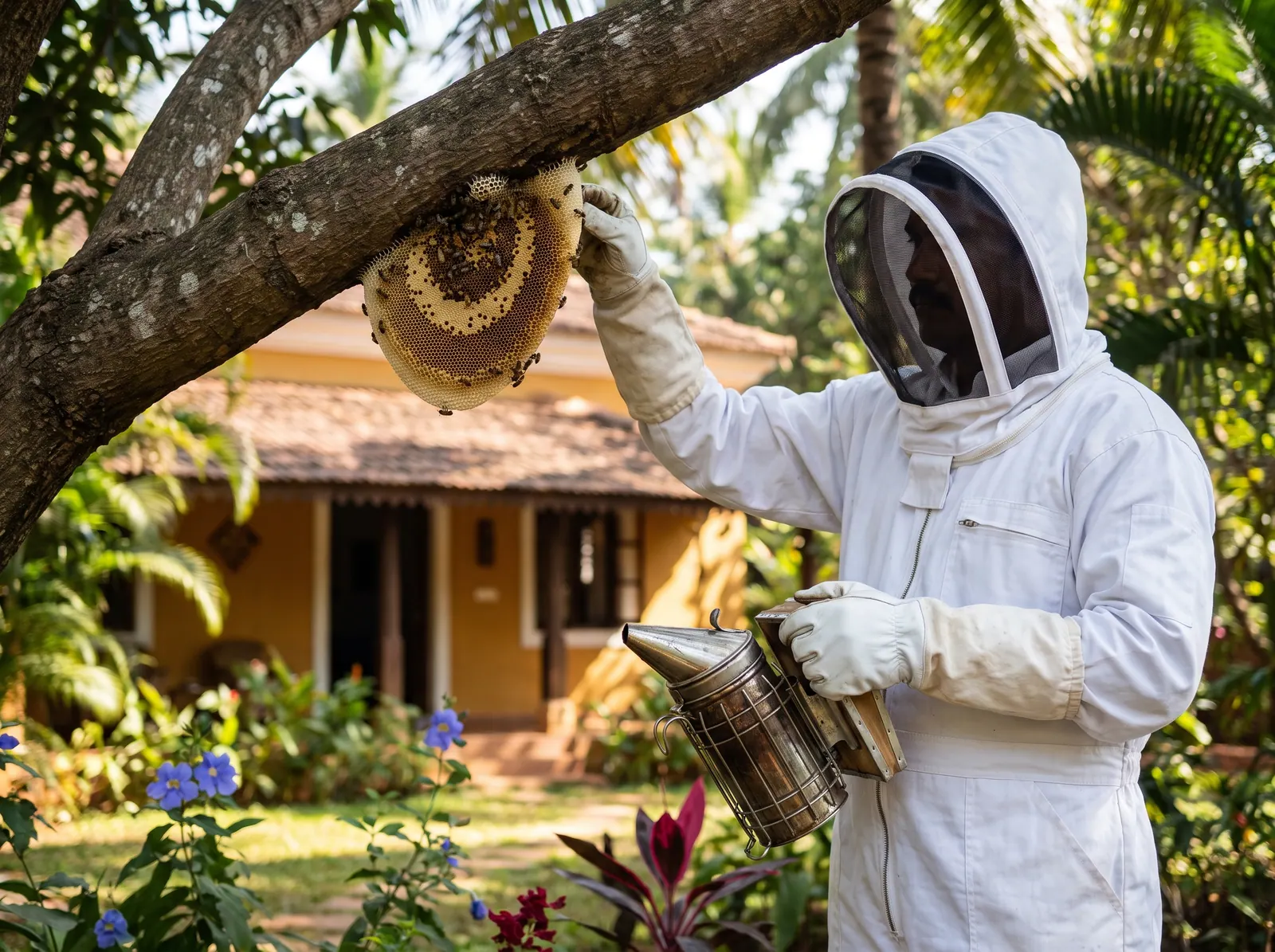
Technicians put on protective clothing before approaching an active nest. This typically means a full-body suit with a veil, gloves and boots, so they can work steadily without rushing. We clear the area of people and pets first, and often plan work for times when the insects are less active.
As a licensed pest control operator (Directorate of Agriculture, Goa), we use CIB&RC-registered products. We maintain Material Safety Data Sheets for the products we use. Any treatment is applied to the nest and its immediate surroundings, not sprayed across the area.
Afterwards, keep people and pets away from the treated spot until it is dry or for as long as the technician advises. Ventilate nearby rooms and wash hands after touching any surface near the treated area. If a nest is in a position that cannot be reached safely, we will explain the options rather than take a risk.
When is relocation by a beekeeper the better option?
Honeybees pollinate gardens, orchards and crops, so destroying a colony should not be the automatic answer. Relocation by an experienced beekeeper is often preferable when:
- the colony is a manageable size and can be reached safely;
- the bees are calm, and the nest is not right beside a door, window or busy walkway;
- the comb is in the open, or inside a cavity that can be opened and repaired afterwards;
- the owner can wait while relocation is arranged.
Sometimes a colony is best left alone. Examples include a swarm passing through, or a nest high in a tree well away from where people walk. Large combs high on buildings, or colonies inside occupied rooms, may not be suitable for relocation. In those cases the safety of residents or guests has to come first.
During the assessment we will tell you which option we think is right, and why.
Bee and wasp nests at hotels, offices and housing societies
At a hotel, resort, office or housing society, one nest can affect many people at once. Guests by the pool, staff at an entrance and residents on a shared staircase may all be close to it. In these settings we plan the work around the people who use the space:
- agreeing a time when the area can be cordoned off and closed to guests, staff or residents;
- asking you to inform occupants and keep nearby windows shut during the work;
- checking the rest of the building for other nests, since roofs, sunshades and ducts can hold more than one;
- sharing a service report after the visit, which helps facility managers keep records.
Housing societies should let the committee know before work on common areas. Please also keep a representative available to accompany the technician during the visit.
Aftercare: how do you stop bees and wasps from rebuilding?
Removing a nest deals with today's problem. Stopping a new colony from moving into the same spot takes a little follow-through.
- Make sure all comb and wax is removed. Leftover comb and honey can attract new swarms, as well as ants and other pests. Melting wax can also stain walls and ceilings.
- Seal cavities and gaps once activity has stopped. This includes openings in eaves, gaps around AC pipes, unused vents, broken roof tiles and the holes bees used to enter a wall void.
- Check sheltered spots regularly. Look under sunshades, eaves, balcony ceilings, water tank stands and garden structures every few weeks, and again once the monsoon eases. Small paper wasp nests are easiest to deal with early, but call us rather than knocking them down.
- Keep water tank lids closed. Bees and wasps visit water, especially in the hot, dry weeks before the monsoon.
- Manage food and waste outdoors. Keep bins covered and clear away fallen fruit, sugary drinks and food scraps. This matters most in hotel gardens and outdoor dining areas.
- Consider netting. Our Goa branch also offers bird netting for balconies, ducts and building ledges. This may help close off some sheltered spaces.
Where in Goa do we offer bee and wasp nest removal?
Bee and wasp nest removal is offered from our Goa branch in Chimbel. Areas covered in our records include Panaji (also called Panjim), Porvorim, Mapusa, Calangute, Candolim, Baga, Ponda, Margao and Vasco da Gama, along with nearby localities. Our area pages give more detail, for example pest control in Panaji, pest control in Porvorim and pest control in Margao.
To get help, reach our Goa branch in Chimbel through our contact page. Please tell us:
- where you are;
- where the nest is and roughly how big it looks;
- how close it is to people;
- a photo taken from a safe distance, if you can.
If you are outside the areas listed, ask anyway and we will let you know whether we can help. Answers to common questions about visits and preparation are on our Goa pest control FAQ.
Frequently asked questions
QDo you kill the bees, or can the hive be relocated?
It depends on the colony. A calm honeybee colony of manageable size, in a position that can be reached safely, is often better relocated by a beekeeper than destroyed. A passing swarm or a nest far from people may simply be left alone. Removal is considered when a nest poses a real risk to residents, guests or staff. Wasp nests near people are generally treated and removed.
QHow much does bee hive or wasp nest removal cost in Goa?
We cannot give a fixed price without understanding the job. Cost depends on the type of insect, the size of the nest, its height and how easy it is to reach. Whether the nest is in the open or inside a wall or roof also matters. Share your location, a description and a photo taken from a safe distance with our Goa branch, and we will explain the next step and provide a quotation.
QIs it safe for my family to stay at home during nest removal?
You can usually stay at home, but away from the work area. Keep children, elderly relatives and pets indoors in a different part of the house, with nearby windows and doors closed. After any treatment, keep everyone away from the treated spot until it is dry or for as long as the technician advises. Ventilate nearby rooms and wash hands after touching surfaces close to that spot.
QWill bees or wasps come back to the same place?
They can, especially if old comb or wax is left behind or an open cavity remains. Sheltered spots under eaves and sunshades can attract new nests even after a clean removal. Remove all comb, seal gaps once activity has stopped, and check sheltered corners regularly so any new nest is noticed while it is still small.
QThe nest is very high on our building or in a tall tree. Can it be handled?
We assess height and access before committing to any work. Many nests on balconies, eaves and lower facades can be reached safely. Some nests high on buildings or trees need special access, or may be better left alone if they are well away from where people walk. If we cannot reach a nest safely, we will explain the options honestly rather than take a risk.
QSomeone has been stung. What should we do?
Move the person away from the nest calmly. If someone has been stung many times, or has swelling of the face or throat, difficulty breathing, dizziness or faintness, get medical help immediately. For any sting reaction, including heavy swelling or pain, please see a doctor. Do not go back to the nest yourself. Keep others away and contact us once the person is being looked after.
Last updated 13 October 2026. Information on this page is general guidance; your technician will advise on your specific property after inspection.